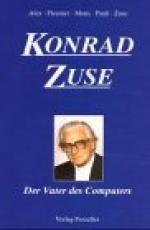
Konrad Zuse.
Zuse, Konrad
German Engineer
1910–1995
Konrad Zuse was a German engineer who designed and built a binary computer during the 1930s. He is thought to have created the first functioning program-controlled computer, however his earliest efforts were destroyed during World War II. By the end of his life, Zuse had received many honors for his contributions to the development of the computer, and he was recognized as one of the pioneers of electromechanical computing.
Zuse was born in Berlin, Germany, in 1910. During his youth he showed talent in art and engineering. As an artist, he created block prints, drawings, and cartoons; as an engineer, he built mechanical devices such as grab cranes and model train rail networks. He graduated from high school at the age of sixteen and entered the Technical University of Berlin, having made the decision to study civil engineering. While he was a university student, he built a vending machine that delivered selected items, accepted money, and returned change.
Zuse completed his degree in 1935 and worked for a brief time as a structural engineer for the Henschel Aircraft Company. He left this position to work independently on building a computer. His parents' living room served as his laboratory, his assistants were unpaid college friends, and his funding was raised from friends and family members. His goal was to create a mechanical calculating machine based on a binary system rather than on the decimal system used in calculators. The machine would consist of a memory unit and an arithmetic unit, and it would be programmable.
Zuse's Z1 computer was operational by 1938. Helmut Schreyer, a friend and electronic engineer, suggested replacing the mechanical relay system with vacuum tubes and telephone relay switches to shorten the processing time. Zuse rejected the vacuum tube idea but considered using the telephone relay switches. The design of the Z2 incorporated this idea.
In 1939 Adolf Hitler and the Nazis invaded Poland, beginning World War II. The war interrupted Zuse's work and he was soon drafted into the German army. To no avail, both Zuse and Schreyer tried to interest the German military in the computer project. However, Zuse was transferred from active duty to work as a structural engineer for Henschel Aircraft. His assignment was related to the development of unmanned flying bombs, or cruise missiles. This transfer allowed him time to complete construction of the Z2, which used telephone relays for the arithmetic unit. In 1940 Zuse successfully demonstrated the Z2 to the German Aeronautics Research Institute or DLV.
As a result, he received partial funding for the next generation model, the Z3, which was constructed from recycled materials. Once again he relied on the support of family and friends. The telephone relays were used equipment rescued by associates who worked for the state telephone and postal system. The Z3 used electromagnetic relays for the memory and arithmetic units, was based on a binary number system, and was programmable. Discarded film strips were used in place of punched cards for input. The Z3 was destroyed during a bombing raid over Berlin.
Construction of the Z4 began in 1942. This model was moved from Berlin to southern Germany when the Allied bombing became intense. At the end of the war in 1945, Zuse, his family, and the Z4 were refugees in Hinterstein, a small alpine village in southern Germany. For the next two years Zuse worked on theoretical problems, developing Plankalkül, an algorithmic language, and formalizing the game of chess. To support his family, he painted and sold alpine scenes to vacationing American troops.
In 1947 Zuse and Harro Stucken, an engineer from the Henschel Aircraft Company, founded Zuse Engineering Company to build computers for science and industry. Later the company became ZUSE KG. The company contracted with Remington Rand to build punched card devices. In 1950 the company leased the Z4 to the Swiss Federal Institute of Technology, where it remained in use until 1955. The company's first German contract was with Leitz Camera to build computers to determine lens specifications.
As the company grew, Zuse began to receive honorary degrees and awards for his work. In 1962 Howard H. Aiken, who designed the MARK I computer (the first American-built programmable computing system) acknowledged Zuse's claim to being one of the first to build a program-controlled computer. During this time a copy of model Z3 was built for display in the German Museum. By the late 1960s the company had been sold to Seimans, and Zuse turned his attention to other areas. He continued to work on problems related to computers and developed a prototype for a CAD, or computer-aided design, machine.
The claim that Zuse built the first computer will remain unresolved, due in part to the destruction of both the Z1 and the Z3 computers inwartime bombings. What is clear, however, is that he developed his machines without knowledge of or interaction with others in the field, without proper funding, and using scavenged materials while always in danger from the war. At the time of his death in 1995, he had gained recognition for his contribution to computer science.
Bertha Kugelman Morimoto
Early Computers; Early Pioneers.
Bibliography
Zuse, Konrad. The Computer: My Life. Berlin and Heidelberg: Springer-Verlag, 1993.
This complete Zuse, Konrad contains 858 words. This
article contains 898 words (approx. 3 pages at 300
words per page).