Forgot your password?  

Not What You Meant?  There are 132 definitions for Wave.

Wave Motion, Law Of | Research & Encyclopedia Articles

Print-Friendly   Order the PDF version   Order the RTF version
About 2 pages (585 words)
Wave Summary


Wave Motion, Law Of

Everyday, everywhere we go, we are surrounded by waves: the sounds we hear are carried through the air in waves; the heat we receive from the Sun arrives in waves; even the light reflected from this book travels toward your eyes in waves. It took scientists thousands of years to realize the importance of wave motion, and even longer to truly understand the behavior of waves. Today, a single equation is all that is needed to understand wave motion.

The first attempt to mathematically describe wave motion was made by Jean Le Rond d'Alembert in 1747. His equation sought to explain the motion of vibrating strings. While d'Alembert's equation was correct, it was overly simplistic. In 1749 the wave equation was improved upon by Leonhard Euler; he began to apply d'Alembert's theories to all wave forms, not just strings. For more than seventy years the equations of Euler and d'Alembert were debated among the European scientific community, most of whom disagreed upon the universality of their mathematics. In 1822, Jean-Baptiste-Joseph Fourier proved that an equation governing all waves could be derived using an infinite series of sines and cosines. The final equation was provided by John William Strutt (Lord Rayleigh) in 1877, and it is his law of wave motion that is used today.

All waves have certain properties in common: they all carry some form of energy, whether it be mechanical, electromagnetic, or other; they all require some point of origin--an energy source; and almost all move through some sort of medium (with the exception of electromagnetic waves, which travel most efficiently through a vacuum).

There are three physical characteristics that all wave forms have in common—wavelength, frequency, and velocity--and it is this common bond that allows the wave equation to apply to all wave types. In order to understand these physical characteristics, consider one of the most familiar wave forms, the water wave.

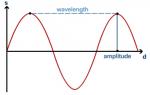
As a wave passes through water it forms high and low areas called, respectively, crests and troughs. The wavelength of the water wave is the minimum distance between two identical points--or, more simply, the distance between two consecutive crests or two consecutive troughs. Imagine the water wave striking a barrier, such as a sea wall; the wave will splash against the wall, followed shortly by another, and so on. The amount of time between each splash (the rate at which the wave repeats itself) is the frequency of the wave. Generally, wavelength and frequency are directly proportional: the higher the frequency, the shorter the wavelength.

The final physical characteristic, velocity, is dependent upon the type of wave generated. A mechanical wave, such as our water wave, will move relatively slowly; a sound wave will move much faster (about 344 meters per second) while a light wave moves faster still (186,000 miles per second or 299,200 km per second).

It is important to note that while a wave will move through a medium, it does not move the medium itself. This is hard to picture in our water example, since it appears as if the water does move with the wave. However, if we were to place a bobber in the water, we would notice the bobber moving up and down as the wave passed but remaining essentially in the same location. Instead of water, imagine a field of wheat; as the wind blows through the field, it causes a wave to pass through the field. After the wave's passage, though, the wheat has returned to its original position--the medium has not been moved.

This is the complete article, containing 585 words (approx. 2 pages at 300 words per page).

More Information
  • View Wave Motion, Law Of Study Pack
  • 132 Alternative Definitions
  • Search Results for "Wave Motion, Law Of"
  • More Products on This Subject
    Wave Motions
    With regard to Earth science, wave motion describes the physical transmission of force or energy po... more

    Wave Motion
    A wave is nothing more than a disturbance that moves from place to place in some medium, carrying e... more


    Ask any question on Wave and get it answered FAST!
    Answer questions in BookRags Q&A and earn points toward
    discounted or even FREE Study Guides and other BookRags products!
    Learn more about BookRags Q&A
    Copyrights
    Wave Motion, Law Of from World of Scientific Discovery. ©2005-2006 Thomson Gale, a part of the Thomson Corporation. All rights reserved.

    Join BookRagslearn moreJoin BookRags

    Join BookRagslearn moreJoin BookRags