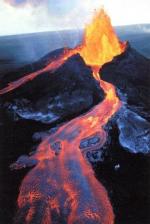
Volcano
Volcanoes are vents or fissures in Earth's crust through which lava, gases, and pyroclastic debris are released. More commonly, the term volcano refers to the landform built up from the accumulation of lava and/or pyroclastic debris. Based on the timing of their last eruption, volcanoes are classified as active (having erupted during historic time), dormant (having no recent eruptions, but with the potential to erupt again), or extinct (having no historic eruptions and showing no evidence of future eruptions). There are currently over 500 active volcanoes on Earth's surface, including famous examples such as Mt. Fuji, Mt. St. Helens, and Mauna Loa. Mt. Vesuvius, which last erupted in A.D.79, is an example of a dormant volcano; Mt. Kilimanjaro is an extinct volcano.
Fueled by Earth's internal processes, volcanoes occur primarily along plate boundaries but also form above hot spots. Eruptive activity may include lava flows, lateral blasts, ash flows, lahars, the release of volcanic gases, or any combination of these. Different types of volcanoes, each with a unique set of characteristics and eruptive styles, include shield volcanoes, composite volcanoes, lava domes, calderas, and cinder cones. Different types of magma form under different plate tectonic settings, and the type of magma present determines the type of volcano that will form in a given area.
Shield volcanoes, with their gentle slopes and curved profile, are the largest of all volcanoes. They are built up from repeated basaltic flows, often beginning at the ocean floor. Basaltic magma has a relatively low silica content, allowing it to flow readily. As a result, shield volcanoes are characterized by lava flows rather than explosive pyroclastic activity. Shield volcanoes are most commonly formed above hot spots under basaltic oceanic crust. They are also formed in areas where the mid-ocean ridge intersects with land, as in Iceland, or in areas of active rifting, like east Africa. In these areas, as the magma is rising to the surface, it mixes with only basaltic rocks, allowing it to preserve its mafic composition and flow readily. Probably the most famous shield volcanoes, Mauna Loa and Mauna Kea, currently rest above the Hawaiian hotspot. Measured from its base on the ocean floor to its summit, Mauna Kea is 5.6 mi (9 km) tall—slightly taller than Mt. Everest.
Composite volcanoes, also known as stratovolcanoes, have steep sides and a characteristic cone shape. They are built up from alternating layers of lava and pyroclastic debris. Lava associated with composite volcanoes generally has an intermediate composition, and is more resistant to flow than basaltic lava. This results in the mixture of flows and explosions. Composite volcanoes occur above subduction zones, where rising magma mixes with both oceanic and continental crust raising the overall silica content. They are ubiquitous along the subduction zones of the Pacific Rim, and some famous examples include Mt. Fuji in Japan and Mt. Rainier in Washington. Their ability to erupt explosively, as demonstrated by Mt. St. Helens in 1980, makes these some of the most dangerous volcanoes on Earth.
Lava domes are steep-sided, rounded domes, formed because of pressure exerted by rising viscous magma. Rhyolite, a felsic magma, is usually associated with lava domes. Its felsic composition makes it highly viscous, forcing it to move slowly, building up pressure and deforming the ground surface above. Lava domes are generally associated with composite volcanoes, although they can occur on their own. They are capable of causing deadly eruptions as tremendous amounts of built-up pressure are suddenly released in giant explosions. Eruption of a lava dome was responsible for the death and destruction caused by the 1902 eruption of Mt. Pelée on Martinique.
Calderas are massive depressions created by rare, violent explosions. Also associated with rhyolitic magma, caldera eruptions are capable of expelling enormous amounts of ash and debris in a single explosion. Calderas form where hotspots occur under continental crust. As magma rises, it mixes with the felsic continental crust, resulting in a high silica content. As is the case with lava domes, the resultant viscous magma cannot flow, and explodes when sufficient pressure has built up. Although there have been none in recent geologic history, about 600,000 years ago a large caldera eruption occurred at what is presently the site of Yellowstone National Park in Wyoming and Montana. The famous hot springs and geysers of the area are the legacy of that eruption, and it is believed that the site has the potential to produce another eruption in the future.
Cinder cones are steep-sided, cone-shaped, relatively small volcanoes that are formed by the accumulation of pyroclastic debris. They are not associated with any one particular lava type, and occur in a number of settings. They are commonly found on the flanks or inside the summit craters of larger volcanoes, and form when pyroclastic debris ejected by the main volcano accumulates to form the smaller cone. Perhaps the most famous cinder cone, Parícutin volcano in Mexico, grew suddenly out of a farmer's cornfield and within one month had risen to a height of almost 1,000 ft (305 m). Cinder cones tend to have short life spans; lava flows released by Parícutin eventually covered an extensive area, but within 10 years the volcano became dormant.
This is the complete article, containing 861 words
(approx. 3 pages at 300 words per page).