BookRags.com Literature Guides Literature Guides Criticism/Essays Criticism/Essays Biographies Biographies My Bibliography Periodic Table U.S. Presidents Shakespeare Sonnet Shake-Up
Research Anything:        
History | Encyclopedias | Films | News | Create a Bibliography | More... Login | Register | Help
Not What You Meant?  There are 11 definitions for Volcano.  Also try: Vulcan or Vent or Kirishima.

Search "Volcanic Eruptions"

Contents Navigation


Volcanic Eruptions

Print-Friendly  Order the PDF version  Order the RTF version
About 3 pages (805 words)
Volcano Summary

Bookmark and Share

Volcanic Eruptions

A volcanic eruption is the release of molten rock and volcanic gases through Earth's crust to the surface. Molten rock within the earth, or magma, is driven to erupt by buoyancy because it is lighter than the surrounding rock. Dissolved gases within the magma are under great pressure and force magma upwards. The upward migrating magma takes advantage of preexisting zones of weaknesses such as fractures or established volcanic necks until it eventually breaks through the surface.

An eruption may last for a few minutes or many hours and days. An eruption may be only a discharge of steam and gases through a small vent, a relatively mild oozing of lava from a fissure in a shield volcano, or a spectacular explosion that shoots huge columns of gases and debris into the sky. The explosiveness of an eruption depends to a great extent on the composition of the molten rock. Magma high in silica will be more viscous than one low in silica. A high-viscosity magma (such as a rhyolite) will tend to trap dissolved gases. The pressure of the gases can build up to the point where they are released in a spontaneous explosive eruption. A less viscous magma (such as a basalt) allows volcanic gases to bubble through more easily, preventing great build-ups of pressure, and resulting in calmer outpourings of lava.

The length an eruption is described as an eruptive pulse, eruptive phase, or eruptive episode. An eruptive pulse is a very short event lasting a few seconds to minutes. An eruption that lasts a few hours to days and consists of numerous eruptive pulses is called an eruptive phase. Eruptions that involve repeated pulses and phases over days, months, or years is an eruptive episode.

Volcanic eruptions are described according to explosivity, lava type, and other constituents such as ash, gas, and steam content or the nature of rock fragments produced. Some common eruption types are named for classic types of volcanoes that characterize the eruption. These include Hawaiian, Plinian (Vesuvian), Strombolian, and Vulcanian. Some types of eruptions have more descriptive names, such as effusive and phreatic.

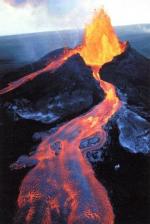
A Hawaiian-type eruption consists of a highly fluid basaltic lava that tends to flow effusively from linear fissures or from a central vent in the production of shield volcanoes. The release is not generally explosive as lava gently flows in streams or through lava tubes. Sometimes the lava accumulates in lava lakes. Occasionally, however, more spectacular fountains of lava spurting out from a vent do occur.

A Plinian, or Vesuvian, eruption is a more explosive and potentially destructive event where large amounts of ash, dust, and gas are blown out of a central source at a high velocity. The eruptive cloud often forms a large column extending high into the air above the volcano. Avalanches of hot ash, rock, and gas, called nuee ardentes, can travel down the side of the volcano at up to 100 mph (160 kph) are possible, such as the one that covered the Italian city of Pompeii. Rhyolitic to dacitic compositions are common. The name is derived from the historian Pliny, who recorded the eruption of Vesuvius in A.D.79.

Strombolian eruptions are characterized by discrete episodic explosions or fountains of basaltic lava from a single vent or crater. The eruptive pulses are caused by the release of volcanic gases, and are separated by periods of a few seconds to hours. Lava fragments consisting of partially molten volcanic bombs that become rounded as they fly through the air are commonly produced.

Vulcanian, or hydrovolcanic eruptions are explosive events that release a combination of ash and steam into the air, producing an eruptive column. Fragments of lava are ejected, but owing to a high viscosity or previous cooling, the fragments do not form aerodynamic bombs. The composition of the lava is generally andesitic to dacitic.

An effusive eruption is a general term for any non-explosive release of lava. The lava gently wells up from the ground and overflows, cooling on its way down the slope. Effusive eruptions are common in a Hawaiian type event. When a basaltic effusive eruption occurs on the ocean floor, pillow lavas often form. As the name suggests, pillow basalts are rounded elongate shapes the lava takes due to extrusion under the pressure of the ocean. As pillow lavas continually erupt, they form stacked mounds of pillows. Effusive eruptions may occur with a range of compositions, although they are most common in low viscosity lavas such as basalt.

If cool ground water or surface water comes in contact with magma below the surface, a phreatic eruption may occur. This is caused by water that is heated into pressurized steam, creating an explosive eruption driven solely by the steam. Because the eruption is driven by steam, no new rock is formed.

This is the complete article, containing 805 words (approx. 3 pages at 300 words per page).

More Information
  • View Volcanic Eruptions Study Pack
  • 11 Alternative Definitions
  • Search Results for "Volcanic Eruptions"
  • Add This to Your Bibliography
  • More Products on This Subject
    Volcanoes
    Composite Volcanoes Composite volcanoes are also known as strato volcanoes. Their formation consis... more

    Volcanoes
    When we think of volcanoes, most of us picture a huge mountain with flames and smoke shooting out... more


    Copyrights
    Volcanic Eruptions from World of Earth Science. ©2005-2006 Thomson Gale, a part of the Thomson Corporation. All rights reserved.

    Join BookRagslearn moreJoin BookRags


    About BookRags | Customer Service | Report an Error | Terms of Use | Privacy Policy