Forgot your password?  

Not What You Meant?  There are 3 definitions for Veblen.

Veblen, Thorstein | Research & Encyclopedia Articles

Print-Friendly   Order the PDF version   Order the RTF version
About 4 pages (1,061 words)
Thorstein Veblen Summary


Veblen, Thorstein

Economist, sociologist, and a founder of institutional economics, Thorstein Bunde Veblen (1857–1929) was born in Manitowoc County, Wisconsin, on July 30. He studied under the economist John Bates Clark at Carleton College in Minnesota, then at Johns Hopkins University before earning his doctorate in philosophy at Yale University in 1884. After a career of teaching at the University of Chicago, Stanford University, the University of Missouri, and the New School for Social Research, he died near Menlo Park, California, on August 3.


Veblen was an iconoclast. During the early twentieth century he was the foremost critic of the business establishment and its effects on culture and society. He alienated other academics by challenging their acquiescence to business interests. He was a prolific writer whose most famous work earned both popular success and intense academic scrutiny.

As one of the first institutional economists, Veblen's writings were often diametrically opposed to classical or neoclassical economics. For Veblen neoclassical economics relies on static notions of individually determined self-interests. In contrast, institutional economics maintains that social institutions, arising from individual economic behavior, influence that behavior in return. This approach views the economy as an evolving system and places a strong emphasis on dynamics, changing structures (including technologies, institutions, and ethics), and shocks to the system arising from technological innovation.

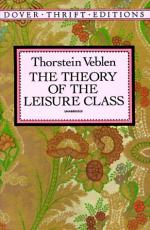
His most famous work, The Theory of the Leisure Class: An Economic Study of Institutions (1899), was a scathing sociocultural commentary. Veblen provides both a dynamic theory of class movement and a theory of consumption. He paints a picture of the business class as evolving from an earlier stage of "savagery," in which people peacefully went about their daily lives without any notion of private property and with relatively little material wealth. Culture then evolved from this primitive state to one of "barbarianism" characterized by private ownership and a leisure class that did not have towork, but instead derived its wealth from the exploitation of other human beings through technology. Members of the leisure class gained their status through control and knowledge of technology. Veblen maintained that the leisure class would remain in power and receive the economic benefits of being in power as long as they could appropriate technological skills, tools, and labor. This appropriation depends mainly on private property and the profits derived from ownership of economic resources. This ability to remain in power and to maintain a dominant class position depends in turn on creation of institutions through business and government to protect the property rights of the leisure class at the expense of everyone else.

Thorstein Veblen, 18571929. The American political economist, sociologist, and social critic wrote about the evolutionary development and mounting internal tensions of modern Western society. ( Corbis-Bettmann.)Thorstein Veblen, 1857–1929. The American political economist, sociologist, and social critic wrote about the evolutionary development and mounting internal tensions of modern Western society. (© Corbis-Bettmann.)

Veblen argued that the concentration of technology and power would often lead to the accumulation of wealth in the hands of a small leisure class at the expense of those at the other end of the economic spectrum. In the absence of institutions, effective property rights, and cultural norms the majority of the population would have access to neither capital nor the means to secure it. This has proven to be the case in many developing countries, where the absence of well-defined and enforceable property rights makes capitalism prone to inequitable outcomes.

Veblen's theory of consumption, especially the idea of consuming something beyond basic necessities, was unique. Conspicuous consumption provides the basis for twentieth-century consumerism in which consumption of goods and services serves not only as a tool to meet basic needs but also as a symbol of status.

Veblen recognized both the importance of science and technology in the creation of wealth and tensions between scientific technology and commercial enterprise. In The Theory of Business Enterprise (1904) and again in The Engineers and the Price System (1921) he analyzed the tensions between technological efforts to create good products and commercial interests in making money. Because of his praise of the "instinct of workmanship" (in his 1914 book published under that title) in ways that would eventually be echoed by Samuel C. Florman's The Existential Pleasures of Engineering (1976), Veblen's analysis inspired the technocracy movement and its effort to place engineers in positions of political power.

Veblen was one of the great thinkers of the twentieth century. Whether it was jealousy of his publishing success or because of his aloof nature, Veblen was shunned by his colleagues during most of his career. Ironically, near the end of his life, the American Economic Association offered him one of the highest honors in the field, the presidency of the association. He declined as he was unconcerned with either fame or recognition by his peers. Instead Veblen focused his efforts on writing and cofounding the New School for Social Research in New York. The posthumous rediscovery of Veblen's ideas has lead to renewed interest in both institutional and evolutionary economics and a new appreciation for and interpretation of Veblen's ideas. His legacy in the creation of social and economic theory continues to grow in importance.


Engineering Ethics;; Management.

Bibliography

Dorfman, Joseph. (1934). Thorstein Veblen and His America. New York: Viking Press. One of the best biographies of Veblen, comprehensive and well written.

Florman, Samuel C. (1976). The Existential Pleasures of Engineering. New York: St. Martin's Press.

Jorgensen, Elizabeth Watkins, and Henry Irvin Jorgensen. (1999). Thorstein Veblen: Victorian Firebrand. Armonk, NY: M.E. Sharpe. A wonderful biography replete with personal letters and interpretations of the letters.

Mouhammed, Adil H. (2003). An Introduction to Thorstein Veblen's Economic Theory. Lewiston, NY: Edward Mellen Press. Comprehensive guide to Veblen's economics and his place relative to other great thinkers of the twentieth century.

Veblen, Thorstein. (1899). The Theory of the Leisure Class: An Economic Study in the Evolution of Institutions. New York: Macmillan. His most cited and popular work; a critique of society and business practices.

Veblen, Thorstein. (1904). The Theory of Business Enterprise. New York: Scribners. A thoroughly convoluted attempt to define the modern corporation and explain why as an institution it is failing society

Veblen, Thorstein. (1914). The Instinct of Workmanship, and the State of Industrial Arts. New York: Macmillan. Veblen himself said this was his only important book. A synthesis of most of his important arguments.

Veblen, Thorstein. (1921). The Engineers and the Price System. New York: B. W. Huebsch. A collection of essays attacking the control of industry by investment bankers and outlining the role of engineers and the common worker in changing the inefficiencies of the existing power structure.

This is the complete article, containing 1,061 words (approx. 4 pages at 300 words per page).

More Information
  • View Veblen, Thorstein Study Pack
  • 3 Alternative Definitions
  • Search Results for "Veblen, Thorstein"
  • More Products on This Subject
    Thorstein Bunde Veblen
    The American political economist, sociologist, and social critic Thorstein Bunde Veblen (1857-1929)... more

    Thorstein Bunde Veblen
    The American political economist, sociologist, and social critic Thorstein Bunde Veblen (1857-1929)... more


    Ask any question on Thorstein Veblen and get it answered FAST!
    Answer questions in BookRags Q&A and earn points toward
    discounted or even FREE Study Guides and other BookRags products!
    Learn more about BookRags Q&A
    Copyrights
    Veblen, Thorstein from Encyclopedia of Science, Technology, and Ethics. Copyright © 2001-2006 by Macmillan Reference USA, an imprint of the Gale Group. All rights reserved.

    Join BookRagslearn moreJoin BookRags

    Join BookRagslearn moreJoin BookRags