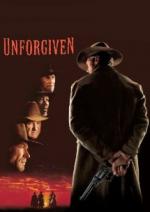
Unforgiven
Of his 1992 film Unforgiven, director and star Clint Eastwood said "the movie summarized everything I feel about the Western." Despite this, the film sparked considerable debate about exactly what it had to say about the Western. Some critics have argued for the film as an anti-Western, tearing down the icons of the genre, while others have insisted that it is simply a continuation of the genre, but with slight variation. Whatever deeper meanings the film may have intended, it meant for many, including the filmmakers, a restoration. Not only did the film give a needed career boost to actors like Eastwood, Gene Hackman, Morgan Freeman, and Richard Harris, but it also was credited with revitalizing the Western genre. Interestingly, the film was also touted by some critics as the final word on the Western. Indeed, none of the Westerns released in Unforgiven's wake have matched the impact of Eastwood's dark, brooding film. Certainly, none matched Unforgiven's critical and commercial success. It broke box office records, not only for a Western, but for an August release, and won four Academy Awards: Best Picture, Best Director, Best Supporting Actor (for Hackman), and Best Editing.
These accomplishments were all the more remarkable given the state of the genre. Within the film industry, the Western was largely considered dead and gone, and earlier attempts to resuscitate it had been tepidly received, with the exception of Kevin Costner's 1990 Western-of-a-sort,
Dances with Wolves. David Webb Peoples penned the
Unforgiven script (originally entitled "The Cut-Whore Killings") in 1976, but it had attracted only slight interest. Francis Ford Coppola had optioned the script but allowed the option to lapse. Eventually it was picked up by Eastwood, who sat on the script for some time, claiming that he needed to age into the lead role of William Munny.
Gene Hackman (left) and Clint Eastwood in a scene from the film Unforgiven.
At the beginning of the film, Munny is a struggling hog farmer raising two young children. A prologue scrolling across the screen tells of a less domestic Munny, a drunk, an outlaw, and a killer, now reformed, according to Munny, by his dead wife. But Munny's reputation brings to the ranch the Schofield Kid (Jaimz Woolvett), who lures Munny away in pursuit of a bounty on two cowboys involved in the mutilation of a prostitute. Munny, in turn, recruits his partner from the old days, Ned Logan (Freeman). What follows is the story of their search for the cowboys and their conflict with the law of the Wyoming town, Big Whisky, and a brutal sheriff named Little Bill Daggett (Hackman). The killings of the cowboys are pivotal. The first is that of Davey Boy, whose crime is largely to have been on the scene at the time of the attack on the prostitute. This is a drawn out and painful scene in which Munny shoots the cowboy from a distance. Rather than dropping to a quick death, the cowboy's life slowly ebbs while he calls out to his friends for water. Logan is left too rattled by the murder to continue in pursuit of the other cowboy. The Schofield Kid, finally living up to his bravado, kills the second cowboy, who is squatting in an outhouse at the time. The Kid is consequently reduced to trembling and tears by the gravity of what he has done, realizing that he isn't the Billy the Kid figure he has pretended to be.
The final scene is one that critics have found more troubling. It is a scene that might well be out of the penny dreadfuls of the Old West. Munny confronts Daggett and his deputies, single handedly killing five armed men. Munny's attack is motivated by vengeance against those who killed his friend, and this, combined with the incredible odds, turns Munny into a kind of mythological force for vengeance, despite the film's earlier attempts to reduce Munny to a very human and fallible man. Still, it can be argued that the final scene doesn't come off quite the way it might in another Western. Given the unpleasantness of the earlier killings, this scene is tainted, polluted with the knowledge that, as Munny puts it, "It's a hell of a thing killing a man."
Certainly, Unforgiven employs many of the genre's clichés while simultaneously undercutting the comfort that comes with such clichés. This had been done before, particularly in spaghetti Westerns, but whereas these presented a parody of the Western myth with almost cartoonish violence, the violence in Unforgiven is decidedly more realistic. Moreover, whereas many earlier Westerns were brightly lit, the action in Unforgiven is often shrouded in darkness and haze.
Eastwood dedicated the film to Sergio Leone and Don Siegel, suggesting a nod to his mentors and influences. Unforgiven is certainly in the tradition of Leone's spaghetti Westerns, but Eastwood carried the tradition to a new level. Putting his own spin on the genre, he created a new standard, a Western for an era in which the invented heroics of the past seem less convincing than they may have in the heyday of the genre. Unforgiven reflects the skepticism of its time, wherein the old John Ford adage "When the legend becomes fact, print the legend" doesn't quite hold up any more. Eastwood's film suggests that the legend is a frail thing and that perhaps truer things have a way of showing though.
Further Reading:
O'Brien, Daniel. Clint Eastwood: Film-Maker. London, Batsford, 1996.
Schickel, Richard. Clint Eastwood: A Biography. New York, Knopf, 1996.
Smith, Paul. Clint Eastwood: A Cultural Production. Minneapolis, University of Minnesota Press, 1993.
This is the complete article, containing 923 words
(approx. 3 pages at 300 words per page).