
Forgot your password?  

Not What You Meant?  There are 15 definitions for Tyndale.

Tyndale, William | Research & Encyclopedia Articles

Print-Friendly   Order the PDF version   Order the RTF version
About 3 pages (796 words)
William Tyndale Summary


Tyndale, William

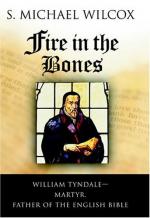
TYNDALE, WILLIAM (1494?–1536), Bible translator and Reformation scholar. William Tyndale came from a well-established family in Gloucestershire in the west of England. After an excellent education at a local Grammar School, he was for ten years at the University of Oxford. In 1516 Tyndale's life took a decisive turn when the New Testament was for the first time printed in Greek, its original language, in an edition made by Desiderius Erasmus in Basle, Switzerland. Along with scholars throughout Europe, and particularly Martin Luther in Germany, Tyndale recognized the importance of a readily available Greek New Testament, and the need for a printed translation which could reach English readers and hearers at any level.

After spending perhaps a year in Cambridge (where Erasmus had been teaching Greek), Tyndale returned to Gloucestershire to begin work on an English New Testament. Such an enterprise was forbidden by the Church, for whom any vernacular deviation from the Latin translation (made in the fourth century) was heresy. This censorship was at its most severe in England, where it was rigidly applied: in the 1380s, alarmed by the spread of handwritten Bible translations made from the Latin into English under the influence of John Wyclif, the English Church had punished many "Lollards," as Wyclif's followers were nicknamed, often by burning them alive. Tyndale needed the permission of a Bishop, and sought it from Erasmus's friend Cuthbert Tunstall, Bishop of London. He was snubbed.

With money from courageous London merchants, Tyndale went to Germany, and in Cologne began printing his English translation. He had reached Matthew's Gospel chapter 22 when the print shop was raided. Tyndale and his helper fled up the Rhine to the safe Lutheran city of Worms. There in 1526 he produced 6,000 copies of his first English New Testament, pocket-size like all his works. Smuggled down the Rhine and eagerly received in England and Scotland, copies were ruthlessly hunted and destroyed: Tunstall supervised their burning at St Paul's. Only three copies now survive, one on permanent display in the British Library.

In Germany, Tyndale learned Hebrew (unknown in England) and in 1530 printed in Antwerp his translation of the "First Five Books of Moses"—the first time that Hebrew had been translated into English. Finding that knowledge of Hebrew deepened his understanding of the Greek biblical text, Tyndale produced a revision of his New Testament, printed in Antwerp in 1534. He worked in Antwerp also on the second quarter of the Old Testament, the Historical books Joshua to 2 Chronicles.

Tyndale's 1534 New Testament, and half of the Old Testament, were reproduced largely unchanged in successive English Bibles throughout the rest of the century, culminating in the influential version made in the name of King James in 1611: five-sixths of that New Testament, and only slightly less of the Old Testament, were there taken over directly from Tyndale, without acknowledgement.

Tyndale's greatness lay in his accurate translation of the original Greek and Hebrew; his clarity of expression; and in his choice of a linguistic register just a little above ordinary speech. He gave English speakers very many phrases still in use, such as "Let there be light." His Plain Style, a Saxon vocabulary in a neutral word order, through his wide Bible readership established English as a good written language that anybody could use. Much of the remarkable development of literature in the hundred years after him came out of his work: it is not fanciful to remark "Without Tyndale, no Shakespeare."

His New Testament affected the nation. A neat definition of the Reformation is "people reading Paul." The Epistle to the Romans in particular, the bedrock of New Testament theology, and read or heard—as Tyndale famously intended—even by "the ploughboy," showed the believer's direct access to God through faith. Moreover, in the newly available Bible a large number of the Church's practices and dogmas were not found: confession to the ear, the celibacy of the priesthood, Purgatory, and so on.

Tyndale wrote other important books. The Parable of the Wicked Mammon (1528) demonstrates the New Testament emphasis on faith rather than works. His The Obedience of a Christian Man (1528) countered the lie put about by his enemies that the reformers preached sedition.

Tyndale had a price on his head as a heretic. Commissioned to do so, Thomas More attacked him at length. In Antwerp, Tyndale was tricked into arrest; he was imprisoned near Brussels for sixteen months, and in October 1536 taken out, strangled, and burned. His heresy was the making of the English Bible: his influence, long ignored, was very large.

Wyclif, John.

Bibliography

Daniell, David. William Tyndale: A Biography. New Haven, Conn., and London, 1994.

Tyndale's New Testament. Introduction by David Daniell. New Haven, Conn., and London, 1989. A modern-spelling edition.

Tyndale's Old Testament. Introduction by David Daniell. New Haven, Conn., and London, 1992. A modern-spelling edition.

This is the complete article, containing 796 words (approx. 3 pages at 300 words per page).

More Information
  • View Tyndale, William Study Pack
  • 15 Alternative Definitions
  • Search Results for "Tyndale, William"
  • More Products on This Subject
    William Tyndale
    William Tyndale (ca. 1495-1536) was the greatest of all English biblical scholars. His translation ... more

    William Tyndale
    As the first translator of the Bible into modern English, being the first to translate both the ent... more


    Ask any question on William Tyndale and get it answered FAST!
    Answer questions in BookRags Q&A and earn points toward
    discounted or even FREE Study Guides and other BookRags products!
    Learn more about BookRags Q&A
    Copyrights
    Tyndale, William from Encyclopedia of Religion. Copyright © 2001-2006 by Macmillan Reference USA, an imprint of the Gale Group. All rights reserved.

    Join BookRagslearn moreJoin BookRags

    Join BookRagslearn moreJoin BookRags

