BookRags.com Literature Guides Literature
Guides
Criticism & Essays Criticism &
Essays
Questions & Answers Questions &
Answers
Lesson Plans Lesson
Plans
My Bibliography Periodic Table U.S. Presidents Shakespeare Sonnet Shake-Up
Research Anything:        
History | Encyclopedias | Films | News | Create a Bibliography | More... Login | Register | Help


Christian Perspectives

Print-Friendly  Order the PDF version  Order the RTF version
About 31 pages (9,398 words)
Christianity Summary

Bookmark and Share Know this topic well? Help others and get FREE products!

Thomas Aquinas

Thomas of Aquino (ca. 1225–1274), a philosopher and theologian, was born into an aristocratic family at Roccasecca, near Naples, Italy. He joined the Dominican order in 1245, taking a licentia docendi at Paris in 1256. He later taught at Paris, Rome, Orvieto, and Naples. Thomas died at the Cistercian abbey of Fossa Nuova on March 7 and was canonized in 1323 by Pope John XXII. The Summa contra Gentiles was completed about 1264. His longest and most influential work, the Summa Theologiae, was unfinished at the time of his death.

Ethics and Politics

Thomas was the foremost contributor to the thirteenth-century recovery of Aristotle. His achievement in ethics lies chiefly in the application of a Christianized version of Aristotle to politics and law. In most respects he departs from the Augustinian orientation of previous generations that found the present world sin-laden and disordered and its politics harsh and coercive.

Thomas accepted the rational, humane, ordered world depicted by Aristotle. There is no tension between the acquisition of present goods on earth and the achievement of eternal ones in heaven so long as the former are directed toward and subordinated to thelatter. Human beings have a final ethical end—eternal blessedness—that transcends all earthly ends, but earthly happiness is also possible and desirable. God has equipped human beings with the rational capacity to pursue earthly as well as heavenly goods, and although sin has impaired the will, it has not obliterated reason. Thomas believes, as Augustine (354–430) did not, that humans are capable, under proper governance, of cooperating with one another to achieve a common good.

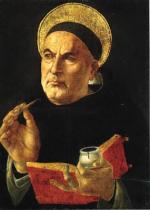
Thomas Aquinas, ?1274. Aquinas was an Italian theologian and philosopher of the Dominican Order of the Catholic Church and is regarded as one of the greatest and most influential thinkers of the Church. He had an important influence on the inteThomas Aquinas, ?–1274. Aquinas was an Italian theologian and philosopher of the Dominican Order of the Catholic Church and is regarded as one of the greatest and most influential thinkers of the Church. He had an important influence on the intellectual awakening that occurred in western Europe during and after his lifetime. (© The National Gallery, London/Corbis.)

For Thomas human beings are by nature political animals; government is not merely a consequence of sin. Even if the Fall of Adam had not occurred, no individual would be able to acquire all the necessities of life unaided; only cooperation can secure the benefits of divisions of labor. However, there are many ways to achieve human ends, and so a community must be guided toward the common good by just and wise rule. The best government is a "mixed" constitution of the kind that Aristotle called politeia. Kingship may be the most efficient form of rule, but it is also the most likely to deteriorate into tyranny. It therefore must be tempered by elements of democracy and aristocracy. A king should choose the best people as his counselors, and what he does should be ratified by the people. Thomas follows Aristotle in supposing that a government in which as many people as possible participate will be the most stable because it will commend itself to all sections of the community.

Law and Ethics

In the Summa Theologiae Thomas develops a typology of law as eternal, natural, human, and divine. This theory has a Platonic starting point insofar as law is defined as a rational pattern or form. In the political realm law thus serves as a "rule and measure" for citizens' conduct. When citizens obey the law, they "participate" in that order in the way a table "participates" in the rational pattern or form of a table.

Because God is the supreme governor of everything, the rational pattern or form of the universe that exists in God's mind is law in the most comprehensive sense: the law that makes the universe orderly and predictable. This rational pattern is what Thomas called eternal law, and to it everything in the universe is subject. The eternal law is similar in content to what science now calls the laws of nature.

Inasmuch as humankind is part of the eternal order there must be a portion of the eternal law that relates specifically to human conduct. This is the lex naturalis, the "law of [human] nature": an idea present in Aristotle to which Thomas gave extensive elaboration. In developing his natural law theory Thomas restored human reason to a central place in moral philosophy. For Thomas, as for Aristotle, human beings are preeminently reason-using creatures. The law or order to which people are subject by their nature is not a mere instinct to survive and breed. It is a moral law ordering people to do good and avoid evil, have families, live at peace with their neighbors, and pursue knowledge. It is natural in that humans are creatures to whom its prescriptions are rationally obvious. To all humans, pagans included, these precepts simply "stand to reason" by virtue of a faculty of moral insight or conscience that Thomas called synderesis.

However, humans act on the principles of natural law with the assistance of more particular and coercive provisions of what Thomas called human law. The natural law is too general to provide specific guidance. Part of this specific guidance can come from the moral virtues that equip people to achieve practical ends: prudence, justice, temperance, and fortitude. However, these personal guidelines are developed and reinforced by human or positive laws that that help cultivate such good habits. These particular, positive rules of behavior include civil and criminal laws of the state as formulated by practical reason, or what Aristotle called phronesis, in the light of the general principles of natural law and have a morally educative function. Human laws that are not based on natural law—laws that oppress people or fail to secure their good—have more the character of force than that of law. Obedience may be called for if disobedience would cause greater harm, but people are not obliged to obey unjust laws. Individuals may exercise independent moral judgment; they are not simply subjects but rational citizens.

The fourth kind of law—divine law—is part of the eternal law but, unlike human law, is not derived from rational reflection on more general principles and historical circumstances. It is a law of revelation, disclosed through Scripture and the Church and directed toward people's eternal end. Human law is concerned with external aspects of conduct, but salvation requires that people be inwardly virtuous as well as outwardly compliant. The divine law governs people's inner lives: It punishes people insofar as they are sinful rather than merely criminal.

Applying Thomism

The strongest implications of Thomas's thought for ethics, science, and technology are found in the doctrine of natural law and the underlying idea of human equality. For instance, Pope Leo XIII in his encyclical Rerum Novarum (1891) drew on law theory to criticize the conditions of labor under industrial capitalism. Insofar as it requires people to do good, avoid evil, pursue knowledge, and live at peace with their neighbors, the natural law suggests that governments should support scientific and technological research intended to have beneficial outcomes. By the same token, it supports the principle that governments should not sponsor such research when it involves the development of weapons of mass destruction or the exploitation of some human beings by others.

Natural law doctrine implies as well that governments should not harm, but seek to preserve, the physical environment of humankind: the natural world that God created and over which humans properly exercise dominion. In regard to biological and medical science, the idea of human nature as a repository of value implies a distinction between laudable biomedical research, which is a work of charity beneficial to the human race, and unacceptable research involving the manipulation or distortion of human nature. In this connection Thomas often is cited in support of the Catholic Church's prohibition of artificial (as distinct from natural) methods of contraception.

Finally, it may be noted that Thomas's insistence on citizen participation in government speaks against any suggestion that political decisions should be made by technocratic elites of scientists and engineers rather than by those who will be affected by those decisions. Thomas presided over a thorough revaluation of the capacity of human beings for autonomous moral action and hence for responsible political participation. In effect, he reinvented the Aristotelian ideal of citizenship after its long medieval eclipse, and that reinvention would apply today to scientific and technological decision making.


Aristotle and Aristotelianism;; Christian Perspectives;; Just War;; Natural Law;; Virtue Ethics.

Bibliography

Chesterton, G. K. (1974). Saint Thomas Aquinas: The Dumb Ox. New York: Image. A popular and uncritical biography, but useful for purposes of orientation.

Dyson, R. W., ed. Political Writings/Thomas Aquinas. Cambridge, UK, and New York: Cambridge University Press. A comprehensive selection of passages in translation, with detailed notes and introduction.

Finnis, John. (1998). Aquinas: Moral, Political and Legal Theory. Oxford, UK: Oxford University Press. A comprehensive and recent scholarly treatment of Thomas's thought on ethics, politics and law.

McInerny, Ralph M. (1982). Ethica Thomistica: The Moral Philosophy of Thomas Aquinas Washington DC: Catholic University of America. A clear exposition and summary of Thomas's moral philosophy; still regarded as a standard textbook on the subject.

O'Connor, D. J. (1967). Aquinas and Natural Law. London: Macmillan.

This is the complete article, containing 1,494 words (approx. 5 pages at 300 words per page).

More Information
  • View Thomas Aquinas Study Pack
  • 22 Alternative Definitions
  • Search Results for "Thomas Aquinas"
  • Add This to Your Bibliography
  • More Products on This Subject
    Christianity
    major religion, stemming from the life, teachings, and death of Jesus of Nazareth (the Christ, or t... more

    Christianity
    Religion stemming from the teachings of Jesus in the 1st century &AD;. Its sacred scripture is the ... more


    Ask any question on Christianity and get it answered FAST!
    Answer questions in BookRags Q&A and earn points toward
    discounted or even FREE Study Guides and other BookRags products!
    Learn more about BookRags Q&A
    Copyrights
    Christian Perspectives from Encyclopedia of Science, Technology, and Ethics. Copyright © 2001-2006 by Macmillan Reference USA, an imprint of the Gale Group. All rights reserved.

    Join BookRagslearn moreJoin BookRags


    About BookRags | Customer Service | Report an Error | Terms of Use | Privacy Policy