BookRags.com Literature Guides Literature
Guides
Criticism & Essays Criticism &
Essays
Questions & Answers Questions &
Answers
Lesson Plans Lesson
Plans
My Bibliography Periodic Table U.S. Presidents Shakespeare Sonnet Shake-Up
Research Anything:        
History | Encyclopedias | Films | News | Create a Bibliography | More... Login | Register | Help

Not What You Meant?  There are 16 definitions for Wasteland.

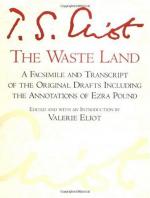
The Waste Land

Print-Friendly  Order the PDF version  Order the RTF version
About 24 pages (7,071 words)
The Waste Land Summary

Bookmark and Share Questions on this topic? Just ask!
Eliot adopted British citizenship in 1927 and became a devoted member of the Anglican Church. His subsequent literary and critical works would reflect a growing political and religious conservatism. Eliot won the Nobel Prize for literature in 1948, married his second wife, Valerie Fletcher, in 1957, and died in 1965. The Waste Land remains one of the most dramatic expressions of the atmosphere pervading Britain after the First World War.

Events in History at the Time of the Poem

World War I. T. S. Eliot left Marburg, Germany, in early August 1914 just as World War I began. Since Harvard had awarded him a travel grant, he went to England and taught there at Oxford University. As a citizen of the United States, which would not enter the war until April 1917, the poet had a unique perspective on the toll it was taking on England and her people. Food had already become scarce when he arrived in London, and it was impossible to overlook the newspaper headlines announcing the tremendous numbers of British causalities.

This is a free page. This page contains 172 words. This article contains 7,071 words (approx. 24 pages at 300 words per page).

Read the rest of this Article with our The Waste Land Access Pass.

Ask any question on The Waste Land and get it answered FAST!
Answer questions in BookRags Q&A and earn points toward
discounted or even FREE Study Guides and other BookRags products!
Learn more about BookRags Q&A
Copyrights
The Waste Land from World Literature and Its Times. ©2008 Thomson Gale, a part of the Thomson Corporation. All rights reserved.


Join BookRagslearn moreJoin BookRags


About BookRags | Customer Service | Report an Error | Terms of Use | Privacy Policy