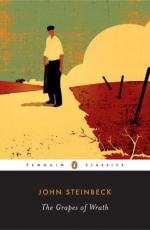
The Grapes of Wrath
Written by John Steinbeck and published in 1939, The Grapes of Wrath describes the Depression era journey of the fictional Joad family from the Dust Bowl of Oklahoma to the agricultural fields of California. A film version of the novel, directed by John Ford and starring Henry Fonda, followed in 1940. Together with evocative photographs by Dorothea Lange, the novel and film focused national attention on the plight of migrant farm workers in California and earned Steinbeck the Pulitzer Prize in fiction in 1940.
The novel recounts the westward journey of the Joads, a three-generation Oklahoma family pushed off their land through a combination of dust storms and foreclosures. Eldest son Tom returns home from the state penitentiary to find the family preparing to head to California in the hopes of obtaining work and eventually a farm of their own. Tom, along with parents, grandparents, an uncle, siblings, and a brother-in-law, are joined in their trek by Jim Casy, an ex-preacher looking to fill the void left by his loss of "the Holy sperit." After leaving Oklahoma, they discover that California is not the land of milk and honey where they can become independent farmers, but rather it is a cold, harsh, uninviting environment, in both the towns and the countryside. Through their journey, Tom and Casy learn about the exploitative practices of landowners and the avenues open to farm laborers to challenge the power of the farm owners. Ma Joad learns, over the course of the novel, that her responsibilities extend beyond the limits of the "fambly" to "the people." She learns the importance of solidarity in regaining and maintaining human dignity, just as Tom learns the value of solidarity in gaining respect in labor. This message is reinforced in the novel's final scene, in which Tom's sister, Rosasharn (Rose-of-Sharon), having just given birth to a stillborn child, gives her maternal breast to a dying man. By the end of the novel, the Joad family has grown to include the family of man.
The Grapes of Wrath is a prime example of the proletarian novel that was popular during the Great Depression in which ordinary working class families (especially agricultural workers) became the focus. Steinbeck strongly believed in the power of literature to bring about change in society through education and example. By exposing the corrupt ways of agribusiness and the benefits of government intervention into the agricultural economy, Steinbeck sought to bring about the creation of a farm labor proletariat. The novel ignited an explosion of controversy over the problems of migrant labor. Accusations about the novel's accuracy led to debates such as the 1940 radio broadcast of "America's Town Meeting of the Air," which addressed the issue "What should America do for the Joads?" Criticisms about the representations of California growers and Oklahoma natives resulted in bans on the book in communities across the nation and most publicly in Kern County, California, a heavily agricultural region of the state.
Stylistically, the novel also recalls the documentary movement of the 1930s in its use of interchapters which depart from the narrative of the Joad family and describe phenomena representative of the migrant population as a whole. The interchapters authenticate the narrative by placing the plight of the Joads within the larger context of Dust Bowl migrants, the agricultural economy, and the American proletariat. Steinbeck portrayed the "Okie" migrants as uneducated, unsophisticated, earthy, and decent folk whose humanity provided a counterpoint to the inhumanity of industrial/agribusiness exploitation. Much like the photography of Margaret Bourke-White, Dorothea Lange, and Walker Evans; and documentary books like Bourke-White and Erskine Caldwell's You Have Seen Their Faces (1937), Lange and Paul Taylor's An American Exodus: A Record of Human Erosion (1939), and Evans and James Agee's Let Us Now Praise Famous Men (1941), The Grapes of Wrath sought to improve society through the presentation of information in a highly emotionally charged narrative.
Upon publication, Daryl Zanuck of Twentieth Century-Fox studios acquired the rights to the novel and set screenwriter NunnallyJohnson to the task of adapting Steinbeck's prose into a screenplay. Production proceeded under tight security conditions as controversy over the novel mounted. Renowned western director John Ford gathered together a cast of actors including Henry Fonda (Tom Joad), Jane Darnwell (Ma Joad), and John Carradine (Preacher Casy). The film's look, through the stark cinematography of Greg Toland, recalls the documentary vision of government photographers like Russell Lee, Arthur Rothstein, and Dorothea Lange. While more optimistic in tone than the novel, the film presents a bleak look at the conditions of migrant farm workers during the Great Depression. John Ford received the Academy Award for Best Director for The Grapes of Wrath.
Henry Fonda (right) at the bedside of Shirley Mill (left) and Jane Darwell in a scene from the film The Grapes of Wrath.Further Reading:
Benson, Jackson J. "'To Tom Who Lived It': John Steinbeck and the Man from Weedpatch." Journal of Modern Literature. Vol. 5, April 1976, 151-224.
French, Warren. Filmguide to "The Grapes of Wrath." Bloomington, Indiana University Press, 1973.
French, Warren, ed. A Companion to "The Grapes of Wrath." New York, Penguin, 1963.
Millichap, Joseph. Steinbeck and Film. New York, Frederick Unger, 1983.
Steinbeck, John. Working Days: The Journals of "The Grapes of Wrath." Edited by Robert DeMott. New York, Viking, 1989.
Wyatt, David, ed. New Essays on "The Grapes of Wrath." New York, Cambridge University Press, 1990.
This is the complete article, containing 889 words
(approx. 3 pages at 300 words per page).