BookRags.com Literature Guides Literature
Guides
Criticism & Essays Criticism &
Essays
Questions & Answers Questions &
Answers
Lesson Plans Lesson
Plans
My Bibliography Periodic Table U.S. Presidents Shakespeare Sonnet Shake-Up
Research Anything:        
History | Encyclopedias | Films | News | Create a Bibliography | More... Login | Register | Help


Air Pollution

Print-Friendly  Order the PDF version  Order the RTF version
About 5 pages (1,514 words)
Air pollution Summary

Bookmark and Share Questions on this topic? Just ask!

Sudbury, Ontario


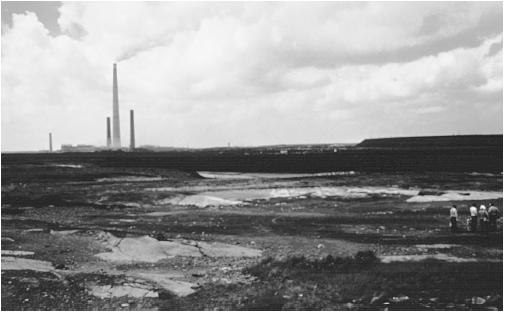
The area around Sudbury, Ontario, was deforested by emissions from nickel and copper smelting. (Photograph by A. J. Copley. Visuals Unlimited. Reproduced by permission.)The area around Sudbury, Ontario, was deforested by emissions from nickel and copper smelting. (Photograph by A. J. Copley. Visuals Unlimited. Reproduced by permission.)

The town of Sudbury, Ontario, has been the site of a large metal mining and processing industry since the latter part of the nineteenth century. The principal metals that have been sought from the Sudbury mines are nickel and copper. Because of Sudbury's long history of mining and processing, it has sustained significant ecological damage and has provided scientists and environmentalists with a clear case study of the results.

Mining and processing companies headquartered at Sudbury began by using a processing technique that oxidized sulfide ores using roast beds, or heaps of ore piled upon wood. The heaps were ignited and left to smolder for several months, after which cooled metal concentrate was collected and shipped to a refinery for processing into pure metals. The side effect of roast beds was the intense, ground-level plumes of sulfur dioxide and metals, especially nickel and copper, they produced. The smoke devastated local ecosystems through direct phytotoxocity and by causing acidification of soil and water. After the vegetative cover was killed, soils eroded from slopes and exposed naked granitic-gneissic bedrock, which became pitted and blackened from reaction with the roast-bed plumes.

After 1928, the use of roast beds was outlawed, and three smelters with tall stacks were constructed. These emitted pollutants higher into the atmosphere, but some local vegetation damage was still caused, lakes were acidified, and toxic contaminants were spread over an increasingly larger area.

Over the decades, well-defined patterns of ecological damage developed around the Sudbury smelters. The most devastated sites occurred closest to the sources of emission. They had large concentrations of nickel, copper, and other metals, were very acidic with resulting toxicity from soluble aluminum ions, and were frequently subjected to toxic fumigations by sulfur dioxide. Such sites had very little or no plant cover, and the few species that were present were usually physiologically tolerant ecotypes of a few widespread species.

Ecological damage and environmental contamination lessened with increasing distance from the point source of emissions. Obvious damage to terrestrial ecosystems was difficult to detect beyond 10–12 mi (15–20 km), but contamination with nickel and copper could be observed much farther away. Oligotrophic lakes with clear water, low fertility, and little buffering capacity, however, were acidified by the dry deposition of sulfur dioxide at least 25–31 mi (40–50 km) from Sudbury.

In 1972, a very tall, 1,247-ft (380-m) "superstack" was constructed at the largest of the Sudbury smelters. The superstack resulted in an even greater dispersion of smelter emissions. This, combined with closing of another smelter, and reduction of emissions by flue gas desulfurization and the processing of lower-sulfur ores, resulted in a substantial improvement of local air quality. Consequently, a notable increase in the cover and species richness of plant cover close to the Sudbury smelters has occurred, a process that has been actively encouraged by revegetation activities along roadways and other amenity areas where soil remained. Lakes close to the superstack and the closed smelter have also become less acidic, and their biota has responded accordingly. There is controversy, however, about the contributions that the still large emissions of sulfur dioxide may be making towards the regional acid rain problem. It is possible that height of the superstack will be decreased to reduce the longer-range transport of emitted sulfur dioxide.

Air Pollution; Contaminated Soil; Water Pollution

Resources

Books

Freedman, B. Environmental Ecology. San Diego: Academic Press, 1989.

Nriagu, J., ed. Environmental Impacts of Smelters. New York: J. Wiley, 1984.

This is the complete article, containing 589 words (approx. 2 pages at 300 words per page).

More Information
  • View Sudbury, Ontario Study Pack
  • Search Results for "Sudbury, Ontario"
  • Add This to Your Bibliography
  • More Products on This Subject
    Air Pollution
    Release into the atmosphere of gases, finely divided solids, or finely dispersed liquid aerosols at... more

    The Omnipotent Destroyer; Car Pollution
    As time progresses forward, so does humanity along with impressive technological advances created t... more


    Ask any question on Air pollution and get it answered FAST!
    Answer questions in BookRags Q&A and earn points toward
    discounted or even FREE Study Guides and other BookRags products!
    Learn more about BookRags Q&A
    Copyrights
    Air Pollution from Environmental Encyclopedia. ©2005-2006 Thomson Gale, a part of the Thomson Corporation. All rights reserved.

    Join BookRagslearn moreJoin BookRags


    About BookRags | Customer Service | Report an Error | Terms of Use | Privacy Policy