BookRags.com Literature Guides Literature
Guides
Criticism & Essays Criticism &
Essays
Questions & Answers Questions &
Answers
Lesson Plans Lesson
Plans
My Bibliography Periodic Table U.S. Presidents Shakespeare Sonnet Shake-Up
Research Anything:        
History | Encyclopedias | Films | News | Create a Bibliography | More... Login | Register | Help

Not What You Meant?  There are 56 definitions for Uncle.  Also try: Stalin or Koba or Soso or Old Joe.

Stalin, Joseph

Print-Friendly  Order the PDF version  Order the RTF version
About 2 pages (596 words)
Joseph Stalin Summary

Bookmark and Share Questions on this topic? Just ask!

Stalin, Joseph

HEAD OF STATE OF THE SOVIET UNION
1879–1953

Joseph Vissarionovich Dzhugashvili was born December 21, 1879, to a peasant family in Georgia. He joined the Russian Social Democratic Labor Party in 1901 and adopted the name Stalin, meaning "man of steel." Stalin undertook a variety of Party tasks, including editing the Party's newspaper, Pravda. In 1913 he wrote the treatise Marxism and the National Question which became the basis of Bolshevik nationalities policy. Vladimir Lenin (1870–1924), leader of the Soviet government, rewarded Stalin by appointing him Commissar of Nationalities in 1917. Stalin became General Secretary in 1922 and used that platform to seize control upon Lenin's death in 1924.

Under the slogan "socialism in one country," Stalin sought to completely transform society by dragging a backward empire into Europe as a modern,

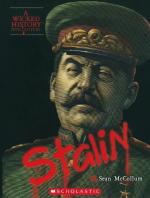
RUSSIAN DICTATOR JOSEPH STALIN SPEAKS IN MOSCOW. Though Stalins tenure as Secretary General from 1922 to 1953 brought about the modernization of the USSR and solidified the countrys military power, it was overshadowed by the devastating effectsRUSSIAN DICTATOR JOSEPH STALIN SPEAKS IN MOSCOW. Though Stalin's tenure as Secretary General from 1922 to 1953 brought about the modernization of the USSR and solidified the country's military power, it was overshadowed by the devastating effects of his economic policies and the vicious executions he ordered of his real or perceived political adversaries. (SOURCE: AP/WIDE WORLD PHOTOS)

secular, and socialist state. All of society was to serve the needs of the state. Stalin ordered massive industrialization campaigns and brutally collectivized agriculture. He launched the first five-year plan in the Union of Soviet Socialist Republics (USSR) and executed economic "saboteurs."

Stalin established a cult of personality that made him the source of Soviet achievements. To deflect blame for numerous failed policies, Stalin needed scapegoats. He accused Leo Trotsky, Nikolai Bukharin, and other Party leaders of attempting to subvert Soviet society and orchestrated mock show trials that sent his perceived rivals to the firing squad. Stalin reigned with terror and gradually created a new political elite totally subservient to him. Spies, informers, and a new class of "political criminals" now populated Soviet society, while tight controls on information kept alternative ideas and full disclosure of the terror from the public.

As Adolf Hitler (1889–1945) rose to power in Central Europe, Stalin signed a non-aggression pact with the Nazi leader in 1939. Hitler ignored the pact and invaded the USSR in June 1941. Stalin used Russian nationalism to rally the country for the subsequent war effort. He also met with Britain's prime minister Sir Winston Churchill (1874–1965), and U.S. Presidents Franklin D. Roosevelt (1882–1945) and Harry S Truman (1884–1972) in Tehran, Yalta, and Potsdam to coordinate Allied strategy.

By the end of World War II (1945), Soviet troops occupied key territories in Eastern Europe. Stalin installed communist regimes throughout the region and prevented leaders of such satellite states from adapting communism to fit their local needs and characteristics. This insistence on uniformity led to clashes with Yugoslav communist leader Josip Broz Tito (1892–1980). The Stalin-Tito split was a watershed in Soviet–East European relations and formed the basis of several future policies. Stalin's portrayal of socialism as an alternative to capitalism caused a rift with the USSR's American and British allies, triggering the Cold War.

In the early 1950s, Stalin's paranoia resurfaced. He accused his doctors of trying to poison him and was prepared to launch a new round of terror. His death on March 5, 1953, thrust the USSR into deep mourning. Three years later, Stalin's successor, Nikita Khrushchev (1874–1971), stunned the world by revealing the excesses of Stalin's reign. Khrushchev launched a campaign of "destalinization" to remove repression and fear from communist societies.

Russia.

Bibliography

Tucker, Robert C. Stalin in Power. New York: Norton, 1990.

Ulman, Adam B. Stalin: The Man and His Era. Boston: Beacon, 1989.

Volkogonov, Dmitri. Stalin: Triumph and Tragedy. New York: Grove, 1994.

This is the complete article, containing 596 words (approx. 2 pages at 300 words per page).

More Information
  • View Stalin, Joseph Study Pack
  • 56 Alternative Definitions
  • Search Results for "Stalin, Joseph"
  • Add This to Your Bibliography
  • More Products on This Subject
    Joseph Stalin
    The Soviet statesman Joseph Stalin (1879-1953) was the supreme ruler of the Soviet Union and the le... more

    Joseph Stalin
    Joseph Stalin was the dictator of the Soviet Union from 1929 to 1953. During these years he epitomi... more


    Ask any question on Joseph Stalin and get it answered FAST!
    Answer questions in BookRags Q&A and earn points toward
    discounted or even FREE Study Guides and other BookRags products!
    Learn more about BookRags Q&A
    Copyrights
    Stalin, Joseph from Governments of the World. Copyright © 2001-2006 by Macmillan Reference USA, an imprint of the Gale Group. All rights reserved.

    Join BookRagslearn moreJoin BookRags


    About BookRags | Customer Service | Report an Error | Terms of Use | Privacy Policy