 Print
Print Word
Word PDF
PDF|
This section contains 1,759 words (approx. 6 pages at 300 words per page) |

|
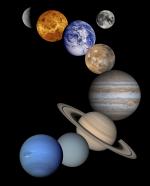
Earth's solar system is comprised of the Sun, nine major planets, some 100,000 asteroids larger than 0.6 mi (1 km) in diameter, and perhaps 1 trillion cometary nuclei. While the major planets lie within 40 Astronomical Units (AU)—the average distance of Earth to the Sun—the outermost boundary of the solar system stretches to 1 million AU, one-third the way to the nearest star. Cosmologists and Astronomers assert that the solar system was formed through the collapse of a spinning cloud of interstellar gas and dust.
The central object in the solar system is the Sun. It is the largest and most massive object in the solar system; its diameter is 109 times that of Earth, and it is 333,000 times more massive. The extent of the solar system is determined by the gravitational attraction of the Sun. Indeed, the boundary of the solar system is defined as the surface within which the...
|
This section contains 1,759 words (approx. 6 pages at 300 words per page) |
|