
 Print
Print Word
Word PDF
PDF|
This section contains 4,165 words (approx. 14 pages at 300 words per page) |

|
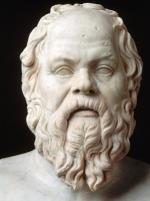
SOCRATES (c. 469–399 BCE) was a Greek philosopher. Commonly regarded as the father of philosophy, Socrates' influence on Western thought has been huge throughout history. Almost every epoch saw in him a precursor of its own ideas and values, and a model of wisdom and morality.
Sources
Socrates is the only Western philosopher who wrote nothing. Hence all first-hand information on his life, personality, and thought derives from reports by those who knew him personally. Among those, a special role is played by his friends and associates who, in a series of dialogues commonly referred to as the Sokratikoi logoi, portray him in discussion with prominent intellectuals and politicians. These writings spread immediately after Socrates' death, becoming a popular literary genre in the first half of the fourth century BCE. Unfortunately, from a corpus of hundreds of conversations only those reported by Plato (428/427–348/347 BCE) and Xenophon (430–355 BCE) survive complete...
|
This section contains 4,165 words (approx. 14 pages at 300 words per page) |
|



