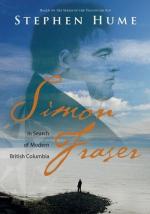
Born 1776, Bennington, Vermont
Died April 19, 1862, St. Andrew’s, Ontario
In the early nineteenth century both Great Britain and the United States competed for rights to the Pacific Northwest. In 1804, Americans Meriwether Lewis (1774–1809) and William Clark (1770–1838) claimed much of the Northwest for the United States in the first government-sponsored expedition across North America to the Pacific Ocean. British North American settlers hurried to establish their own claims in the area, the movement led by fur-trading companies. Simon Fraser, part-owner of the North West Company, set up fur-trading posts and settlements in what would become central British Columbia and explored west of the Rocky Mountains in an attempt to find an easy water route to the Pacific. In his unsuccessful attempts to find the Columbia—the largest North American river that flows into the Pacific Ocean—he discovered a great river of western Canada: the Fraser.
Fraser was born into a family of Roman Catholic Scottish immigrants who settled in Vermont in 1774. His father fought with the British during the American Revolution (1775–1783), was captured, and died in a prison in Albany, New York, in 1778. Fraser’s mother moved the family to British North America in 1784, settling in Cornwall, upper Canada (Ontario), where Simon grew up. At sixteen, he began an apprenticeship with the British North West Company, a major furtrading business (furs comprised the main industry of upper North America) located in Montreal, Quebec. By 1802, at the age of twenty-five, Fraser was made a partner in the company.
In 1805 Fraser was given the task of establishing trading posts on the western side of the Rocky Mountains. Along with opening up new territories for fur-trapping, he was instructed to try to find an easy route to the Pacific Ocean. That way trade goods and supplies could go back and forth from inland to the coast, instead of along an expensive overland route to distant Montreal. The North West Company had been interested in the area ever since fur tradesman Alexander Mackenzie crossed the Rockies from the east in 1793. While Mackenzie had reached the Pacific Ocean, the route he had taken was such a difficult one that it was considered useless for future travelers. Members of the North West Company hoped that Fraser would have better luck on his expedition.
Fraser headed for Fort Chipewyan on Lake Athabasca, the North West Company’s trading post in what is now northeastern Alberta. He then followed Mackenzie’s route and explored the upper reaches of the Peace and Parsnip rivers into what is now central British Columbia. Fraser called the area New Caledonia (Caledonia was the ancient name for Scotland), because it reminded him of his mother’s description of the land of his ancestors. For a time he explored the northern Rockies, developing the local fur trade there. He founded Fort McLeod, the first European settlement west of the Rockies.
But when news of Lewis and Clark’s explorations in the Northwest reached him, Fraser was anxious to launch an expedition in search of a water route to the Pacific. During the winter of 1805–1806 he and his lieutenant—John Stuart—had heard from local inhabitants about a nearby lake (which would be called Stuart Lake) that emptied into a river flowing south. Hoping that the river might be the great Columbia, which flows into the Pacific Ocean near present-day Portland, Oregon, Fraser set off to find it on May 20, 1806. He and his party of twenty-four men reached Stuart Lake on July 26 and he founded a trading post there called Fort St. James. But because his supplies were very low, he had to stop traveling and wait for a shipment to come from the east in the fall of 1807. During the delay he and his men built two other posts in the area: Fort Fraser and Fort George (now the town of Prince George, British Columbia).
On May 28, 1808, the expedition finally left Fort George in four canoes and followed the great river—which would later be called the Fraser—south. The men were retracing Mackenzie’s route; the earlier explorer had believed that he, too, was traveling on the Columbia. And, like Mackenzie, Fraser met with Native Americans along the way who gave him very discouraging reports about making much progress on the river. For it was full of rapids, whirlpools, and waterfalls, and the steep rocky cliffs on either side made portaging (carrying a boat around an obstacle) extremely dangerous. At one point the rock walls were more than three thousand feet high. But unlike Mackenzie, who had left the river’s difficult course in favor of an overland route, Fraser was determined to follow it to its end.
But by June 10, even Fraser realized that the river was unnavigable. Near the present-day town of Lillooet (in British Columbia), he and his men abandoned their canoes, deciding to follow the river overland. Just as treacherous as the swirling rapids that threatened to swallow them, their land route was often comprised of narrow, slippery paths along high cliffs. As they approached the river’s mouth, the water became calmer and looked more suitable for boat travel. Finally, on July 2, Fraser and his men reached the Strait of Georgia, where the river joins the Pacific. The newly discovered ocean outlet would become the site of the great city of Vancouver.
When Fraser reached the river’s mouth he took a latitude reading. It showed that he and his men had definitely not been traveling on the Columbia, which was known to empty into the Pacific Ocean much farther south. In addition, the river that they had traveled down had been so unnavigable that it would be of no use to inland fur traders trying to reach the coast. Fraser was disappointed with the results of his expedition.
Faced with hostile Native Americans on the coast and a shortage of supplies, Fraser and his men turned back at once. They recovered their hidden canoes and paddled upriver, following the same difficult route. Amazingly, the party arrived safely back at Fort George on August 6, 1808.
Sometime after 1811, Fraser was assigned to manage the North West Company’s fur trading posts near the Red River in what is now southern Manitoba. He became involved in disputes between fur traders and settlers there, and in 1816 he was accused of participating in an attack on a Hudson’s Bay Company post. He was acquitted of all wrongdoing following a trial in Ontario. A few years later, in 1820, he retired to a farm in Stormont County in eastern Ontario. During the Canadian rebellion of 1837–1838 he served as a militia captain and was severely injured. His injuries prevented him from running his farm, and he lived out the last twenty-four years of his life in poverty, dying on April 19, 1862.
Baker, Daniel B., ed. Explorers and Discoverers of the World. Detroit: Gale Research, 1993.
Bohlander, Richard E., ed. World Explorers and Discoverers. New York: Macmillan, 1992.
Delpar, Helen, ed. The Discoverers: An Encyclopedia of Explorers and Exploration. New York: McGraw-Hill, 1980.
Waldman, Carl and Alan Wexler. Who Was Who in World Exploration. New York: Facts on File, 1992.
This is the complete article, containing 1,203 words
(approx. 4 pages at 300 words per page).