Forgot your password?  

Not What You Meant?  There are 36 definitions for Notation.

Scientific Notation | Research & Encyclopedia Articles

Print-Friendly   Order the PDF version   Order the RTF version
About 2 pages (606 words)
Scientific notation Summary


Scientific Notation

Scientific notation is a method of writing very large and very small numbers. Ordinary numbers are useful for everyday measurement, such as daily temperatures and automobile speeds, but for large measurements like astronomical distances, scientific notation provides a way to express these numbers in a short and concise way.

The basis of scientific notation is the power of ten. Since many large and small numbers have a few integers with many zeros, the power of ten can be used to shorten the length of the written number.

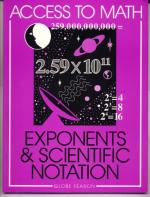
A number written in scientific notation has two parts. The first part is a number between 1 and 10, and the second part is a power of ten. Mathematically, writing a number in scientific notation is the expression of the number in the form n × 10x where n is a number greater than 1 but less than 10 and x is an exponent of 10. An example is 15,653 written as 1.5653 × 10⁴. This type of notation is also used for very small numbers such as 0.0000000072, which, in scientific notation, is rewritten as 7.2 × 10⁻⁹.

Some examples of measurements where scientific notation becomes useful follow.

  • The wavelength for violet light is 40-millionths of a centimeter 4 × 10⁻⁵cm.
  • Some black holes are measured by the amount of solar masses they could contain. One black hole was measured as 10,000,000 or 1.0 × 10⁷ solar masses.
  • The weight of an alpha particle, which is emitted in the radioactive decay of Plutonium-239, is 0.000,000,000,000,000,000,000,000,006,6 45 kilograms (6.645 × 10⁻²⁷ kilograms).
  • A computer hard disk could hold 4 gigabytes (about 4,000,000,000 bytes) of information. That is 4.0 × 109 bytes.
  • Computer calculation speeds are often measured in nanoseconds. A nanosecond is 0.000000001 seconds, or 1.0 × 10⁻⁹ seconds.

Converting Numbers Into Scientific Notation

Complete the following steps to convert large and small numbers into scientific notation. First, identify the significant digits and move the decimal place to the right or left so that only one integer is on the left side of the decimal. Rewrite the number with the new decimal place and include only the identified significant digits. Then, following the number, write a multiplication sign and the number 10. Raise the 10 to the exponent that represents the number of places you moved the decimal point.

If the number is large and you moved the decimal point to the left, the exponent is positive. Conversely, if the number is small and you moved the decimal point to the right, the exponent is negative.

If a chemist is trying to discuss the number of electrons expected in a sample of atoms, the number may be 1,100,000,000,000,000,000,000, 000,000. Using three significant figures the number is written 1.10 × 1027. Along the same lines the weight of a particular chemical may be 0.0000000000000000000721 grams. In scientific notation the example would be written 7.21 × 10⁻²⁰

Powers, Exponents, and Scientific Notation

The process of calculating scientific notation comes from the rules of exponents.

  • Any number raised to the power of zero is one.
  • Any number raised to the power of one is equal to itself.
  • Any number raised to the nth power is equal to the product of the number used as a factor n times.

Measurement, Metric System Of; Numbers, Massive; Powers and Exponents.

Bibliography

Devlin, Keith J. Mathematics, the Science of Patterns: The Search for Order in Life, Mind, and the Universe. New York: Scientific American Library, 1997.

Morrison, Philip, and Phylis Morrison. Powers of Ten: A Book About the Relative Size of Things in the Universe and the Effect of Adding Another Zero. New York: Scientific American Library, 1994.

Pickover, Clifford A. Wonders of Numbers: Adventures in Math, Mind, and Meaning. Oxford, U.K.: Oxford University Press, 2001.

This is the complete article, containing 606 words (approx. 2 pages at 300 words per page).

More Information
  • View Scientific Notation Study Pack
  • 36 Alternative Definitions
  • Search Results for "Scientific Notation"
  • More Products on This Subject
    Scientific Notation
    When it is necessary to write very large or very small numbers, scientists and mathematicians use a... more


    Ask any question on Scientific notation and get it answered FAST!
    Answer questions in BookRags Q&A and earn points toward
    discounted or even FREE Study Guides and other BookRags products!
    Learn more about BookRags Q&A
    Copyrights
    Scientific Notation from Macmillan Science Library: Mathematics. Copyright © 2001-2006 by Macmillan Reference USA, an imprint of the Gale Group. All rights reserved.

    Join BookRagslearn moreJoin BookRags

    Join BookRagslearn moreJoin BookRags