Scientific Method
The scientific method is a group of interdependent concepts involving observation and experimentation. In an ideal world, researchers would use the scientific method to conduct experiments under completely controlled conditions, drawing observations based on logic and reason. Perfectly controlled conditions are almost impossible to achieve. However, closely controlled conditions are important because no experiment is valid unless it can be duplicated and verified in other laboratories. This safeguard is built into scientific and medical research to help scientists guard against wasting time and resources on faulty data.
Researchers try to expand on others' findings so new discoveries can be made for everyone's benefit. Therefore, each experiment must serve as a sound building block on which other research can be based. By agreeing on the scientific method as their common framework, researchers give their work international credibility. Scientists who deviate from the scientific method risk being charged with scientific misconduct, a very serious accusation in the research community. Research begins with a hypothesis, or theory, and an experiment is designed to see if the hypothesis is valid. After careful control of experimental methods, analysis, and interpretation, the researcher tries to draw general conclusions that will apply in other situations.
Some of the earliest records of sound research principles began with Aristotle in Greece during the fourth century B.C. Aristotle developed a method of observing, classifying, and drawing general conclusions, the foundation for the scientific method. Subsequent scholars admired Aristotle's methods but were unable to expand upon his ideas until the Middle Ages. Medieval scholars copied Aristotle's manuscripts, but it was a time of scholastic conformity, and independent thought was not valued. Scholars apparently lacked the understanding to draw conclusions based on what they observed. By the end of the thirteenth century, an educated person knew no more about the physical universe than the ancient Greeks. Parisian scholars broke this impasse in the fourteenth century when they questioned Aristotle's law of motion.
The scientific revolution of the sixteenth century advanced the scientific method, because scholars were now free to explain physical phenomena on the basis of cause and effect. Previously, educated people had explained most observations as part of God's plan. Historians of science see the Industrial Revolution of the nineteenth century as a further application of the scientific method because for the first time, science was used as a means of designing and improving products for the general public.
The interdependent concepts of the scientific method rest on two primary thought processes: inductive reasoning, where one starts with a particular observation and notices a general pattern; and deductive reasoning, where one goes from the general to the particular.
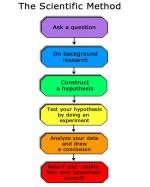
The experimenter begins with a hypothesis that may spring from past experience or a new idea. It is important to state the hypothesis very precisely, to keep the experiment from being sidetracked by other observations. The experiment's purpose must also be clearly defined. At this point, the researcher is designing the experiment to answer an underlying question and to test the hypothesis. The experimenter will outline the methods and materials he expects to use. After these basics have been addressed, side issues may be explored. The written hypothesis guides the experimenter during the experiment, the interpretation, and any generalizations that might result.
The researcher must choose appropriate methods for obtaining observations and measurements. Does the research design allow for all possible variables? Are the observations and measurements truly representative? Is there a lack of randomness in the design that could lead to accusations of research bias? Before the experiment starts, the researcher must take another look at the methods that will be used to analyze data. How will the record keeping be performed? Experiments that appear to be routine might lend themselves to shortcuts or to reliance on memory rather than on written notes.
After the experiment is carried out and the researcher begins to analyze data, the most difficult step interpretation begins. Correct interpretation accomplishes much more than deciding whether the findings confirm or refute the hypothesis. The experimenter has to be able to read experimental data correctly, then place the data in some sort of order. There is a temptation to discard findings that don't fit, but the correct approach is to re-examine the experiment to seek reasons for data that are out of line.
As part of interpreting the data, the researcher must be on guard for four types of variation. Usually the researcher will lack precise control over the variables. There may be variables that are unknown to the experimenter. Perhaps the samples used in the experiment are not representative. These first three forms of variation can be used to determine whether a difference between two samples of data is significant or not. There is also a kind of variation between types of data that can only be seen as the experiment is carried out. In the interpretation, the researcher must also guard against the problem of comparing data when it is not legitimate to do so. For example, data might be organized by the day specimens arrive in the laboratory, but that might actually be irrelevant to the purpose of the experiment. The experimenter must also watch for coincidental relationships between variables and avoid false conclusions of cause and effect. The next step is to compare the actual data with what was expected.
The researcher will present the results in as close to their original form as possible. Summarizing graphs can be used if they help the reader and do not distort the data. The researcher will also evaluate the validity of the hypothesis. The conclusion should help to place the experiment into the body of previous work and should identify areas where further experimentation would bring about greater understanding.
This is the complete article, containing 944 words
(approx. 3 pages at 300 words per page).