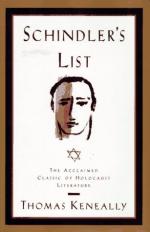
The highly anticipated film Schindler's List, directed by Steven Spielberg and based on a 1982 historical novel entitled Schindler's Ark by Australian writer Thomas Keneally, premiered in December of 1993. In a year that had also seen the opening of the Holocaust Museum in Washington, D.C., the film quickly became a cultural event. The public and many critics praised the harrowing but inspirational tale of individual decency in response to the horrors of genocide. The $23 million film was also a box-office success, eventually earning more than $300 million worldwide, in spite of its black-and-white photography and three-hour-plus running time—normally considered audience deterrents. Given the epic film's high public profile and cross-cultural praise, it was not surprising that Schindler's List would go on to garner seven Academy Awards in 1994, winning for best picture and giving Spielberg his first-ever best director honors from the Academy. It should be noted that a great many academic critics are troubled by certain aspects of Spielberg's treatment of such sensitive subject matter, particularly in regard to the film's sentimentalized conclusion, the portrayal of Jews as passive victims, and the perhaps-inevitable trivializing of the Holocaust through traditional Hollywood narrative technique. However, even with the shortcomings, the film was generally acknowledged to be Spielberg's most mature, visually striking, and well-crafted work to date. Not even Saving Private Ryan, another Spielberg-directed World War II epic that opened to another round of general praise during the summer of 1998, has come close to capturing the cultural impact of Schindler's List.
Ralph Fiennes, walking by a line of women prisoners, in a scene from the film Schindler's List.
The film and novel differ in dramatic emphasis and characterization but are both reasonably faithful to the details of the real-life story of a Catholic-German entrepreneur named Oskar Schindler, who saved more than one thousand Polish Jews from the Nazi death camps during World War II. As detailed in the novel, Schindler was born in 1908 in the Sudetenland, in an area that would later become Czechoslovakia. As he grew to manhood, Schindler quickly developed a reputation as a carouser and playboy—a reputation founded in reckless actions that even his early marriage in 1927 to a devoutly religious woman named Emilie did not stop. His parents were prosperous in their hometown of Zwittau until the family business, a farm implement factory, went bankrupt in 1935. At this point, the elder Schindler left his wife, and Oskar was forced to seek his living elsewhere. As a salesman and a member of both the Nazi Party and German military intelligence, Oskar traveled alone to Krakow after the German military occupation of Poland in 1939. (This is the point at which Spielberg's adaptation of the novel begins.) In Krakow, Schindler bought an enamel factory that he then staffed with Jewish workers.
Shortly thereafter, the Germans forced the Jews of Krakow to move to a ghetto within the city and also built a forced labor camp named Plaszow outside the city. The extermination camp of Auschwitz began receiving Plaszow inmates during 1942. Throughout the escalating levels of Nazi persecution and brutality directed against Jews, Schindler was able to keep his well-treated Jewish workforce more or less intact, even after the Krakow ghetto was closed in 1943 and all Jews were forced into Plaszow, commanded by a ruthless man named Amon Goeth. Goeth and Schindler formed an unusual relationship: each exploiting the other for personal advantage but nevertheless reluctantly sharing some similarities of taste and lifestyle. (Spielberg emphasizes their duality of character throughout the middle portion of the film.)
Schindler's employees were able to work in his factory by day until 1944, when orders came to send all of Plaszow's Jews to Auschwitz. Through his close contacts with Goeth and others in the German military hierarchy, Schindler somehow managed to receive permission to relocate one thousand Jewish workers to another camp in the relative safety of Czechoslovakia. In one of the most amazing episodes of the Schindler legend, he even retrieved a group of his female employees from Auschwitz, where their train had been mistakenly diverted. At the Czechoslovakian camp, Schindler provided a haven for another two hundred or so escaped Jewish refugees. With the European war's end in May of 1945, the "Nazi war profiteer" Schindler and his wife were forced to flee the camp ahead of its Russian liberators.
After the war, Schindler moved from Austria to Argentina to West Germany, eventually leaving Emilie. He proved consistently unable to make any kind of living and in the end had to rely for daily survival on the financial largesse of the Jews he had so protected during the war. He also visited Israel yearly, all expenses paid by Jewish organizations and individuals. The Holocaust memorial in Jerusalem, Yad Vashem, recognized Schindler as a Righteous Gentile in 1962. He died, perhaps predictably given his lifestyle, of liver failure in 1974 and was buried in a Catholic cemetery in Jerusalem.
The story of Oskar Schindler remained in relative obscurity until the early 1980s, when author Thomas Keneally published Schindler's Ark. The historical novel had its origins in a 1980 visit by Keneally to a luggage store in Los Angeles, where Keneally met the storeowner—a Jew who had been rescued by Schindler. Intrigued by the owner's dramatic tale of the long-ago events, Keneally interviewed dozens of the Schindlerjuden (Schindler Jews) in several different countries and researched the relevant documents in Israel and Poland. After Keneally's book was published as Schindler's List in America, Universal Studios acquired it for development. Director Steven Spielberg, about to achieve yet another spectacular box-office success with E.T.: The Extraterrestrial, read the book and was determined that he, too, when he felt he was a mature-enough filmmaker, would someday tell the story of Oskar Schindler.
Ten years passed, during which Spielberg alternated between taking on the project and passing it to others. Finally, in 1992, Spielberg believed the time was personally and historically right to begin active production on the film. He made several important and risky artistic decisions: to use black-and-white film, to shoot on location in Europe, to rely heavily on handheld cameras, to select European extras, and to cast nonstars in the key roles (Liam Neeson as Schindler, Ben Kingsley as Schindler's Jewish accountant Stern, and Ralph Fiennes as Amon Goeth). In spite of Spielberg's determination to use authentic locations, some were unavailable: Spielberg had to painstakingly reconstruct the Plaszow camp; and when his request to film inside Auschwitz was denied by the World Jewish Congress, he and production designer Allan Starski built a chillingly convincing replica directly outside the grounds. After principal photography was finished, Michael Kahn edited the film to its three-and-a-half-hour running length, and longtime Spielberg collaborator John Williams composed the musical score.
The final result, released to theaters at the end of 1993, was generally well received and capped one of Spielberg's most personally and financially successful years ever. (Earlier that summer, his film Jurassic Park had earned nearly $360 million domestically.) Many critics reevaluated their previous dismissal of Spielberg as a skilled but trivial filmmaker. But more significantly for history, with the profits from Schindler's List, Spielberg established two organizations: The Righteous Persons Foundation, dedicated to memorializing Gentile rescuers of Jews during World War II, and the Shoah Visual History Foundation, set up to record the first-hand accounts of Holocaust survivors before the passage of time silences their voices.
Further Reading:
Loshitzky, Yosefa, ed. Spielberg's Holocaust: Critical Perspectives on Schindler's List. Bloomington, Indiana University Press, 1997.
Palowski, Franciszek. The Making of Schindler's List: Behind the Scenes of an Epic Film. Secaucus, New Jersey, Carol Publishing Group, 1998.
Perry, George. Steven Spielberg Close Up: The Making of His Movies. New York, Thunder's Mouth Press, 1998.
This is the complete article, containing 1,277 words
(approx. 4 pages at 300 words per page).