
Forgot your password?  

Not What You Meant?  There are 10 definitions for Rosalind.

Rosalind Elsie Franklin | Research & Encyclopedia Articles

Print-Friendly   Order the PDF version   Order the RTF version
About 2 pages (591 words)
Rosalind Franklin Summary


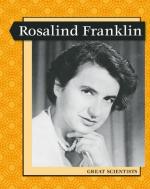
Rosalind Elsie Franklin

1920-1958

English Physical Chemist and Molecular Biologist

Rosalind Franklin made important studies of the physical chemistry of coal and played a significant role in the determination of the structure of deoxyribonucleic acid, a role which wasnot adequately acknowledged until a number of years after her death.

Franklin was born in London. She completed her undergraduate studies in physical chemistry at Newnham College of Cambridge University in 1941 and, in 1942, began work in the laboratories of the British Coal Utilization Research Association. The structural studies of coal and coke that she carried out there produced significant results that found important applications in industrial processes. In 1945, she returned to Cambridge to receive her Ph.D.

In 1947, she left England to accept a position at the Laboratoire Centrale des Services Chimiques de l'Etat in Paris. During her continued studies of the structure of carbon in France, she began to learn and apply x-ray crystallographic methods to crystal structure determination.

When she returned to England in 1951, she undertook the study of the structure of crystalline deoxyribonucleic acid (DNA) as a research fellow in biophysics at King's College in London. DNA is among the most important molecules of nature. It is found in the nuclei of virtually all cells and functions in the synthesis of proteins as well as containing the genetic material that functions as the carrier of the information of heredity.

Franklin applied the x-ray crystallographic methods that she had learned in Paris to the DNA structure problem and invented new techniques for the application of x-ray crystallography that could be applied specifically to this type of study. She determined that the phosphate sugar groups are located on the outer part of DNA and was continuing her analysis of x-ray photographs of DNA crystals in her attempt to learn more about its structure.

Her co-worker on this project at King's College was Maurice Wilkins (1916- ). Unfortunately, they did not work well together. In the midst of her studies, Wilkins showed her data, without her knowledge, to James D. Watson (1928- ) and Francis H.C. Crick (1916- ) who were working on the DNA structure problem at Cambridge. Watson and Crick were able to use Franklin's data to support their conclusion that the DNA molecule is shaped like a double helix. They published their proposal in the scientific journal Nature in January 1953.

In 1953, Franklin moved to the laboratory of crystallographer J.D. Bernal at Birkbeck College in London where her subsequent studies of DNA provided additional support for the double helix model for the structure of DNA. She also undertook the determination of the structure of plant viruses, including tobacco mosaic virus. She demonstrated a single-stranded helical structure for the ribonucleic acid in this virus. She was studying the structure of live polio virus when she died of cancer at the age of 37 in 1958. This study was regarded as so dangerous that it was discontinued after her death.

In 1962, Watson, Crick, and Wilkins shared the Nobel Prize for the determination of the structure of DNA. The Nobel is only given to living individuals, and Franklin, therefore, would have been ineligible to share the Prize. Her significant contributions, however, were largely ignored at the time. The importance of Rosalind Franklin's role has since been brought to light and widely accepted, largely as the result of the efforts of individuals such as Anne Colquhoun Sayer, who published Rosalind Franklin and DNA in 1975. Franklin's case has become an important example in the study of sexism in science, the ethics of science, and the sociology of science.

This is the complete article, containing 591 words (approx. 2 pages at 300 words per page).

More Information
  • View Rosalind Elsie Franklin Study Pack
  • 10 Alternative Definitions
  • Search Results for "Rosalind Elsie Franklin"
  • More Products on This Subject
    Rosalind Elsie Franklin
    The British physical chemist and molecular biologist Rosalind Elsie Franklin (1920-1958) made her m... more

    Rosalind Elsie Franklin
    Deoxyribonucleic acid (DNA) carries the genetic instructions for life. Johann Miescher (1844-1895),... more


    Ask any question on Rosalind Franklin and get it answered FAST!
    Answer questions in BookRags Q&A and earn points toward
    discounted or even FREE Study Guides and other BookRags products!
    Learn more about BookRags Q&A
    Copyrights
    Rosalind Elsie Franklin from Science and Its Times. ©2005-2006 Thomson Gale, a part of the Thomson Corporation. All rights reserved.

    Join BookRagslearn moreJoin BookRags

    Join BookRagslearn moreJoin BookRags

