BookRags.com Literature Guides Literature Guides Criticism/Essays Criticism/Essays Biographies Biographies My Bibliography Periodic Table U.S. Presidents Shakespeare Sonnet Shake-Up
Research Anything:        
History | Encyclopedias | Films | News | Create a Bibliography | More... Login | Register | Help
Not What You Meant?  There are 24 definitions for ER.


Roosevelt, Eleanor

Print-Friendly  Order the PDF version  Order the RTF version
About 2 pages (644 words)
Eleanor Roosevelt Summary

Bookmark and Share

Roosevelt, Eleanor

FORMER FIRST LADY OF THE UNITED STATES
1884–1962

Anna Eleanor Roosevelt (or ER as she came to be known) was one of the most admired, respected, and controversial figures of the twentieth century. Although born to a family of privilege on October 11, 1884, she was deeply concerned with the plight of the disadvantaged. ER married Franklin D. Roosevelt (FDR) (1882–1945), her fifth cousin once removed, on March 17, 1905. ER was a good mate for FDR; she encouraged him to enter public life and served as an important political asset throughout his life. ER was a strong politician with keen negotiating skills who remained optimistic despite harsh criticism from her enemies. Years before she became the longest-serving first lady, ER was a Democratic Party activist, political campaigner, teacher, writer, journalist, editor, mother, and faithful wife who nursed her husband back to health when he was stricken with polio.

One of ER's enduring legacies was the manner in which she transformed the role of the First Lady in American politics. She traveled throughout the nation, serving as her physically handicapped husband's "eyes and ears," observing firsthand the concerns and living conditions of millions. In touring coal mines, tenements, schools, hospitals, and war zones, ER understood the urgent need for many of FDR's programs; she provided him with intimate knowledge of the plight of common Americans. She advocated powerfully for the disadvantaged, pushed for a minimum wage, called for an end to racial discrimination, promoted women's rights, and fought to abolish child labor. In 1936 she began writing a syndicated column, "My Day," that became one of the most popular newspaper columns in the country. As First Lady ER regularly held scheduled press conferences to which only women journalists were invited, forcing some major presses to hire women reporters to avoid missing out on important news.

After FDR's death in 1945, ER considered entering private life but decided to continue her work. Later in that year President Harry S Truman (1884–1972) appointed her to the first U.S. delegation for the newly created United Nations (UN), where she was soon regarded as the hardest-working delegate. In this role her most important work ensued: She was unanimously elected chair of the United Nations Commission on Human Rights, which was charged with drafting the Universal Declaration of Human Rights. The Declaration was adopted on December 10, 1948, largely through ER's efforts.. Her hard work and political skills coupled with her humanitarian ideals helped create a document that has endured as an accepted standard of basic individual rights for nations around the world. ER's uncompromising belief in the value of all human beings and her commonsense approach to life are reflected in the straightforward language of this important document.

In 1961 ER chaired President John F. Kennedy's (1917–1963) Commission on the Status of Women, which partly fueled the modern women's rights

ELEANOR ROOSEVELT AT THE UNITED NATIONS IN GENEVA. Eleanor Roosevelt met with delegates at the United Nations Commission on Human Rights in Geneva starting in 1946. She chaired the commission and considered the adoption of the Universal DeclaraELEANOR ROOSEVELT AT THE UNITED NATIONS IN GENEVA. Eleanor Roosevelt met with delegates at the United Nations Commission on Human Rights in Geneva starting in 1946. She chaired the commission and considered the adoption of the Universal Declaration of Human Rights in 1948 her greatest achievement. (SOURCE: © BETTMANN/CORBIS. REPRODUCED BY PERMISSION.)

movement. She died on November 7, 1962, never wavering in her convictions. A woman ahead of her time, ER was an activist with a lifelong commitment to social justice and the promotion of human rights. Her sincerity and conviction touched people everywhere; she is remembered for her passionate efforts to promote peace and human dignity for all.

United Nations Commission on Human Rights; Universal Declaration of Human Rights.

Bibliography

Emblidge, David. Eleanor Roosevelt's My Day, ed. Rochelle Chadakoff. New York: Pharos Books, 1989–1991.

Gerber, Robin. Leadership the Eleanor Roosevelt Way: Timeless Strategies from the First Lady of Courage. Paramus, NJ: Prentice Hall, 2003.

Wotkyns, Eleanor R. With Love, Aunt Eleanor: Stories from My Life with the First Lady of the World. Petaluma, CA: Scrapbook Press, 2004.

This is the complete article, containing 644 words (approx. 2 pages at 300 words per page).

More Information
  • View Roosevelt, Eleanor Study Pack
  • 24 Alternative Definitions
  • Search Results for "Roosevelt, Eleanor"
  • Add This to Your Bibliography
  • More Products on This Subject
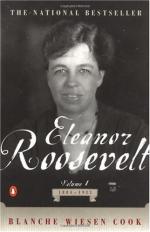
    Eleanor Roosevelt
    Anna Eleanor Roosevelt (1884-1962), wife of the thirty-second president of the United States, was a... more

    Eleanor Roosevelt- a First Lady Like No Other
    Before Eleanor Roosevelt, in the United States, the role of First Lady had always been more of a fo... more


    Copyrights
    Roosevelt, Eleanor from Governments of the World. Copyright © 2001-2006 by Macmillan Reference USA, an imprint of the Gale Group. All rights reserved.

    Join BookRagslearn moreJoin BookRags


    About BookRags | Customer Service | Report an Error | Terms of Use | Privacy Policy