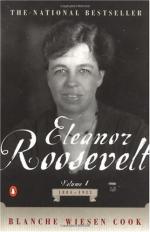
Roosevelt, Eleanor
(b. October 11, 1884; d. November 7, 1962) First Lady from 1933 to 1945, during the administration of Franklin Delano Roosevelt; one of the most important public figures of the twentieth century.
Anna Eleanor Roosevelt was a First Lady, social reformer, diplomat, and one of the most important public figures of the twentieth century. Throughout her political life she was a powerful advocate for human rights, international peace, and race and gender equality. She devoted herself to the underprivileged, disenfranchised, and downtrodden of the nation and the world.
Eleanor Roosevelt was born in New York City to a wealthy and politically active family. At the age of ten, following the death of her parents, Eleanor Roosevelt went to live with her grandparents and later attended boarding school in England. It was after she finished school that she first became active in the social reform movement, where she worked to better the working and living conditions of the urban poor, and performed settlement house work. In 1905 she married Franklin Delano Roosevelt, her fifth cousin once removed and the future four-term president of the United States. During the United States' participation in World War I, Eleanor Roosevelt coordinated activities at a Red Cross canteen in Washington, D.C., worked with wounded soldiers recovering in area hospitals, spoke at patriotic rallies, and performed other duties at home to aid the war effort abroad.
In the years leading up to World War II, Eleanor Roosevelt became more active in the social reform movement on an increasingly large scale. During the period between the World Wars she reversed her opposition to women's suffrage and became active in the League of Women Voters, the Women's International League for Peace and Freedom, and other political groups. After Franklin was elected president, Eleanor became the first politically active first lady in the history of American democracy. She stepped outside the role of the "politician's wife" and created her own distinct political identity. Eleanor Roosevelt effectively lobbied to enhance the role women played at all levels of American government. She worked with her husband and congress to ensure that women were not neglected in the New Deal programs of the 1930s. She tried to use her influence to focus public attention on injustice and racial inequality, publicly resigning from the Daughters of the American Revolution to protest racism in the organization in 1939. She also presented her social and political views through radio programs, lectures, political writings, and her nationally syndicated daily newspaper column "My Day."
Prior to the outbreak of World War II, Eleanor Roosevelt publicly supported the use of international economic pressure, rather than arms, to fight fascism overseas. She changed her mind in the years immediately preceding U.S. entry into the war, however, as she gradually developed a belief that Adolf Hitler and other Fascist leaders could not be stopped without the use of military force. During the war itself, Eleanor Roosevelt continued to champion the rights of oppressed citizens. She worked toward justice and equality for African Americans, consistently objecting to the hypocrisy of American political discourse that criticized Nazi racism abroad while condoning racism towards African Americans at home. She also attempted to work with the U.S. State Department, both during and after the war, to find a safe haven for Jewish refugees who managed to flee persecution in Europe. Eleanor Roosevelt was an outspoken opponent of Japanese interment, and an outspoken supporter of conscientious objectors who opposed compulsory armed service.
Eleanor Roosevelt (center left) talking to patients at a field hospital in Guadalcanal, Solomon Islands, on September 25, 1943. AP/WIDE WORLD PHOTOS
At the onset of American participation in World War II, Eleanor Roosevelt served as codirector of the Office of Civilian Defense during the early stages of its development. In that capacity she was responsible for administering an agency that provided American citizens with protection in the event of enemy attack, until her resignation amid controversy over her physical fitness program in 1942. She influenced women to support the war effort by encouraging them to enlist, support the activities of the Red Cross, and work in war related industries. She carried on an active correspondence with soldiers in the field and with their family members who remained at home, as well as visiting troops in the European and Pacific theaters.
Following her husband's death and the end of the war, Eleanor Roosevelt emerged as a powerful figure inside the Democratic Party. She eschewed offers to run for elected office in order to continue her political activities independently. She gained an avid interest in veterans' issues, and publicly supported such measures as the GI Bill and full employment legislation that was designed to provide soldiers with jobs once they returned to civilian life. In 1946 President Harry Truman appointed her to the United States delegation to the United Nations, where she navigated the troubled waters of Cold War international diplomacy, lead the committee that drafted the International Declaration of Human Rights, championed democracy abroad, and tirelessly worked to maintain international peace.
Holocaust, American Response To; New Deal; Red Cross, American; Roosevelt, Franklin Delano.
Bibliography
Black, Allida M. Casting Her Own Shadow: Eleanor Roosevelt and the Shaping of Postwar Liberalism. New York: Columbia University Press, 1996.
Black, Allida M. Courage in a Dangerous World: The Political Writings of Eleanor Roosevelt. New York: Columbia University Press, 1999.
Hoff-Wilson, Joan, and Lightman, Majorie. Without Precedent: The Life and Career of Eleanor Roosevelt. Bloomington: Indiana University Press, 1984.
Lash, Joseph P. Eleanor and Franklin: The Story of their Relationship Based on Eleanor Roosevelt's Personal Papers. New York: W.W. Norton & Company, 1971.
Lash, Joseph P. Eleanor Roosevelt: The Years Alone. New York: W.W. Norton & Company, 1972.
Scharf, Lois. Eleanor Roosevelt: First Lady of American Liberalism. Boston: Twayne Publishers, 1987.
This is the complete article, containing 950 words
(approx. 3 pages at 300 words per page).