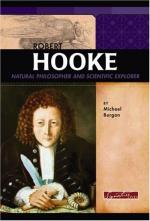
Robert Hooke
1635-1703
English Physicist
Robert Hooke was a scientist with broad interests and accomplishments. He is best known for his research on elastic solids and for the discovery of the law that governs their behavior.
Hooke was educated at Westminster and at Christ Church of Oxford University. While at Oxford, he met chemist Robert Boyle who hired Hooke to assist him in his research on the behavior of gases. In 1622, Hooke was made curator of experiments for the Royal Society of London and was elected a fellow of the Society the following year. In 1665, he was chosen to be professor of geometry at Gresham College in London, a position he held for thirty years. He also served as City Surveyor of London and was Christopher Wren's chief assistant in the effort to rebuild London after the Great Fire of 1666.
Title page from Robert Hooke's book Micrographia. (Bettmann/Corbis. Reproduced with permission.)
The expression Renaissance man is applied to a person who is able to gain more than a superficial knowledge of a wide range of intellectual areas. Robert Hooke could be used as the prototype of such a person. A man of great intellect and ability, he developed a curiosity regarding virtually all scientific fields and devoted his life to pursuing these interests. Among his early endeavors was the construction of a telescope, the first of its type, with which he made significant astronomical observations, especially concerning Jupiter and Mars, obtaining results that were useful later in establishing the properties of these planets. He also proposed that a numerical value for gravity could be ascertained by using a pendulum.
Elastic materials are defined as solids that will return to their original condition when an external force that has stretched them is removed. Hooke's experiments with elastic substances led to the discovery of a fundamental relationship known, in his honor, as Hooke's Law. This principle states that the amount that an elastic material will stretch when an external stress is placed upon it is proportional to the stress. He made a number of applications of this principle, including the improvement of the accuracy of watches using balance springs.
In 1865, he gained wide recognition as a result of the publication of his book Micrographia, an illustrated discussion of observations he made with a reflecting microscope he built himself. His commentary included biological specimens, and he coined the word cell to explain the microscopic structures he observed. Micrographia also presented the results of his microscopic studies of crystalline solids, including snowflakes. Based on his observations, he proposed that solids form different structures as a result of different packing arrangements of microscopic spherical particles. This led to more extensive studies of crystal structure, and consequently, he is regarded as the founder of the science of crystallography. He became one of the earliest supporters of the concept of extinction of species and of biological evolution as a result of his microscopic study of fossils.
Results of his eclectic interests included the invention of a telegraph system, the discovery of the diffraction of light, a proposal of a wave theory of light, and a theory of earthquakes. He was first to assert that matter expands when heated and first to propose that air is made up of microscopic particles located at relatively large distances from each other. He stated the inverse square law of planetary motion in 1678, without mathematical proof, and informed Isaac Newton (1642-1727). Newton was able to support the postulate mathematically and later used it as a fundamental principle in his theory of gravitational attraction, without giving any credit to Hooke. This led to a prolonged acrimonious controversy between the two over credit for the discovery.
This is the complete article, containing 608 words
(approx. 2 pages at 300 words per page).