BookRags.com Literature Guides Literature
Guides
Criticism & Essays Criticism &
Essays
Questions & Answers Questions &
Answers
Lesson Plans Lesson
Plans
My Bibliography Periodic Table U.S. Presidents Shakespeare Sonnet Shake-Up
Research Anything:        
History | Encyclopedias | Films | News | Create a Bibliography | More... Login | Register | Help


Robert Heinrich Hermann Koch

Print-Friendly  Order the PDF version  Order the RTF version
About 2 pages (670 words)
Robert Koch Summary

Bookmark and Share Know this topic well? Help others and get FREE products!

Robert Heinrich Hermann Koch

1843-1910

German Physician

Robert Koch was a key player in the field of bacteriology and, ultimately, hygiene and public health. His brilliant research uncovered the causes of anthrax, tuberculosis, and cholera, and led to the development of Koch's Postulates, a series of guidelines for the study of infectious diseases that are still used today.

Koch was born on December 11, 1843, in Clausthal, Germany, a mining town in the Harz Mountains. As a boy he loved natural scienceand collected rocks and plants and dreamed of being a great explorer. He studied at the University of Göttingen and, after interning in Hamburg, married and settled down to become a country doctor. Upon receiving a microscope for his 28th birthday, he began to study many things, including anthrax, a dreaded disease of warm-blooded animals, especially sheep. Isolating the organism from the blood, he grew the microbes in various media and discovered a stage where the anthrax bacilli have translucent coverings called spores. These spores could remain in the ground for years, then, when conditions were right, emerge into the rod-shaped organisms that cause the disease. Koch perfected the idea that these organisms could be cultured in pure form. In 1877 he published a work describing how thin smears of bacteria could be fixed on slides by gentle heat. His work was illustrated with excellent photomicrographs. He also invented the hanging drop, in which bacteria are suspended in a nutrient solution on a glass slide. Studying various wounds, Koch infected healthy animals with six different bacteria, demonstrating that a particular bacteria causes a specific disease.

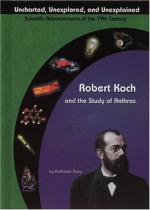
Robert Koch. (The Library of Congress. Reproduced by permission.)Robert Koch. (The Library of Congress. Reproduced by permission.)

Koch's scientific investigations earned him a position in Berlin in the German Health Office. He devised a new method of growing organisms on gelatin and then transferring pure colonies totest tubes of nutrient broth. Modifying the staining techniques developed by Paul Ehrlich (1854-1915), Koch worked to find the cause of tuberculosis. The bacillus that causes tuberculosis is very difficult to grow in pure culture, but Koch devised a technique of successive media and finally succeeded in growing them. On March 24, 1882, he announced to the Physiological Society of Berlin that he had isolated the bacillus that causes tuberculosis.

Koch devised a series of four basic principles, known as Koch's Postulates, by which a particular bacterium may be decisively linked to a specific disease. First, the bacterium in question must be present in every case of the infectious disease. Second, it must be possible to cultivate this bacterium in a pure culture. Third, a laboratory animal inoculated with the pure culture of the bacterium must develop the disease. Fourth, the bacterium must be recovered from the inoculated and infected test animal and reproduced again in a pure culture. If all of these criteria are met, it may be deduced that the suspect bacterium is indeed the cause of the disease.

When a serious cholera epidemic struck in 1883, Koch participated in a medical expedition to Egypt as a member of a German government commission. He soon isolated a small commashaped bacillus that he believed to be the cause. When the outbreak subsided he went to India, where cholera was endemic, and found the disease was transmitted by drinking water, food, and clothing.

Winning much acclaim and a large monetary prize, Koch returned to Germany to continue research as the director of the Institute of Hygiene. He concentrated again on tuberculosis and, in 1890, announced the discovery of tuberculin, which he hoped would be a cure. Tuberculin proved a failure as a cure for the disease, but is still used today as a diagnostic test for tuberculosis.

After his disappointment and embarrassment with tuberculin, Koch expanded his research into a variety of diseases, including leprosy, hinderpest, bubonic plague, surra, Texas fever, and malaria. He led expeditions in East and West Africa to study tropical diseases. In 1905 he received the Nobel Prize in medicine for his investigations and discoveries in relation to tuberculosis. He died on May 10, 1910, in Baden-Baden, Germany, of a heart attack.

This is the complete article, containing 670 words (approx. 2 pages at 300 words per page).

More Information
  • View Robert Heinrich Hermann Koch Study Pack
  • Search Results for "Robert Heinrich Hermann Koch"
  • Add This to Your Bibliography
  • More Products on This Subject
    Heinrich Hermann Robert Koch
    The German physician and bacteriologist Heinrich Hermann Robert Koch (1843-1910) devised many bacte... more

    Heinrich Hermann Robert Koch
    Koch was born on December 11, 1843. As one of thirteen children born to a mining engineer and his w... more


    Ask any question on Robert Koch and get it answered FAST!
    Answer questions in BookRags Q&A and earn points toward
    discounted or even FREE Study Guides and other BookRags products!
    Learn more about BookRags Q&A
    Copyrights
    Robert Heinrich Hermann Koch from Science and Its Times. ©2005-2006 Thomson Gale, a part of the Thomson Corporation. All rights reserved.

    Join BookRagslearn moreJoin BookRags


    About BookRags | Customer Service | Report an Error | Terms of Use | Privacy Policy