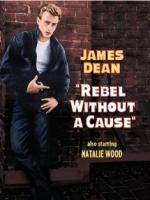
Rebel Without a Cause
Rebel without a Cause (1955) is Hollywood's best film about rebellious youth in the 1950s. Promoted as a story about why a kid from a "good" family would "tick … like a bomb," the film sympathetically presents an adolescent perspective on the rebelliousness of middle-class youth of the time. The film focuses on three frustrated teenagers who seek to form their own identities apart from the world and values of their parents and other adults from which they feel alienated. In his role as James Stark, James Dean presented the American archetype of the troubled and tormented teenager, and in so doing became a spokesman for frustrated youth.
The Jim Stark character is the insecure offspring of a domineering mother (Ann Doran) and henpecked father (James Backus), whoseeks to find a place where his inner gentleness and love can be safely expressed. The other two teenagers include John Crawford (Sal Mineo)—called "Plato"—whose divorced parents have abandoned him, and Judy (Natalie Wood), who cannot understand why her father (William Hopper) seems to have withdrawn his love now that she is a young lady. The three meet at a police station at the beginning of the film, where Plato is brought in for drowning puppies, Judy for being out after curfew, and Jim for being drunk.
James Dean (right) in a scene from the film Rebel without a Cause.
The juvenile offenders officer Ray Framek (Edward Platt) is the only sympathetic adult in the film, offering the teenagers a calm and considerate hearing. In contrast, both Judy and Jim's parents seem confused by the needs of their teenagers and misunderstand or avoid their children's desires for comfort and guidance. Plato is cared for by a powerless black nanny (Marietta Canty).
Director Nicholas Ray felt young people and their problems were an important subject matter and regularly made movies that sympathized with outsiders. Rebel was adopted from his 17-page "The Blind Run," a series of images of troubled teens that lacked any real story. Taking his idea to Warner Bros., Ray was asked to adapt a nonfiction book by Dr. Robert M. Lindner called Rebel without a Cause: The Story of a Criminal Psychopath into a script. Ray refused because he wanted to dramatize the problems of "normal" delinquents from "ordinary" families. The studio consented, and Ray's movie took Lindner's title but nothing else.
Leon Uris, Irving Shulman—the author of the first novel to deal with modern juvenile delinquency, The Amboy Dukes —and Stewart Stern all collaborated with Ray on the script. After Stern spent 10 days in juvenile court passing himself off as a welfare worker and talking to various kids, he created a despairing script which convinced the studio that a film could be made from the project. Rebel was a modern-day version of Peter Pan, with three kids inventing a world of their own, and expressing teen feelings about the nature of loneliness and love. The story also had a mythic feeling because the action was confined to a single day, recounting the happenings from dawn-to-dawn.
Ray had already selected Dean for the role of Jim Stark, and Dean had helped conceive many of the film's scenes. In playing Stark, Dean portrays the tensions of adolescence, bottling up his feelings to the point of explosion. Rebel captures the path Stark takes toward manhood, having him learn that he does not need violence to assert his power, that he can be brave, and that he can go against the pack and risk being unpopular as long as he is true to himself. Dean definedmasculinity in a different way for his time, allowing the audience to see the undercurrent of sweetness in a character who longs for a world where people drop their bravado and treat each other gently.
To cast the supporting juvenile roles, Ray held two weeks of mass improvisations at an amphitheater on the Warner's backlot, where 300 boys were asked to run to the top of the bleachers, play King of the Mountain and other games. Ray cast not according to who was the winner, but according to the attitudes he could see expressed by the players as they competed. Ray considered Jeff Silver, Billy Gray, and even Dennis Hopper for the role of Plato, but Mineo expressed such enthusiasm as well as a facility for improvisation for the role that Ray was won over.
For Judy, the studio wanted a star and considered borrowing Debbie Reynolds from MGM, while Ray wanted Carroll Baker, consigning Natalie Wood to playing Judy's scheming friend. Wood badly wanted the part, and after being in a car accident with Dennis Hopper, when the police asked her for her parents' phone number, she supplied them with Ray's instead. She later told the director, "Nick, they called me a goddam juvenile delinquent, now do I get the part?" She did, though Jack Warner initially complained about her delivery, resulting in Ray sending Wood to voice coach Nina Moise.
Censorship demands curtailed some of the violence in the film. There could not be any intention to kill, knives during the chase scene were to be replaced by bicycle chains which could not be whirled about, and there were to be no doubts about the innocent nature of cigarettes furtively palmed or Judy's chastity. Even so, when the movie opened in Great Britain, the British censor was so appalled at the chicken run, where teens watch as Buzz and Jim drive their cars over a cliff (originally over a crowded road, but changed to an empty seacoast at the studio's insistence), that he demanded six minutes of cuts and still gave the film an X rating.
Rebel without a Cause was released four days after Dean's reckless demise in a car accident. The film received three Academy Award nominations, to Ray for Best Original Story, to Mineo for Best Supporting Actor, and to Wood for Best Supporting Actress, but won none of them. It was Ray's only film to be so honored. James Dean, giving the finest performance of his career and one that would cement him forever in the public's imagination, was overlooked entirely, but the film unquestionably belongs to him and his portrayal of an anguished adolescent.
Further Reading:
Archer, Eugene. "Generations without a Cause." Film Culture. No. 7, 1956.
Eisenschitz, Bernard. Nicholas Ray: An American Journey. London, Faber & Faber, 1990.
Fox, Terry. "Nicholas Ray, with a Cause." Village Voice. 1979.
McVay, D. "Rebel without a Cause." Films and Filming. August 1977.
Ray, Nicholas. "Rebel—The Life Story of a Film." Daily Variety. October 31, 1951.
——. "Story into Script." Sight and Sound. Autumn 1956.
Steen, Mike. Hollywood Speaks. New York, G.P. Putnam's Son, 1974.
This is the complete article, containing 1,096 words
(approx. 4 pages at 300 words per page).