BookRags.com Literature Guides Literature Guides Criticism/Essays Criticism/Essays Biographies Biographies My Bibliography Periodic Table U.S. Presidents Shakespeare Sonnet Shake-Up
Research Anything:        
History | Encyclopedias | Films | News | Create a Bibliography | More... Login | Register | Help
Not What You Meant?  There are 5 definitions for Ronald Reagan.  Also try: Dutch or Reagan or Rawhide.

Search "Reagan, Ronald"

Contents Navigation
 

Reagan, Ronald

Print-Friendly  Order the PDF version  Order the RTF version
About 3 pages (977 words)
Ronald Reagan Summary

Bookmark and Share

Reagan, Ronald

(b. February 6, 1911; d. June 5, 2004) Fourtieth president of the United States (1981–1989).

Ronald Reagan took an unconventional route to the White House, as he spent almost three decades as a movie and television actor in Hollywood before entering electoral politics. A staunch anti-Communist, he helped bring about startling improvements in Soviet-American relations while president.

Reagan first became involved in politics through the Screen Actors Guild when he led efforts to protect the movie industry against alleged Communist subversion during the early years of the Cold War (1946–1991). Although he had been a New Deal Democrat, Reagan began to take more conservative positions on political issues, a shift that continued during the 1950s after he became a corporate spokesperson for the General Electric Company. By the early 1960s, Reagan had developed a set of views that guided his political career. He believed that the United States was an inspiration to freedom-loving people around the world, that international Communism was the greatest threat to U.S. security, and that high taxes and excessive federal regulations discouraged private investment and business innovation. Reagan formally switched his registration to the Republican Party in 1962 and campaigned for presidential candidate Barry Goldwater in 1964. Although Goldwater lost in a landslide to Lyndon Johnson, Reagan impressed influential conservatives with his ideological zeal and speech-making skills. Their backing encouraged him to run for governor of California, and he won overwhelming victories in 1966 and again in 1970.

As the Republican nominee for president in 1980, Reagan made national security a major campaign issue. He insisted that the Cold War strategy of détente had become under President Jimmy Carter a policy of onesided concessions that allowed the Soviet Union to gain superiority in both strategic and conventional armaments and to expand its global power. Reagan believed that to counter the Soviet bid for world domination America had to abandon its "Vietnam syndrome," a reluctance to use military force for fear of becoming mired in another costly and controversial war. Critical support for Reagan's victory over Carter came from so-called Reagan Democrats, voters who had previously supported Democratic presidential candidates but who were discontented with Carter's failure to control inflation and unemployment and distressed over declining national strength and prestige, symbolized by the Iran hostage crisis, in which fifty-two Americans spent 444 days in captivity in Tehran.

As president, Reagan slashed taxes and helped end the raging inflation. He secured record-high defense budgets

Ronald Reagan delivering his inaugural address on January 21, 1981. AP/WIDE WORLD PHOTOSRonald Reagan delivering his inaugural address on January 21, 1981. AP/WIDE WORLD PHOTOS

that contributed to high federal deficits. Reagan insisted that the big increases in military spending were essential to restore "our margin of safety in an increasingly hostile world." Reagan also stepped up pressure on the Soviets by expanding covert assistance, begun under Carter, to the mojahedin, Afghan resistance forces who successfully fought against the Soviet invasion that began in December 1979. He also authorized the Central Intelligence Agency to train and equip the Contras in Nicaragua, counter revolutionaries who opposed a government that Reagan believed was a Soviet-Cuban satellite. Efforts to evade congressional restrictions on this military assistance eventually led to the Iran-Contra scandal. Although generally reluctant to commit U.S. combat forces, Reagan authorized an intervention on the Caribbean island of Grenada in October 1983 that overthrew a revolutionary government allegedly headed by totalitarian Marxists. The military success in Grenada took place two days after the deaths of 241 U.S. Marine peacekeeping troops in Lebanon, victims in their barracks of a terrorist bombing.

Reagan's greatest success was in helping to end the Cold War. U.S.-Soviet relations at first worsened after Reagan came to the White House. The president bluntly condemned the Soviet Union, calling it an "evil empire" in a speech to the National Association of Evangelicals, an organization that was part of the religious Right, which strongly supported Reagan. Some Soviet officials feared that Reagan might launch a preventive war, especially after his announcement in March 1983 of a strategic defense initiative (SDI). This plan, popularly known as Star Wars, would use new technologies to build a shield against nuclear attack. However, at the same time Reagan quietly sought to improve Soviet-American relations, accelerating these efforts after Mikhail Gorbachev came to power in March 1985. The two developed a strong personal relationship, and they signed an Intermediate Nuclear Forces treaty in 1987 requiring both sides to destroy an entire category of nuclear missiles. When he visited Moscow in May 1988, Reagan told reporters that the "evil empire" was part of "another time, another era." In a speech in Berlin in June 1987, Reagan had demanded, "Mr. Gorbachev, tear down this wall." Two years later, in November 1989, the Berlin Wall, which separated East from West Berlin and which was the most visible symbol of the Cold War, came down.

Historians still debate how much Reagan's defense buildup contributed to the eventual collapse of the Soviet Union in 1991. Yet there is little doubt that Reagan's willingness to engage Gorbachev was a critical step toward ending the Cold War.

Communism and Anticommunism; Containment and Détente; Popular Culture and Cold War; Star Wars; Triumphalism.

Bibliography

Brownlee, W. Elliot, and Graham, Hugh Davis, eds. The Reagan Presidency: Pragmatic Conservatism and Its Legacies. Lawrence: University Press of Kansas, 2003.

Cannon, Lou. President Reagan: The Role of a Lifetime. New York: Public Affairs, 2000.

Fischer, Beth A. The Reagan Reversal: Foreign Policy and the End of the Cold War. Columbia: University of Missouri Press, 1997.

Gaddis, John Lewis. "The Unexpected Ronald Reagan." In The United States and the End of the Cold War: Implications, Reconsiderations, Provocations, by John Lewis Gaddis. New York: Oxford University Press, 1992.

Schweizer, Peter. Reagan's War: The Epic Story of His Forty-Year Struggle and Final Triumph over Communism. New York: Doubleday, 2002.

Skinner, Kiron K.; Anderson, Annelise; and Anderson, Martin, eds. Reagan, in His Own Hand: The Writings of Ronald Reagan that Reveal His Revolutionary Vision for America. New York: Touchstone, 2001.

This is the complete article, containing 977 words (approx. 3 pages at 300 words per page).

More Information
  • View Reagan, Ronald Study Pack
  • 5 Alternative Definitions
  • Search Results for "Reagan, Ronald"
  • Add This to Your Bibliography
  • More Products on This Subject
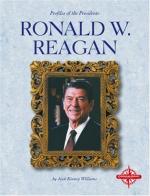
    Ronald W. Reagan
    Beginning as a radio sports announcer, Ronald W. Reagan (born 1911) enjoyed success as a motion pic... more

    Ronald Reagan
    Ronald Reagan was one of the most influential presidents in American history; yet he is one of the l... more


    Copyrights
    Reagan, Ronald from Americans at War. Copyright © 2001-2006 by Macmillan Reference USA, an imprint of the Gale Group. All rights reserved.

    Join BookRagslearn moreJoin BookRags


    About BookRags | Customer Service | Report an Error | Terms of Use | Privacy Policy