Forgot your password?  


Popular Sovereignty | Research & Encyclopedia Articles

Print-Friendly   Order the PDF version   Order the RTF version
About 2 pages (574 words)
Popular sovereignty Summary


Popular Sovereignty

The concept of popular sovereignty is grounded in three terms: popular, which refers to behavior or sentiments associated with the common people or with all of the people, as in popular culture and popular opinion; sovereign, which refers to a person or group invested with the highest authority and exercising supreme power, as with a sovereign monarch or government; and sovereignty, which refers to the condition or quality of being sovereign, as with the sovereignty of states in the international community.

The idea of popular sovereignty took root in the West with the onrush of modernism. This was especially evident in the sphere of governance and politics. By the end of the sixteenth century, new states, mostly in Europe, were being carved out of old empires—a process that spread across the world and continued to almost the end of the twentieth century. Early on, a distinctive vocabulary was devised to explain and legitimize this historic development, beginning, in 1576, with the French thinker Jean Bodin (1530–1596) introducing the legal concept of state sovereignty.

In a generic sense the concept of sovereignty speaks to the right of the government in a state to make and enforce rules within a defined territory containing a permanent population, without external interference. A state that is free and independent from others, and commands obedience from its citizens or subjects, is regarded as sovereign, or invested with sovereignty.

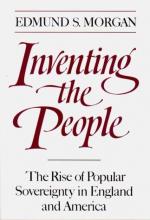
For Bodin, sovereignty was lodged in a ruler, the monarch, who, unrestrained by law, had unqualified power over the people inhabiting a defined territory. Subsequently, political theorists such as Thomas Hobbes, John Locke, and Jean-Jacques Rousseau instead associated the concept of sovereignty with either the government or the people themselves. This was the basis for popular sovereignty, a doctrine in law and political theory holding that government is created by and subject to the will of the people.

In the modern parlance of governance and politics, popular sovereignty has been displaced by another concept, democracy, meaning, literally, the "rule of the people." In its modern incarnation, popular sovereignty is integral to institutional arrangements for arriving at political decisions intended to serve the common good by making the people decide issues by electing individuals who then carry out the popular will.

ENGRAVING OF FRENCH PHILOSOPHER JEAN BODIN. In 1576 Bodins book, Six Livres de la Rpublique (Six Books of the Republic), asserted that an orderly state was one in which national leaders possess total authority, allowing for consideration of socENGRAVING OF FRENCH PHILOSOPHER JEAN BODIN. In 1576 Bodin's book, Six Livres de la République (Six Books of the Republic), asserted that an orderly state was one in which national leaders possess total authority, allowing for consideration of social customs and natural law. While his theory encountered much opposition at the time, it represented the basis for popular sovereignty. (SOURCE: ART RESOURCE)

Modern authoritarianism often seeks to cloak tyranny and repression with the vocabulary of popular sovereignty. For example, in the aftermath of World War II (post-1945) the Soviet Union imposed "people's democracies" throughout Central and Eastern Europe, mocking the key attributes of modern democracy: governance in accordance with the rule of law; citizens having the right of free expression of opinion on matters of policy; and respect for a broad range of human rights. In the early twenty-first century a similar disposition can be found in numerous authoritarian societies, among them the Islamic Republic of Iran and the Democratic People's Republic of Korea (North Korea).

Democracy; Representation; Republic.

Bibliography

Commager, Henry Steele, ed. Documents of American History. New York: F.S. Crofts & Company, 1943.

MacIver, R. M. The Web of Government. New York: Macmillan, 1947.

UN General Assembly. Universal Declaration of Human Rights. Resolution 217A. New York: United Nations, 1948.

This is the complete article, containing 574 words (approx. 2 pages at 300 words per page).

Ask any question on Popular sovereignty and get it answered FAST!
Answer questions in BookRags Q&A and earn points toward
discounted or even FREE Study Guides and other BookRags products!
Learn more about BookRags Q&A
Copyrights
Popular Sovereignty from Governments of the World. Copyright © 2001-2006 by Macmillan Reference USA, an imprint of the Gale Group. All rights reserved.

Join BookRagslearn moreJoin BookRags

Join BookRagslearn moreJoin BookRags