Photosynthesis
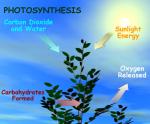
The process by which plants convert carbon dioxide and water into food via sunlight is called photosynthesis, which comes from the Latin words for "formation in light." All our food comes from this process, either directly or indirectly. We eat green plants and their grains and fruits as well as the animals that feed on such plants.
It took scientists hundreds of years to understand what happens during photosynthesis. In this process, sunlight stimulates the chlorophyll found in structures in green plants called chloroplasts. In the chloroplasts, the sunlight reacts with carbon dioxide that the plant breathes in through microscopic holes in its leaves called stomata and with water that it absorbs through its roots. During a series of light and dark reactions, the water molecules are broken down into hydrogen and oxygen, and the hydrogen combines with carbon dioxide to produce glucose, a simple sugar that is used as a building block for starch and other complex carbohydrates. The excess oxygen is later released into the atmosphere during the processes of respiration and transpiration, and, in this manner, photosynthesis is responsible for the renewal of the Earth's oxygen supply.
Research on photosynthesis has been closely linked to knowledge of the growth cycles and physical structure of plants. In the 1640s, the work of both Johannes (Jan) Baptista van Helmont and English clergyman and physiologist Stephen Hales indicated that plants require air and water to grow. In the 1700s, chemists began to identify the individual gases involved in the processes of combustion, respiration, and photosynthesis. Joseph Priestley demonstrated that green plants can replenish stale, or oxygen-poor, air so that it is capable of supporting combustion and respiration.
Dutch doctor and plant physiologist Jan Ingenhousz, inspired by Priestley's research, later learned that only the green parts of plants can revitalize stale air--that is, take in carbon dioxide and release oxygen--and that they do so only in the presence of sunlight. This was the first indication of light's role in the photosynthetic process. Ingenhousz also discovered that only the light of the Sun--and not the heat it generates--is necessary for photosynthesis.
In the nineteenth century, research on photosynthesis centered on the chemical processes in which carbon is "fixed" in carbohydrates. In the late 1800s, German botanist Julius von Sachs (1832-1897) suggested that starch is a product of carbon dioxide. He also argued in 1865 that, in the presence of light, chlorophyll catalyzes photosynthetic reactions, and he discovered the chlorophyll-containing chloroplasts. In the 1880s, German physiologist Theodor Wilhelm Engelmann (1843-1909) showed that the light reactions, which capture solar energy and convert it into chemical energy, occur within the chloroplasts and respond only to the red and blue hues of natural light.
It was not until the twentieth century that scientists began to understand the complex biochemistry of photosynthesis. Richard Willstätter recognized that there were two major types of chlorophyll in land plants: blue-green, or "a" type, and yellow-green, or "b" type. Martin David Kamen (1913-), a Canadian-born American biochemist, used the isotope oxygen-18 to trace the chemical's role in the process. He confirmed that the oxygen created during photosynthesis comes only from the water molecules. German biochemist Otto Warburg found that, under suitable conditions, the efficiency of the photosynthetic process can approach 100 percent, meaning that nearly all of the Sun's energy is converted to chemical energy.
In 1940, the discovery of carbon-14, a radioactive isotope of carbon isolated by Kamen, allowed for more detailed studies of photosynthesis. Using carbon-14, Melvin Calvin was able to trace carbon's path through the entire photosynthetic process. During the 1950s and 1960s, he confirmed that the light reactions involving chlorophyll instantly capture the Sun's energy. Then he studied the subsequent dark reactions, so-called because they can take place without sunlight, finding that carbohydrate molecules begin to form at this stage of the process. Working with green algal cells, Calvin interrupted the photosynthetic process at different stages and plunged the cells into an alcohol solution. Then, using the laboratory technique called paper chromatography, he analyzed the cells and the chemicals that had been produced, identifying at least ten intermediate products that had been created within a few seconds. This series of reactions is now called the Calvin cycle.
In 1998, scientists at Arizona State University announced that they had created an artificial photosynthetic energy system. The cell-like machine used light to power the synthesis of adenosine triphosphate (ATP), a carrier of chemical energy in all organisms. The new technology could eventually lead to biological computers and new drugs.
This is the complete article, containing 743 words
(approx. 2 pages at 300 words per page).