
Forgot your password?  

Not What You Meant?  There are 32 definitions for Penn.

Penn, William | Research & Encyclopedia Articles

Print-Friendly   Order the PDF version   Order the RTF version
About 3 pages (784 words)
William Penn Summary


Penn, William

PENN, WILLIAM (1644–1718), Quaker religious leader and theologian, was a proponent of religious and political rights, and founder of Pennsylvania. Educated at Oxford, the French Protestant academy at Saumur, and, briefly, at Lincoln's Inn, Penn came under Dissenter influence and renounced a life of social prominence for Quakerism in 1667. Intent on transforming England into a more truly Christian society, he wrote many of his more than 140 books, pamphlets, and broadsides from 1668 to 1680, when he spent virtually all of his time working to organize, spread, and protect the Quaker movement, also known as the Society of Friends. Having found England resistant to change, he secured a charter for a colony he envisioned as both a haven for persecuted Friends and a model consensual society that would demonstrate to a skeptical world the fruitfulness and practicality of Quaker principles. Pennsylvania received most of his time and energy from 1680 to 1685, and Penn's duties as proprietor were his major concern the rest of his life. He remained active as a Quaker leader in England and played a central role in the successful attempt to demonstrate that Quakers were sufficiently orthodox to be acceptable under the terms for toleration established after the Glorious Revolution of 1688.

Although a source of controversy at times within the Quaker movement, Penn was at the center of the network of Quaker leaders and was probably the most effective mediator between Friends and the rest of the world. He was a close friend and collaborator of George Fox, the founder of the movement; his wife Margaret Askew Fell Fox; and Robert Barclay, the movement's major theologian. Penn traveled extensively as a preacher and organizer throughout England and in Ireland, Germany, and Holland and from 1672 was active in the London Morning Meeting, the Quakers' informal executive body. In favor of the disciplinary practices and organizational structure espoused by Fox, he was active in upholding the authority of the central leadership against the individualistic conception of authority favored by schismatics. Penn's unique contribution as a leader of Friends was his injection of a prophetic activism into the movement at a time when many first-generation leaders were settling into a more quietist, sectarian posture. He helped organize the Meeting for Sufferings in 1675 as a committee for the legal and political defense of indicted Quakers and led it into political activity in support of sympathetic candidates in parliamentary elections. His toleration treatises of the 1670s and 1680s had wide influence in the battle for religious liberty for all English Christians and effectively stated his views of mixed constitutional government and fundamental English rights.

Penn was one of the most prolific and theologically knowledgeable exponents of Quaker thought, and he distilled the visions and experiences of Fox and the "First Publishers of Truth" into the theological language of the times. His works include exhortatory letters, ethical treatises, refutations of schismatics, historical accounts of the movement, expositions of Quaker thought, and defenses against the attacks of Anglicans, Presbyterians, Independents, Baptists, and spiritualists. His distinctive approach to Quaker thought was his understanding of the "inner light" or "Christ within" as an epistemological principle making divine knowledge available in a manner that bypassed the indirect sense-knowledge emphasized in sacramental Roman Catholicism and scripture-based Protestantism. His Platonic rationalism, identification of Christ with the universal Logos, critique of scripture as a comprehensive source of revelation, and corresponding insistence on the metaphorical and symbolic nature of Christian theological formulas, such as those for the Trinity and atonement, linked him with such liberal Anglicans of his day as the Cambridge Platonists. These same ideas have had many echoes in subsequent theology.

Quakers.

Bibliography

Penn's correspondence, journals, religious and political papers, and business and legal records have been published in microfilm form by the Historical Society of Pennsylvania, The Papers of William Penn, 14 reels, 1975. The first two volumes of a projected four-volume edition of the most important of these materials have appeared, The Papers of William Penn, vol. 1, 1644–1679, and vol. 2, 1680–1684, edited by Mary Maples Dunn and Richard S. Dunn (Philadelphia, 1981–1982). A fifth volume containing a definitive annotated bibliography is also in preparation. The Papers of William Penn do not include the published works, which are available in a two-volume edition, A Collection of the Works of William Penn, To Which Is Prefixed a Journal of His Life, edited by Joseph Besse (London, 1726). Selections from this incomplete collection with many textual problems were reprinted in 1771, 1782, and 1825. No adequate biography exists; the most useful is William I. Hull's William Penn: A Topical Biography (New York, 1937). Penn's religious life and thought are comprehensively discussed in my William Penn and Early Quakerism (Princeton, 1973).

This is the complete article, containing 784 words (approx. 3 pages at 300 words per page).

More Information
  • View Penn, William Study Pack
  • 32 Alternative Definitions
  • Search Results for "Penn, William"
  • More Products on This Subject
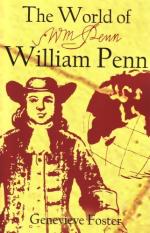
    William Penn
    William Penn (1644-1718) founded Pennsylvania and played a leading role in the history of New Jerse... more

    William Penn
    Contrary to his popular image, William Penn was an unusually complex, energetic, versatile, and cre... more


    Ask any question on William Penn and get it answered FAST!
    Answer questions in BookRags Q&A and earn points toward
    discounted or even FREE Study Guides and other BookRags products!
    Learn more about BookRags Q&A
    Copyrights
    Penn, William from Encyclopedia of Religion. Copyright © 2001-2006 by Macmillan Reference USA, an imprint of the Gale Group. All rights reserved.

    Join BookRagslearn moreJoin BookRags

    Join BookRagslearn moreJoin BookRags

