 Print
Print Word
Word PDF
PDF|
This section contains 1,604 words (approx. 6 pages at 300 words per page) |

|
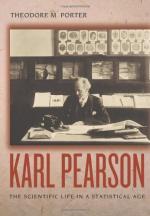
Karl Pearson, a British scientist and philosopher of science, was born in London. He studied mathematics at King's College, Cambridge, where he became acquainted with James Clerk Maxwell, Sir George Stokes, and Isaac Todhunter and developed an interest in history, religion, and philosophy. He became a fellow of his college in 1880 and also studied law at Heidelberg and Berlin. Although he was called to the bar in 1881, he never practiced law. In 1884, at the age of twenty-seven, he was appointed to the chair of applied mathematics and mechanics at University College, London, a post that he held until 1911. For part of this time he also held a lectureship in geometry at Gresham College, London, where he developed his ideas in the philosophy of science for a popular audience. Through his friend Francis Galton he became interested in statistical problems in the biological sciences, helped...
|
This section contains 1,604 words (approx. 6 pages at 300 words per page) |
|