BookRags.com Literature Guides Literature
Guides
Criticism & Essays Criticism &
Essays
Questions & Answers Questions &
Answers
Lesson Plans Lesson
Plans
My Bibliography Periodic Table U.S. Presidents Shakespeare Sonnet Shake-Up
Research Anything:        
History | Encyclopedias | Films | News | Create a Bibliography | More... Login | Register | Help

Not What You Meant?  There are 6 definitions for Werther.

Pearson, Karl (1857–1936)

Print-Friendly  Order the PDF version  Order the RTF version
About 5 pages (1,626 words)
Karl Pearson Summary

Bookmark and Share Questions on this topic? Just ask!

Pearson, Karl(1857–1936)

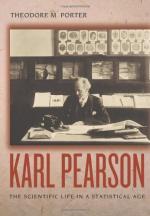
Karl Pearson, a British scientist and philosopher of science, was born in London. He studied mathematics at King's College, Cambridge, where he became acquainted with James Clerk Maxwell, Sir George Stokes, and Isaac Todhunter and developed an interest in history, religion, and philosophy. He became a fellow of his college in 1880 and also studied law at Heidelberg and Berlin. Although he was called to the bar in 1881, he never practiced law. In 1884, at the age of twenty-seven, he was appointed to the chair of applied mathematics and mechanics at University College, London, a post that he held until 1911. For part of this time he also held a lectureship in geometry at Gresham College, London, where he developed his ideas in the philosophy of science for a popular audience. Through his friend Francis Galton he became interested in statistical problems in the biological sciences, helped to lay the foundations of modern statistical theory and biometry, and, in 1901, with Galton and Weldon, founded the journal Biometrika. In 1896 he was elected a fellow of the Royal Society and in 1911 he was appointed to the new chair of eugenics at University College. Pearson was an enthusiastic socialist and humanist.

This is a free page. This page contains 201 words. This article contains 1,626 words (approx. 5 pages at 300 words per page).

Read the rest of this Article with our Pearson, Karl (1857–1936) Access Pass.

Ask any question on Karl Pearson and get it answered FAST!
Answer questions in BookRags Q&A and earn points toward
discounted or even FREE Study Guides and other BookRags products!
Learn more about BookRags Q&A
Copyrights
Pearson, Karl (1857–1936) from Encyclopedia of Philosophy. Copyright © 2001-2006 by Macmillan Reference USA, an imprint of the Gale Group. All rights reserved.

Join BookRagslearn moreJoin BookRags


About BookRags | Customer Service | Report an Error | Terms of Use | Privacy Policy