BookRags.com Literature Guides Literature Guides Criticism/Essays Criticism/Essays Biographies Biographies My Bibliography Periodic Table U.S. Presidents Shakespeare Sonnet Shake-Up
Research Anything:        
History | Encyclopedias | Films | News | Create a Bibliography | More... Login | Register | Help


Pasteur, Louis

Print-Friendly  Order the PDF version  Order the RTF version
About 2 pages (444 words)
Louis Pasteur Summary

Bookmark and Share

Louis Pasteur is known as the "father of bacteriology."Louis Pasteur is known as the "father of bacteriology."

Pasteur, Louis

French Chemist and Microbiologist 1822-1895

Louis Pasteur, the father of modern bacteriology, was born on December 27, 1822, in Dôle in eastern France. Pasteur proved that microorganisms cause fermentation and disease; he also originated the process known as pasteurization. Pasteur created vaccinations for rabies, anthrax, and chicken cholera. He is also credited with saving the beer, wine, and silk industries in France during his time.

Pasteur, the son of a tanner, attended primary and secondary schools in Arbois and Besançon. As a boy he showed more interest in art than science. Pasteur attended the Royal College in Besançon, earning his bachelor of arts degree in 1840 and bachelor of science degree in 1842. The following year, he attended the École Normale Supérieure in Paris, earning his master of science degree in 1845, and his doctor of philosophy degree in 1847. By the age of twenty-six, Pasteur was famous for his work on the structure of crystals. In 1848 he received an appointment as professor of physics at the Dijon Lycée. Shortly thereafter, he became a professor of chemistry at the University of Strasbourg. This was the start of a distinguished career at various French universities. He married Marie Laurent, with whom he had five children. (Only two survived childhood.)

In 1854 Pasteur began his studies on fermentation, the chemical breakdown of substances by microbes. His work brought important improvements in brewing and winemaking. By the 1860s he had originated the process ofpasteurization, applying controlled heat to kill disease-causing microbes in wine, beer, vinegar, and milk. This made it possible to produce, preserve, and transport these goods without their becoming ruined. Pasteur studied the mysteries of bacteriology and was the first to show that living things come only from living things. Before that, many scientists had believed in spontaneous generation, a theory that life could come from things that are not alive.

In 1865 Pasteur began studying a disease of silkworms that was devastating the silk industry. He isolated the germ that caused the disease and found methods of preventing contagion and detecting diseased stock, thus saving the silk industry. In the 1880s Pasteur began to realize that disease was spread by microorganisms (microscopic-sized organisms). His germ theory of disease was one of the greatest scientific discoveries of the nineteenth century. He went on to develop vaccinations for preventing the disease anthrax in sheep, chicken cholera in fowl, and rabies in humans. Pasteur was admired by his countrymen and honored by the French Parliament in many ways. He died on September 28, 1895.

Bibliography

The New Encyclopedia Britannica, 15th ed. Chicago: Encyclopedia Britannica, Inc.,

1993.

The World Book Encyclopedia. Chicago: World Book, Inc., 1995.

This is the complete article, containing 444 words (approx. 1 page at 300 words per page).

More Information
  • View Pasteur, Louis Study Pack
  • Search Results for "Pasteur, Louis"
  • Add This to Your Bibliography
  • More Products on This Subject
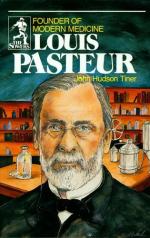
    Louis Pasteur
    The French chemist and biologist Louis Pasteur (1822-1895) is famous for his germ theory and for th... more

    Louis Pasteur
    Louis Pasteur was one of the most extraordinary scientists in history, leaving a legacy of scientif... more


    Copyrights
    Pasteur, Louis from Macmillan Science Library: Animal Sciences. Copyright © 2001-2006 by Macmillan Reference USA, an imprint of the Gale Group. All rights reserved.

    Join BookRagslearn moreJoin BookRags


    About BookRags | Customer Service | Report an Error | Terms of Use | Privacy Policy