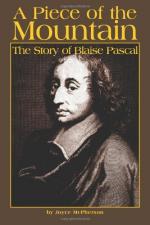
Mathematician, physicist, inventor, philosopher, religious thinker, and writer, Blaise Pascal (1623–1662) was born in Clermont-Ferrand, France, on June 19, 1623, the second of three children of Étienne Pascal, a government official and man of wide learning. His mother died in 1626, and in 1631 the family moved to Paris. His exceptional talents evident early on, Pascal was educated entirely by his father, who in 1635 introduced him to Marin Mersenne's newly founded académie, where the latest problems in mathematics, science, and philosophy were being discussed. At sixteen he wrote an original work on conic sections. At nineteen he invented a calculating machine, the Pascaline, that was awarded an early form of patent; a series of further machines were built and a few have survived. (Some letters were discovered in 1935 and 1956, written in 1623–1624 by the German scientist Wilhelm Schickard, which contained a description and sketch of a mechanical calculator he had developed, and the news that his model was destroyed in a fire.) There is now a programming language called Pascal.
Technology, Experiment, Theory
Hearing about Evangelista Torricelli's experiment with the barometer (a glass tube of mercury inverted in a bowl of mercury), Pascal undertook in 1646 to carry out variations of the experiment and then explained the results, showing that atmospheric pressure decreases (the mercury level drops) with increasing altitude. He discovered the basic principle of hydrostatics, Pascal's Law: In a fluid at rest in a closed container, a pressure change in one part is transmitted without loss to every portion of the fluid and the walls of the container. (The SI unit of pressure is the pascal.) He invented the syringe and the hydraulic press.
These developments had revolutionary impact on scientific thought, as they refuted the Aristotelian doctrine that there is no vacuum. Pascal asserted that in studying nature careful experiment and logical thinking must take precedence over respect for authority (Preface
Blaise Pascal, 1623–1662. The French scientist and philosopher was a precocious and influential mathematical writer, a master of the French language, and a great religious philosopher. (The Library of Congress.)
to the Treatise on the Vacuum [1651]). He gave a detailed exposition of scientific method, with the following thesis: A hypothesis is false if contradicted by a single experimental result, and only possible or probable if all observations are consistent with it (New Experiments Concerning the Vacuum [1647]).
A 1654 correspondence of Pascal with the mathematician Pierre de Fermat (1601–1665) concerning a gambling problem marked the birth of probability theory, the study of patterns of chance events and the formulation of laws governing random variation. Pascal solved the problem by means of the arithmetic triangle, a numeric structure that now bears his name, and in the process introduced the binomial distribution for equal chances and the method of mathematical induction (reasoning by recurrences) applied to expectations. In his studies of the cycloid, the curve traced by a point on a circle that rolls along a straight line, he anticipated the calculus. His 1658 treatise On Geometrical Demonstration shows that he was also far ahead of his time in recognizing the importance of the axiomatic method in mathematics.
Religion and Decision
At the forefront of science in technology, experiment, and theory, Pascal was drawn to religion in 1646, when his family came in contact with Jansenism, an austere Catholic movement with its center at Port-Royal, near Paris. On November 23, 1654, he had a profound religious experience that became the dominant force in his life; a parchment record of it, called Pascal's Mémorial, was found sewn into his coat after his death. He never formally joined the Jansenist community, but Port-Royal was henceforth his spiritual home. His Provincial Letters (1656–1657) were written in defense of a Jansenist theologian accused of heresy, and as such are mainly of historical interest. Their enduring popularity rests with the brilliance of Pascal's style, which set the tone for the development of modern French prose.
But Pascal is best known for his Pensées, a collection of nearly 1,000 fragments of writing for a projected defense of Christianity. With an incisive portrayal of the human condition in all its glory and misery, Pascal explores the limits of reason and the hope offered by faith in revelation. Especially famous is the fragment known as "Pascal's Wager," intriguing, but often misunderstood.
Pascal introduces mathematical concepts to address a theological issue. The question of God's existence is to be answered as if by the toss of a coin at the end of life. By analogy with a game of chance, Pascal presents an existential dilemma that calls for a decision, and in his approach foreshadows modern existentialist thought. In an imagined dialogue with a worldly skeptic, he employs what are key elements of decision theory, a product of the twentieth century concerning courses of action in the face of uncertainty.
Pascal proposes betting on God's existence and acting accordingly. If God exists, the gain will be eternal bliss in the hereafter—infinite gain for a finite risk. But he goes further, on the theory that practice yields insight. He submits that even if God does not exist, the rewards of a life of virtue will lead to the realization that nothing has been risked. At the end of the "Wager," Pascal explains that the arguments he used were inspired by his own faith, his passionate desire to show others the way.
In frail health from childhood, Pascal was, in his final years, too ill for sustained intellectual effort. He gave his belongings to the poor. In the last year of his life, he designed and inaugurated the first public transportation service, leaving the proceeds to charity. He died in Paris on August 19, 1662.
Pascal is a major figure in the history of ideas because of the range and intensity of his interests and his thought-provoking response to the uncertainties revealed in the expanding world of the seventeenth century. He accepted the skeptic's view that it is impossible to prove first principles. But he stressed the role of intuition, and across the spectrum of human experience pleaded for the full use of reason as the ethical norm: "Man is only a reed, the weakest in nature, but he is a thinking reed. ... All our dignity consists in thought. ... Let us then strive to think well; that is the basic principle of morality" (Pascal 1995, p. 66).
Davidson, Hugh M. (1983). Blaise Pascal. Boston: Twayne Publishers. Short general biography in Twayne's World Authors Series.
Guardini, Romano. (1966). Pascal for Our Time, trans. Brian Thompson. New York: Herder and Herder. Analysis of Pascal's life and work from a broad cultural and psychological perspective by a leading philosopher of religion and literature interpreter of the twentieth century.
Mesnard, Jean. (1952). Pascal, His Life and Works, trans. G. S. Fraser. New York: Philosophical Library, Inc. Classic biography by a Pascal scholar and editor.
Miké, Valerie. (2000). "Seeking the Truth in a World of Chance." Technology in Society 22: 353–360. Discusses the relevance of Pascal to problems of contemporary culture.
Pascal, Blaise. (1952). The Provincial Letters; Pensées; Scientific Treatises. In Great Books of the Western World, Vol. 33. Chicago: Encyclopedia Britannica. Contains six major scientific treatises, including those cited in the article, and the extant correspondence with Fermat on the theory of probability.
Pascal, Blaise. (1995). Pensées [Thoughts], trans. A. J. Krailsheimer. London: Penguin Books. Fine modern English translation, with introduction by the translator.
Pascal, Blaise. (2000 [1998]). Oeuvres Complètes [Complete Works], 2 vols., ed. Michel Le Guern. Paris: Gallimard. New edition of Pascal's complete works.
This is the complete article, containing 1,248 words
(approx. 4 pages at 300 words per page).