 Print
Print Word
Word PDF
PDF|
This section contains 7,015 words (approx. 24 pages at 300 words per page) |

|
Introduction
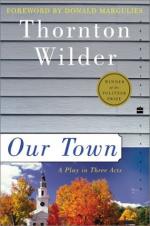
Thornton Wilder won his second Pulitzer Prize for the 1938 drama Our Town, with its understated but resonant depiction of the fundamental goal of humanity: to find love and, ultimately, a sense of belonging. In writing Our Town, Thornton Wilder joined other writers, such as Robert Frost, who searched for meaning in America after World War I and the Depression years. New England represented traditional American values, as well as the dreams that had built the nation, and by setting the play in New Hampshire, Wilder borrowed from a deeply rooted cultural, social, and political past. Even if readers could not identify with Our Town, they could believe that it existed.
Wilder's version of the American dream, as well as a parable about how to attain it, lives in Our Town. Our Town depicts ordinary lives and ordinary...
|
This section contains 7,015 words (approx. 24 pages at 300 words per page) |
|