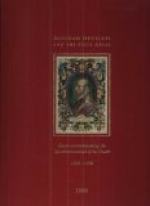
Ortelius, Abraham (1527-1598)
Belgian cartographer, geographer, and archaeologist
Commercially the most successful cartographer of his time, Ortelius satisfied the ever increasing demand for more and better maps during the Age of Exploration and pushed accurate mapmaking toward the status of fine art.
Ortelius is variously known as "Oertel," "Wortel," "Wortels," "Ortel," "Ortels," "Ortello," "Ortellius," and even "Portello." Born on either April 14 or 4, 1527, in Antwerp, Belgium, the son of a rich merchant from Augsburg, Germany, he began selling maps as a young boy and joined the chart colorers guild of St. Luke when he was 20. Some historians speculate that he may have had to work to help support his family after his father died in 1535, but there is little evidence for that speculation. It was common then for children of the merchant class to begin learning a trade at a very early age.
Ortelius's mercantile shrewdness, artistic talent, and technical mapmaking skill made him successful by the 1550s. He contracted as an engraver for one of the most important early printers, Christophe Plantin (1520–1589). He traveled widely, conducting business throughout Germany and the Low Countries. In 1559 and 1560, he toured France with his new friend Gerhard Mercator (1512–1594), who encouraged him to make original maps, rather than just copies. Inspired by Mercator and urged by map aficionado and merchant Gillis Hooftman (1520?–1581) and Hooftman's protégé, Johan Radermacher de Oude (1538–1617), Ortelius envisioned greater works and began to create them.
In 1570, Plantin published Ortelius's major work, Theatrum orbis terrarum (Theatre of the lands of the world), which contained 70 maps on 53 sheets with accompanying text. A book of maps was not called an "atlas" until 1585, when Mercator coined the term for that purpose, but the Theatrum was the first modern atlas of the world. Subsequent editions had more maps and it was in print long into the next century, edited by the Flemish engraver Joan Babtista de Vrients (1552–1612) after Ortelius's death. Among the most useful features of the Theatrum is Ortelius's historical synopsis of eighty-seven of his predecessors. In many cases, his words are all that is now known about these early cartographers.
In 1575, King Philip II of Spain rewarded Ortelius for the Theatrum by appointing him royal geographer, but only after the influential Spanish Benedictine monk, Benedictus Arias Montanus (1527–1598), had assured Philip that Ortelius was a Roman Catholic. Philip's patronage made Ortelius rich.
During Ortelius's lifetime, his atlases sold better than Mercator's. He was not an innovative mathematical cartographer like Mercator, but was a better artist, and an expert at editing, updating, and accurately presenting the data of explorers, geographers, and previous cartographers as far back as Ptolemy (fl. ca. 130). A broadly learned man, he kept company with scholars and corresponded with the Catholic humanist Justus Lipsius (1547–1606). In 1577, he toured the British Isles and met the most prominent British and Irish geographers. Among his other publications was the Thesaurus geographicus (Geographical treasury) in 1587. He died in Antwerp on either July 4 or June 28, 1598.
Cartography; History of Exploration Ii (Age of Exploration); Mapping Techniques
This is the complete article, containing 513 words
(approx. 2 pages at 300 words per page).