
BookRags.com Literature Guides Literature Guides Criticism/Essays Criticism/Essays Biographies Biographies My Bibliography Periodic Table U.S. Presidents Shakespeare Sonnet Shake-Up
Research Anything:        
History | Encyclopedias | Films | News | Create a Bibliography | More... Login | Register | Help
Not What You Meant?  There are 21 definitions for Noyes.


Noyes, John Humphrey

Print-Friendly  Order the PDF version  Order the RTF version
About 2 pages (723 words)
John Humphrey Noyes Summary

Bookmark and Share

Noyes, John Humphrey

NOYES, JOHN HUMPHREY (1811–1886), American religious reformer and founder of the Oneida Community. Born to a prominent family in Brattleboro, Vermont, John Humphrey Noyes graduated from Dartmouth College and attended Andover and Yale theological seminaries, studying under Nathaniel W. Taylor. Because of his unorthodox "perfectionist" beliefs, Noyes soon lost his ministerial license and became the focus of opprobrium and ridicule. He argued that Christ's second coming and the end of the Jewish dispensation had occurred in 70 CE, when the Temple was destroyed in Jerusalem. Henceforth, "perfect holiness," a right attitude that would lead to right works, was literally possible on earth as part of the establishment of the kingdom of God.

These beliefs, which Noyes attempted to propagate throughout New York State and New England, attracted little support. In 1836 Noyes returned to his family estate in Putney, Vermont, and started a Bible school, which became the Putney Community. By 1845 the group had moved toward full communal ownership of property, inspired by the Christian communism of Acts 2:44–45. An effort in 1846 to introduce a form of group marriage led to expulsion from Putney in 1847 and the establishment of the Oneida Community in central New York State in 1848.

At Oneida, and at the smaller related community established in 1851 at Wallingford, Connecticut, the practices that had originated at Putney became fully institutionalized. Central to these was "complex marriage." Oneida Community members, who eventually numbered more than two hundred adults, all considered themselves married to each other in an "enlarged family." Men and women exchanged sexual partners frequently, and exclusive romantic attachments were broken up as threats to group stability. Members lived, ate, and worked together, had a system of communal child rearing, and held all but the most basic property in common. Government was achieved through a daily religious and business meeting, a method of group feedback and control called "mutual criticism," and an informal hierarchy known as "ascending and descending fellowship." A system of birth control called "male continence," technically coitus reservatus, was used exclusively until the final decade of the community's existence, when a "stirpiculture," or eugenics, experiment was inaugurated among some members. At Oneida there was far less sex-role stereotyping than in comparable American groups. Men and women worked alongside each other, and women served in positions of authority over men in certain jobs.

Complex marriage existed at Oneida from 1848 until 1879, when it was renounced because of internal dissatisfactions and external pressure. Noyes, with a few of his followers, had meanwhile fled to Canada, where he lived until his death in 1886. In 1881 the group also gave up its communistic system of economic organization, reorganized as a joint-stock corporation, and went on to become a successful business, best known for its silverware. Throughout his career, Noyes was primarily concerned with disseminating his religious ideas through the newspapers that he and his associates published. Subsequent scholars and popular writers, however, have been most fascinated by his unorthodox sexual ideas and practices, which sometimes have been held up as a prototype for the future.

Bibliography

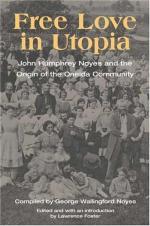
The only comprehensive biography that captures the spirit of John Humphrey Noyes and his communal efforts is Robert Allerton Parker's A Yankee Saint: John Humphrey Noyes and the Oneida Community (New York, 1935). The most accessible primary materials are found in George Wallingford Noyes's two edited documentary volumes, The Religious Experience of John Humphrey Noyes (New York, 1923) and John Humphrey Noyes: The Putney Community (Oneida, N. Y., 1931), and in Free Love in Utopia: John Humphrey Noyes and the Origin of the Oneida Community (Urbana, Ill., 2001), compiled by George Wallingford Noyes and edited by Lawrence Foster. Two classic and complementary nineteenth-century studies that analyze the Oneida Community within the context of the communitarian movement of which it was a part are John Humphrey Noyes's History of American Socialisms (Philadelphia, 1870) and Charles Nordhoff's The Communistic Societies of the United States (New York, 1875). For the most important primary source material on Noyes and his various communal ventures, serious scholars must consult the periodicals that he and his associates published between 1834 and 1879. These went by many different titles, including The Circular (Brooklyn and Oneida, N. Y., and Wallingford, Conn., 1851–1864), and are available through Uni-versity Microfilms, Ann Arbor, Mich., or the Syracuse University Library, the official repository of Oneida materials.

This is the complete article, containing 723 words (approx. 2 pages at 300 words per page).

More Information
  • View Noyes, John Humphrey Study Pack
  • 21 Alternative Definitions
  • Search Results for "Noyes, John Humphrey"
  • Add This to Your Bibliography
  • More Products on This Subject
    John Humphrey Noyes
    John Humphrey Noyes (1811-1886) was the founder of the Oneida Community, one of the notable experim... more

    Civil War and Reconstruction 1850-1877: Religion
    Americans in the mid nineteenth century had a profound sense of religious freedom. According to th... more


    Copyrights
    Noyes, John Humphrey from Encyclopedia of Religion. Copyright © 2001-2006 by Macmillan Reference USA, an imprint of the Gale Group. All rights reserved.

    Join BookRagslearn moreJoin BookRags


    About BookRags | Customer Service | Report an Error | Terms of Use | Privacy Policy

