BookRags.com Literature Guides Literature
Guides
Criticism & Essays Criticism &
Essays
Questions & Answers Questions &
Answers
Lesson Plans Lesson
Plans
My Bibliography Periodic Table U.S. Presidents Shakespeare Sonnet Shake-Up
Research Anything:        
History | Encyclopedias | Films | News | Create a Bibliography | More... Login | Register | Help

Not What You Meant?  There are 15 definitions for Nixon.  Also try: RN or Milhous.

Nixon, Richard M.

Print-Friendly  Order the PDF version  Order the RTF version
About 3 pages (893 words)
Richard Nixon Summary

Bookmark and Share

Nixon, Richard M.

(b. January 9, 1913, d. April 22, 1994) Thirty-seventh United States president of the United States (1969–1974).

As a Republican congressman, senator, vice president, president, author, and advisor, Richard M. Nixon played a central role in shaping American attitudes toward Communism throughout the Cold War (1946–1991). A committed internationalist, Nixon gained recognition initially as one of the nation's most vocal anticommunists. As president, however, Nixon's détente policies shifted American Cold War containment strategy from confrontation to negotiation.

Nixon's impact on American Cold War attitudes was felt from the start of his election to congress in 1946. As a member of the 1947 Herter Commission that investigated conditions in postwar Europe, Nixon was shocked by the devastation and became a strong proponent of the Marshall Plan to provide economic aid for reconstruction. Nixon's strong stand for internationalism helped to define the strategy the United States would follow throughout the Cold War.

Nixon also made his mark as a member of the House Committee on Un-American Activities (HUAC). He gained prominence during the 1948 hearings into Communist subversion in the United States through his dogged investigation of Alger Hiss, a foreign policy advisor to Franklin Roosevelt. Because Hiss was accused of passing secret State Department documents to the Soviet Union, his subsequent conviction for perjury helped to forge a national consensus behind the emerging containment doctrine by seeming to demonstrate the dire Soviet threat to U.S. national security.

Following the Communist victory in China in 1949, Nixon became a persistent critic of the Truman administration's foreign policy. To Nixon the "loss" of China was the result of the Eurocentric focus of Truman's containment policies. This criticism helped to globalize containment in 1950 through the national security policy directive known as NSC #68 and to elect a Republican president in 1952.

Nixon furthered his commitment to internationalism during his vice presidency. As the Eisenhower administration's goodwill ambassador to the world, he traveled to Asia, Europe, and South America, meeting most of the world's leaders. After his narrow loss to John F. Kennedy in the 1960 presidential election, and defeat in the California gubernatorial election, Nixon returned to private life. The Vietnam War gave him the opportunity to run again for the presidency. Sensing that popular support for the war was fading by 1968, Nixon won the presidency by promising voters that he would end the war and achieve "peace with honor." As president Nixon would end American involvement in Vietnam, but his policies were often controversial.

President Nixon and his national security advisor, Henry Kissinger, believed that the United States could employ a new strategy of détente, or a lessening of tensions, because of the developing division within the Communist bloc. By 1968 the Soviet Union had also gained rough parity with the United States in strategic weaponry, and as the American economy entered a period of slowing growth, Nixon believed that spending on national defense had to be reduced. These changes encouraged him to pursue détente with the Communist superpowers. Under this policy, Nixon signed the first Strategic Arms Limitation Treaty (SALT) with the Soviet Union in 1972 and began to normalize diplomatic relations with China with a surprise visit to the Asian nation in 1972. The televised pictures of Richard Nixon drinking toasts with Chinese leaders Mao Tse-tung and Chou Enlai symbolized to most Americans the sea change in the Cold War.

Although Nixon won great public acclaim for détente, his policies in Vietnam polarized still further an already divided nation. His efforts to end the war honorably followed several different paths. Nixon believed that détente would encourage the Soviet Union and China to reduce their support for the Communist regime in North Vietnam. The president also pursued peace through secret, back-channel negotiations between Kissinger and the North Vietnamese diplomat Le Duc Tho, while simultaneously withdrawing U.S. troops under his "Vietnamization" policy. Finally, to increase the pressure on North Vietnam, Nixon intensified the bombing of the North and widened the war into neighboring Cambodia.

Nixon signed a peace treaty with North Vietnam in January 1973, finally ending America's longest war. Meanwhile, illegal partisan activity, including the bugging of Democratic Party headquarters, conducted during the 1972 presidential campaign became known as the Watergate scandal. Nixon's support collapsed when he was implicated in a conspiracy to cover up the Watergate break-in, and in August 1974 he became the first U.S. president to resign. Although President Gerald Ford quickly pardoned him, it took Nixon a decade before he regained part of his lost prestige. Détente, which significantly reduced tensions in an era that saw some of the gravest confrontations of the Cold War, will undoubtedly stand as his most important diplomatic triumph.

Richard M. Nixon, surrounded by soldiers, in the village of Di An, Vietnam. AP/WIDE WORLD PHOTOSRichard M. Nixon, surrounded by soldiers, in the village of Di An, Vietnam. AP/WIDE WORLD PHOTOS

Civil Liberties, 1946–Present; Containment and Détente; Eisenhower, Dwight D.; Goldwater, Barry; Johnson, Lyndon Baines; Kennedy, John Fitzgerald; Kissinger, Henry; Nsc #68; Pentagon Papers; "Who Lost China" Debate.

Bibliography

Ambrose, Stephen E. Nixon, 3 volumes. New York: Simon and Schuster, 1987–1992.

Gaddis, John Lewis. Strategies of Containment. New York: Oxford University Press, 1982.

Gellman, Irwin. The Contender: Richard Nixon—The Congress Years, 1946–1952. New York: Free Press, 1999.

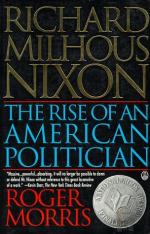
Morris, Roger. Richard Milhous Nixon: The Rise of an American Politician. New York: Henry Holt, 1989.

Nixon, Richard M. RN: The Memoirs of Richard Nixon. New York: Simon and Schuster, 1990.

Wicker, Tom. One of Us: Richard Nixon and the American Dream. New York: Random House, 1993.

This is the complete article, containing 893 words (approx. 3 pages at 300 words per page).

More Information
  • View Nixon, Richard M. Study Pack
  • 15 Alternative Definitions
  • Search Results for "Nixon, Richard M."
  • Add This to Your Bibliography
  • More Products on This Subject
    Richard Milhous Nixon
    Although Richard Milhous Nixon (1913-1994) successfully served as a member of the House of Represen... more

    Richard Milhous Nixon
    Richard Milhous Nixon served as the thirty-seventh president of the United States from 1969 to Augu... more


    Copyrights
    Nixon, Richard M. from Americans at War. Copyright © 2001-2006 by Macmillan Reference USA, an imprint of the Gale Group. All rights reserved.

    Join BookRagslearn moreJoin BookRags


    About BookRags | Customer Service | Report an Error | Terms of Use | Privacy Policy