
BookRags.com Literature Guides Literature
Guides
Criticism & Essays Criticism &
Essays
Questions & Answers Questions &
Answers
Lesson Plans Lesson
Plans
My Bibliography Periodic Table U.S. Presidents Shakespeare Sonnet Shake-Up
Research Anything:        
History | Encyclopedias | Films | News | Create a Bibliography | More... Login | Register | Help

Not What You Meant?  There are 24 definitions for Krebs.

Nicholas of Cusa

Print-Friendly  Order the PDF version  Order the RTF version
About 2 pages (696 words)
Nicholas of Cusa Summary

Bookmark and Share Questions on this topic? Just ask!

Nicholas of Cusa

NICHOLAS OF CUSA (1401–1464), German canonist, Christian theologian, and philosopher. Nicholas was born at Kues (present-day Bernkastel-Kues) on the Moselle, and studied at Heidelberg, Padua, and Cologne. At the Council of Basel, with his treatise De concordantia catholica (1434), he defended conciliar authority over the pope and proposed extensive reforms consistent with this position. He later converted to the cause of the papacy. As papal legate he traveled to Constantinople to promote Christian reunification (1437), and as cardinal and bishop of Brixen, he worked throughout Germany and Bohemia on behalf of papal authority and ecclesiastical reform. During his last years in Rome, Nicholas lived simply, having used much of his income to establish the Saint Nikolas Hospital in Kues, which still contains his large personal library.

Amid this active life Nicholas wrote numerous speculative works, beginning with De docta ignorantia (Learned Ignorance; 1440). He accords intellect a central role in the religious life, and emphasizes the desire to know God. All inquiry requires a "proportion" between the known and the as yet unknown, but there is no proportion between the infinity of God and the finite human intellect. Knowledge of God therefore becomes "learned ignorance," that is, the knowledge that one cannot know God precisely in the divine nature, but only symbolically through God's self-revelation in the universe and in Christ, who unites finite humanity and divine infinity. Nicholas correlates learned ignorance with "conjecture" (De coniecturis, 1442–1443). More than mere guesswork, conjecture approximates truth in limited, indirect ways. Nicholas's conjectures include many metaphors, mathematical symbols, and attempts to name God (e.g., as Absolute Maximum; as Possest, or the union of possibility and actual being; and as Not-other). Nicholas uses a distinctive logic, the "coincidence of opposites," which points beyond the contrasts of finite reason toward the infinite unity of God. The ability to formulate this logic indicates that the mind, while finite, nevertheless conceives of divine infinity and approaches it without limit. In Idiota de mente (The Layman: About Mind; 1450) Nicholas claims that the mind is a living image of God that "has the power of corresponding more and more without limit to its unreachable original." Participating in God's creative activity, humanity also creates a cultural world. This human world provides examples for Nicholas's art of conjecture, for example in his De ludo globi (1463), in which a ball game becomes the focus for theological speculation.

Nicholas's tolerance of religious diversity emerges in two works written in response to the Turkish conquest of Constantinople. De pace fidei (The Peace of Faith; 1453) recognizes the conjectural truth of all religions, yet sees their fulfillment in Christianity. Cribratio Alcoran (Sifting the Qurʾān; 1461) is perhaps the most tolerant examination of Islam in the late medieval West.

In controversies over conciliarism, theology, and Islam, Nicholas of Cusa is an original, even idiosyncratic, thinker. The roots of his thought run deep in the medieval world, particularly in the Christian Neoplatonic tradition. His works were widely circulated in four early printed editions. He influenced Giordano Bruno, through whom Leibniz and other German thinkers encountered Nicholas's ideas. Commentators like Ernst Cassirer have viewed Nicholas as the first modern philosopher because of his novel epistemology and cosmology. While claims for Nicholas's modernity should be tempered, his learned ignorance, conjectural theology, and religious tolerance do address persistent problems of religious knowledge and practice.

Bibliography

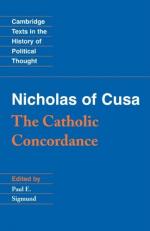
The critical edition of Nicholas of Cusa's Opera omnia (Leipzig and Hamburg, 1932–) is in progress under the direction of the Heidelberg Academy. There is also a more accessible edition of the Latin text, with German translation: Philosophische-Theologische Schriften (Vienna, 1964–1967; 3d edition, 1989). English translations include Paul E. Sigmund's The Catholic Concordance (Cambridge, 1991), H. Lawrence Bond's Nicholas of Cusa: Selected Spiritual Writings (New York, 1997), and Jasper Hopkins's Complete Philosophical and Theological Treatises of Nicholas Cusa, 2 vols. (Minneapolis, Minn., 2001). Perceptive studies are Paline M. Watt's Nicolaus Cusanus: A Fifteenth-century Vision of Man (Leiden, 1982), James E. Biechler's The Religious Language of Nicholas of Cusa (Missoula, Mont., 1975), Clyde Lee Miller's Reading Cusanus (Washington, D. C., 2003), and the essays edited by Gerald Christianson and Thomas M. Izbicki in Nicholas of Cusa on Christ and the Church (Leiden, 1996).

This is the complete article, containing 696 words (approx. 2 pages at 300 words per page).

More Information
  • View Nicholas of Cusa Study Pack
  • 24 Alternative Definitions
  • Search Results for "Nicholas of Cusa"
  • Add This to Your Bibliography
  • More Products on This Subject
    Nicholas of Cusa
    The German prelate and humanist Nicholas of Cusa (1401-1464) was active in conciliating various sch... more

    Nicholas of Cusa
    Nicholas of Cusa was a leading churchman, philosopher, and theologian of the fifteenth century. His... more


    Ask any question on Nicholas of Cusa and get it answered FAST!
    Answer questions in BookRags Q&A and earn points toward
    discounted or even FREE Study Guides and other BookRags products!
    Learn more about BookRags Q&A
    Copyrights
    Nicholas of Cusa from Encyclopedia of Religion. Copyright © 2001-2006 by Macmillan Reference USA, an imprint of the Gale Group. All rights reserved.

    Join BookRagslearn moreJoin BookRags


    About BookRags | Customer Service | Report an Error | Terms of Use | Privacy Policy

