Forgot your password?  

Not What You Meant?  There are 28 definitions for Murdoch.  Also try: The Bell.

Murdoch, Iris | Research & Encyclopedia Articles

Print-Friendly   Order the PDF version   Order the RTF version
About 3 pages (788 words)
Iris Murdoch Summary


Murdoch, Iris

Philosopher and novelist (Jean) Iris Murdoch (1919–1999) was born in Dublin, Ireland on July 15 and educated at St. Anne's College, Oxford, where she also taught from 1948 to 1963. She won the 1978 Booker Prize for her novel The Sea, The Sea, which provocatively opens with the protagonist's project of "learning to be good, after a life of egoism, art and power." Murdoch is especially renowned for reviving the classical humanistic philosophy of Plato. She makes Plato's philosophy of ideal truth, beauty, and goodness timely and accessible to general readers, articulating a view of human life as love's labor in journeying from illusion to truth. This vision is especially challenging in a world dominated by scientific reason and technologicalpursuits of material goods. Murdoch died on February 8 in Oxford, England.

Iris Murdoch, 19191999. The works of this novelist and philosopher portray characters whose warped and often dreamlike perceptions of reality create suffering among those whose lives they attempt to dominate. (The Library of Congress.)Iris Murdoch, 1919–1999. The works of this novelist and philosopher portray characters whose warped and often dreamlike perceptions of reality create suffering among those whose lives they attempt to dominate. (The Library of Congress.)

Murdoch's uniqueness as a twentieth-century novelist-philosopher is found in Acastos (1987), her two Platonic dialogues on love and religion. Like Plato, Murdoch writes philosophically about aesthetics and moral values, arguing that close connections between facts and values in the creative arts and the sciences are necessary to enable humans to live better and more wisely. For Murdoch, the critical difference between creativity in the arts versus the sciences is that the arts, especially literature, represent humanity in the world of relationships, reflected through the creative mind in play with the unlimited, unconscious self. In Murdoch's writings, individuals aim to refine human desires and longings for unreachable goodness through their interpersonal relations of love, and are not satisfied with the more abstract beauty and goodness prominent in the sciences. In thus reinventing literary art and ethics, Murdoch explores the quest of the passionate self for a goodness beyond any individualistic center of self. This indefinable, sublime good that humans seek can become destructive when desires and relationships are based more upon obsessive loves and fantasies about oneself and others, than upon moral and spiritual goodness and love. Unlike basically selfish, egotistical humans, goodness represents a necessary, ideal otherness that transcends the human ego.

For self and society to move toward the good is to be rescued from vices of deception and self-deception in the search for beauty, truth, and the virtues of self-knowledge, humility, and compassion. Beauty is the one good to which humans are attracted as if by instinct, and is what galvanizes the creative pursuits of new technologies as well as arts. Yet without developing a purer sense of self, and humility based on knowledge of oneself and others, humans fail in their creativity to find or experience the very things they yearn for, love and happiness, acceptance and understanding.

Murdoch draws inspiration not only from Plato, but also from related philosophers such as Immanuel Kant (1724–1804). For Plato, the ideal forms are distinct from the physical universe, and the form of the Good is even "beyond being" (The Republic, Book VI, 509b). For Kant, the dualism lies in the contrast between the rational free will and the determinism of the natural world known by sense experience and laws of causality. Murdoch drew further influence from central twentieth-century philosophers such as the existentialist Jean-Paul Sartre, on whom she wrote the first book in English, and the philosopher of language Ludwig Wittgenstein, with whom she shared a mistrust of written words and language as unable to express full wisdom. With Sigmund Freud she also shared the view that the source and impetus toward knowledge and achievement is sexual.

Murdoch's achievements as both novelist and Platonist argue the importance of living well, ethically, and wisely. By breaking away from barriers to female philosophers and novelists in her own time and place, Murdoch reinvigorated the Idea of the Good for an era dominated more by laws and rules than by the creative works of arts and sciences, to reveal and embody material progress toward ideal truth, beauty, and goodness.


Consequentialism;; Deontology;; Virtue Ethics.

Bibliography

Bayley, John. (1999). Elegy for Iris. New York: St. Martin's Press. Also see the film Iris (2001), based on her husband John Bayley's memoir of Murdoch's struggle with and death from Alzheimer's disease.

MacIntyre, Alasdair. "Which World Do You See?" New York Times Review of Books, January 13, 1993. A review of Metaphysics As A Guide to Morals, by Iris Murdoch.

Murdoch, Iris. (1983). The Philosopher's Pupil. New York: Viking Penguin Press, Inc.

Murdoch, Iris. (1987). Acastos: Two Platonic Dialogues. New York: Viking Penguin Press.

Murdoch, Iris. (1992). Metaphysics As A Guide to Morals: Philosophical Reflections. London and New York: Allen Lane Publisher.

Murdoch, Iris. (1998). Existentialists and Mystics: Writings on Philosophy and Literature, ed. Peter Conradi. New York: Penguin Books.

This is the complete article, containing 788 words (approx. 3 pages at 300 words per page).

More Information
  • View Murdoch, Iris Study Pack
  • 28 Alternative Definitions
  • Search Results for "Murdoch, Iris"
  • More Products on This Subject
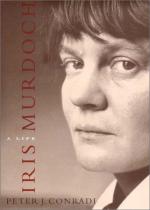
    Iris Murdoch
    One of the dominant figures of postwar British literature, Iris Murdoch continues to divide the cri... more

    Iris Murdoch
    The works of the novelist and philosopher Jean Iris Murdoch (1919-1999) portray characters whose wa... more


    Ask any question on Iris Murdoch and get it answered FAST!
    Answer questions in BookRags Q&A and earn points toward
    discounted or even FREE Study Guides and other BookRags products!
    Learn more about BookRags Q&A
    Copyrights
    Murdoch, Iris from Encyclopedia of Science, Technology, and Ethics. Copyright © 2001-2006 by Macmillan Reference USA, an imprint of the Gale Group. All rights reserved.