BookRags.com Literature Guides Literature
Guides
Criticism & Essays Criticism &
Essays
Questions & Answers Questions &
Answers
Lesson Plans Lesson
Plans
My Bibliography Periodic Table U.S. Presidents Shakespeare Sonnet Shake-Up
Research Anything:        
History | Encyclopedias | Films | News | Create a Bibliography | More... Login | Register | Help

Not What You Meant?  There are 4 definitions for MKG.  Also try: Bapu.

Mohandas Karamchand Gandhi (1869 – 1948) Indian Religious Leader

Print-Friendly  Order the PDF version  Order the RTF version
About 2 pages (573 words)
Mahatma Gandhi Summary

Bookmark and Share Questions on this topic? Just ask!

Mohandas Karamchand Gandhi (1869 – 1948) Indian Religious Leader

Mohandas Karamchand Gandhi led the movement that freed India from colonial occupation by the British. His leadership was based not only on his political vision but also on his moral, economic, and personal philosophies. Gandhi's beliefs have influenced many political movements throughout the world, including the civil rights movement in the United States, but their relevance to the modern environmental movement has not been widely recognized or understood until recently.

In developing the principles that would enable the Indian people to form a united independence movement, one of Gandhi's chief concerns was preparing the groundwork for an economy that would allow India to be both self-sustaining and egalitarian. He did not believe that an independent economy in India could be based on the Western model; he considered a consumer economy of unlimited growth impossible in his country because of the huge population base and the high level of poverty. He argued instead for the development of an economy based on the careful use of indigenous natural resources. His was a philosophy of conservation, and he advocated a lifestyle based on limited consumption, sustainable agriculture, and the utilization of labor resources instead of imported technological development.

Gandhi's plans for India's future were firmly rooted both in moral principles and in a practical recognition of its economic strengths and weaknesses. He believed that the key to an independent national economy and a national sense of identity was not only indigenous resources but indigenous products and industries. Gandhi made a point of wearing only homespun, undyed cotton clothing that had been handwoven on cottage looms. He anticipated that the practice of wearing homespun cotton cloth would create an industry for a product that had a ready market, for cotton was a resource that was both indigenous and renewable. He recognized that India's major economic strength was its vast labor pool, and the low level of technology needed for this product would encourage the development of an industry that was highly decentralized. It could provide employment without encouraging mass migration from rural to urban areas, thus stabilizing rural economies and national demography. The use of cotton textiles would also prevent dependence on expensive synthetic fabrics that had to be imported from Western nations, consuming scarce foreign exchange. He also believed that synthetic textiles were not suited to India's climate, and that they created an undesirable distinction between the upper classes that could afford them and the vast majority that could not.

The essence of his economic planning was a philosophical commitment to living a simple lifestyle based on need. He believed it was immoral to kill animals for food and advocated vegetarianism; advocated walking and other simple forms of transportation contending that India could not afford a car for every individual; and advocated the integration of ethical, political, and economic principles into individual lifestyles. Although many of his political tactics, particularly his strategy of civil disobedience, have been widely embraced in many countries, his economic philosophies have had a diminishing influence in a modern, independent India, which has been pursuing sophisticated technologies and a place in the global economy. But to some,his work seems increasingly relevant to a world with limited resources and a rapidly growing population.

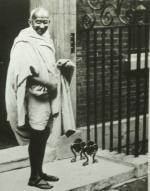
Mohandas Karamchand Gandhi. (AP/Wide World Photos. Reproduced by permission.)Mohandas Karamchand Gandhi. (AP/Wide World Photos. Reproduced by permission.)

Resources

Books


Chadha, Yogesh. Gandhi: A Life. Wiley, 1998.

Fischer, L. The Life of Mahatma Gandhi. New York: Harper, 1950.

Mehta, V. Mahatma Gandhi and His Apostles. New York: Viking, 1977.

This is the complete article, containing 573 words (approx. 2 pages at 300 words per page).

More Information
  • View Mohandas Karamchand Gandhi (1869 – 1948) Indian Religious Leader Study Pack
  • 4 Alternative Definitions
  • Search Results for "Mohandas Karamchand Gandhi (1869 – 1948) Indian Religious Leader"
  • Add This to Your Bibliography
  • More Products on This Subject
    Mohandas Karamchand Gandhi
    Mohandas Karamchand Gandhi (1869-1948) was an Indian revolutionary religious leader who used his re... more

    Mohandas Karamchand Gandhi
    Mohandas Karamchand Gandhi was an revolutionary spiritual leader who used his influence for politic... more


    Ask any question on Mahatma Gandhi and get it answered FAST!
    Answer questions in BookRags Q&A and earn points toward
    discounted or even FREE Study Guides and other BookRags products!
    Learn more about BookRags Q&A
    Copyrights
    Mohandas Karamchand Gandhi (1869 – 1948) Indian Religious Leader from Environmental Encyclopedia. ©2005-2006 Thomson Gale, a part of the Thomson Corporation. All rights reserved.


    Join BookRagslearn moreJoin BookRags


    About BookRags | Customer Service | Report an Error | Terms of Use | Privacy Policy