Forgot your password?  

Not What You Meant?  There are 10 definitions for Aster.

Mitosis | Research & Encyclopedia Articles

Print-Friendly   Order the PDF version   Order the RTF version
About 2 pages (513 words)
Mitosis Summary


Mitosis

Mitosis is the process during which two complete, identical sets of chromosomes are produced from one original set. This allows a cell to divide during another process called cytokinesis,thus creating two completely identical daughter cells.

In order for an organism to grow and develop, the organism's cells must be able to duplicate themselves. Three very basic events must take place to achieve this duplication: the deoxyribonucleic acid DNA, which makes up the individual chromosomes within the cell's nucleus must be duplicated; the two sets of DNA must be packaged up into two separate nuclei; and the cell's cytoplasm must divide itself to create two separate cells, each complete with its own nucleus. The two new cells, products of the single original cell, are known as daughter cells.

During much of a cell's life, the DNA within the nucleus is not actually organized into the discrete units known as chromosomes. Instead, the DNA exists loosely within the nucleus, in a form called chromatin. Prior to the major events of mitosis, the DNA must replicate itself, so that each cell has twice as much DNA as previously. Mitosis is then ready to begin.

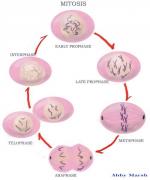
The first stage of mitosis is called prophase. During prophase, the DNA organizes or condenses itself into the specific units known as chromosomes. Chromosomes appear as double-stranded structures. Each strand is a replica of the other and is called a chromatid. The two chromatids of a chromosome are joined at a special region, the centromere. Structures called centrioles position themselves across from each other, at either end of the cell. The nuclear membrane then disappears.

During the stage of mitosis called metaphase, the chromosomes line themselves up along the midline of the cell. Fibers called spindles attach themselves to the centromere of each chromosome.

During the third stage of mitosis, called anaphase, spindle fibers will pull the chromosomes apart at their centromere (chromosomes have two complementary halves, similar to the two nonidentical but complementary halves of a zipper). One arm of each chromosome will migrate toward each centriole, pulled by the spindle fibers.

During the final stage of mitosis, telophase, the chromosomes decondense, becoming unorganized chromatin again. A nuclear membrane forms around each daughter set of chromosomes, and the spindle fibers disappear. Sometime during telophase, the cytoplasm and cytoplasmic membrane of the cell split into two (cytokinesis), each containing one set of chromosomes residing within its nucleus.

Mitosis always creates two completely identical cells from the original cell. In mitosis, the total amount of DNA doubles briefly, so that the subsequent daughter cells will ultimately have the exact amount of DNA initially present in the original cell. Mitosis is the process by which all of the cells of the body divide and therefore reproduce. The only cells of the body which do not duplicate through mitosis are the sex cells egg and sperm cells). These cells undergo a slightly different type of cell division called meiosis, which allows each sex cell produced to contain half of its original amount of DNA, in anticipation of doubling it again when an egg and a sperm unite during the course of conception.

This is the complete article, containing 513 words (approx. 2 pages at 300 words per page).

More Information
  • View Mitosis Study Pack
  • 10 Alternative Definitions
  • Search Results for "Mitosis"
  • More Products on This Subject
    Mitosis
    Christian Campusano Biology Mitosis Purpose: To examine the various stages of mitosis i... more

    Mitosis
    Mitosis July 21, 2005 Summary In the lab exercise related to Mitosis, we view various slides con... more


    Ask any question on Mitosis and get it answered FAST!
    Answer questions in BookRags Q&A and earn points toward
    discounted or even FREE Study Guides and other BookRags products!
    Learn more about BookRags Q&A
    Copyrights
    Mitosis from World of Genetics. ©2005-2006 Thomson Gale, a part of the Thomson Corporation. All rights reserved.

    Join BookRagslearn moreJoin BookRags

    Join BookRagslearn moreJoin BookRags