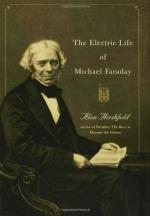
Michael Faraday
1791-1867
British Chemist and Physicist
Michael Faraday, British chemist and physicist, demonstrated electromagnetic rotation (the basis of electrical motors and dynamos), the laws of electrochemistry, and introduced the concept of electromagnetic fields.
Michael Faraday was born in London, the son of a poor blacksmith. As a child his education covered only the basics of reading, writing, and arithmetic. At the age of 14 he was apprenticed to a bookbinder for seven years. This occupation brought him into contact with books on science and introduced him to the idea that the subject was comprehensible. He spent the years of his apprenticeship reading any scientific works he could find and attending public science lectures. In 1812 Faraday began to seek employment in science. He wrote to Humphry Davy (1778-1829), a leading British scientist of the day, and enclosed with the letter the notes he had taken during several of Davy's lectures at the Royal Institution. He was hired as Davy's assistant, and in 1813 he was granted a full-time position as laboratory assistant at the Royal Institution, an institution designed to promote science among the public. He became director of the laboratory in 1825. During these years he became an extremely skilled experimentalist and began pursuing his own research in chemistry and electromagnetism. After being appointed director, Faraday initiated the Friday Evening Discourses, which became a prominent feature of the Royal Institution. Faraday was devoted to the idea of communicating science to the public and for close to forty years his very popular lectures brought experimental and theoretical physical science to a broad audience.
In 1821 Faraday conducted a series of experiments that demonstrated electromagnetic rotation. The previous summer Hans Christian Oersted (1777-1851) had discovered that an electrical current could produce a circular magnetic force. Faraday showed that this force would make a magnet rotate around a current-carrying wire. After a decade of pursuing other researchprojects, Faraday returned to the study of electromagnetism in 1831. He was able to demonstrate the reverse of Oersted's 1821 discovery. His brilliant experiments uncovered the phenomenon of electromagnetic induction, the process by which changing magnetic conditions produce an electric current. His paper on this was the first in a 25-year series of articles entitled "Experimental Researches in Electricity" and established his reputation as a leading scientist. He showed in part that a moving magnet would produce an electrical current. This was a discovery of fundamental importance because it proved that the physical movement of the magnet could be converted into electricity. Faraday's experimental setup was the first dynamo, a simple machine using mechanical force to produce electricity.
Humphry Davy. (The Library of Congress. Reproduced by permission.)
In 1834 Faraday developed his two laws of electrochemistry, which claimed that the amount of chemical activity in matter is directly proportional to the amount of electricity passed through the matter, and that the masses of matter produced from an electrochemical reaction are proportional to their chemical equivalents. During his electrochemical studies, Faraday introduced such now-standard vocabulary terms as ion, cation, anion, electrode, cathode, and anode.
Faraday's final major contribution to science arose from many outside sources, including his religion. Faraday belonged to a small sect calledthe Sandemanians who attempted to practice a simple, early form of Christianity. Because he believed that God had created a beautiful, orderly world, he was convinced that electricity and magnetism were produced by some single force. Whereas most scientists of the time believed electromagnetism to be caused by fluids of particles, Faraday introduced the concept of the "field," described by lines of force, in which the manifestation and energy of electricity and magnetism existed in the space around the magnet and not in the magnet itself. His concept of fields would later be fully clarified and expanded by James Clerk Maxwell (1831-1879) in his famous mathematical equations.
Michael Faraday. (The Library of Congress. Reproduced by permission.)
Despite his lack of mathematical training, Faraday made vital contributions to chemistry and physics in the nineteenth century. His expertise with experimentation led to numerous discoveries, and his somewhat unorthodox and idiosyncratic ideas led him to suggest radical theories which opened new doors of scientific investigation.
This is the complete article, containing 680 words
(approx. 2 pages at 300 words per page).