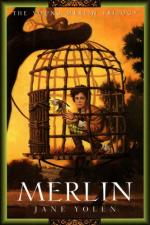
Merlin
MERLIN. The origins of Merlin, the magician, prophet, and guardian of the legendary British king Arthur and a central figure in medieval Arthurian romance in both French and English, are to be found in a number of early Welsh poems and related material in Latin. The name Merlin was created by the twelfth-century pseudohistorian Geoffrey of Monmouth, who described the conception of "a fatherless boy" by a nun who had been impregnated by an incubus in the South Wales town of Caerfyrddin (modern-day Carmarthen). The omniscient boy's advice to King Vortigern suggests that Geoffrey modeled his Merlin on an earlier Welsh story of the wonder-child Ambrosius. Although two later exploits, the removal of Stonehenge from Ireland to England and the disguising of Uter Pendragon as Gorlois so that he might sleep with the latter's wife (a ruse that results in the conception of Arthur), are not found in the earlier sources, Merlin's major role as a political prophet in Geoffrey's Historia regum Britanniae is traditional.
The prophet's birth at Caerfyrddin is a sure sign that he is in fact the Welsh Myrddin, whose name is variously spelled Merddin, Merdin, and Myrtin, which Geoffrey changed to Merlin to avoid unfortunate associations with the French merde. There are extant a large number of medieval Welsh poems claimed to have been composed by a fictional Myrddin. The majority of these are post hoc vaticinations and contemporary comments on political events attributed to the famed prophet, who had acquired this role by the tenth century, as the poem Armes Prydein (c. 935) shows, a role he was to retain throughout the Middle Ages. There may also be discerned, however, a substratum of story to which other pre-twelfth-century poems allude and which can be reconstituted from these and other sources. Myrddin, a member of the court of King Gwenddoleu, became insane at the Battle of Arfderydd (fought in 573 in modern-day Cumbria). He fled in terror from King Rhydderch of Strathclyde to the Caledonian Forest (in the Scottish Lowlands), and lived there the life of a wild man (his Welsh epithet is Wyllt, "wild"). He was befriended by his sister, or lover, Gwenddydd, to whom he prophesied events at court. These traditions were used by Geoffrey of Monmouth in his poem Vita Merlini, which is designed to correct the nontraditional elements and to supplement the picture he had earlier given in his Historia. His two Merlins appeared to contemporaries as distinct characters named Merlinus Ambrosius (in the Historia) and Merlinus Silvestris (in the Vita), but it is better to regard the distinction as being due to Geoffrey's imprecise knowledge of the genuine tradition at the time of his writing of the Historia.
The northern Myrddin is found under the name Lailoken in the twelfth-century Vita Kentigerni of Joceline of Furness, and he has an analogue in the ninth-century Irish character Suibhne Geilt. Lailoken's tale was relocated in South Wales, and, according to the claims of A. O. H. Jarman, the madman was given a new name derived from Caerfyrddin. Rachel Bromwich, stressing Myrddin's status as a poet in Welsh bardic tradition, suggests that he was a sixth-century historical poet, none of whose work is extant but who developed legendary features, as happened to Taliesin. There is little doubt that the sagas of two characters have influenced one another, and they are linked in a pre-twelfth-century dialogue poem which may have been known to Geoffrey of Monmouth, who used the device of dialogue in the Vita. Although Welsh literature does not show the influence of later Arthurian romance in the character of Myrddin, late medieval Welsh poetry does contain allusions to his imprisonment and death and to erotic elements in the legend.
Bibliography
A good and concise account of the development of the theme of Myrddin/Merlin is presented in The Legend of Merlin (Cardiff, 1960) by A. O. H. Jarman. Consult, also, Jarman's article titled "A oedd Myrddin yn fardd hanesyddol," Studia Celtica 10/11 (1975–1976): 182–197. This article is written in response to Rachel Bromwich's piece, "Y Cynfeirdd a'r Traddodiad Cymraeg," Bulletin of the Board of Celtic Studies 22 (1966): 30–37. A thorough review of the important issues is found in Trioedd Ynys Prydein: The Welsh Triads, 2d ed. (Cardiff, 1978), which was edited and translated by Bromwich. For views on Merlin's historical origins see Nikolai Tolstoy, The Quest for Merlin (London, 1985).
This is the complete article, containing 723 words
(approx. 2 pages at 300 words per page).