Martin, Steve (1945—)
Steve Martin's crazy, off-the-wall brand of humor had major effects on stand-up, television, film, and print. From the 1970s, when his white-suited appearances on the ensemble comedy show Saturday Night Live were widely enjoyed and copied, to the 1990s, when his witty short pieces were printed on the back page of the New Yorker, Martin has brought his wacko bursts of intelligent comedy to millions. Clean-cut yet uninhibited, Martin rolled with the decades, growing from a novelty act to a respected comedic actor and author.
Martin was born August 14, 1945, in Waco, Texas. His family moved to California when he was five, and he grew up near Disneyland. He dropped out of college at 21 and began writing comedy for the Smothers Brothers in the late 1960s and then for Sonny and Cher in the early 1970s. He appeared on the Tonight Show more than forty times and released four comedy albums.
It was his gigs hosting Saturday Night Live, however, that made Steve Martin a household name. He appeared on the late-night sketch comedy show as King Tut, Theodoric of York: Medieval Barber, Gilda Radner's dance partner in "Dancing in the Dark," and, with Dan Aykroyd, as one of the Festrunck brothers, whose catch phrase "We are two wild and crazy guys" never failed to get a laugh. Martin's arrow-through-the-head crazy antics were typical of the early SNL era, and he hosted the show more than a dozen times. His sarcastic "well, excuuuuuuuse me" and "naaaaah" became schoolyard mantras.
In 1980, Martin had his first starring role in a film: Navin R. Johnson in The Jerk, for which he also wrote the screenplay. During the next two decades he made several comedies, including Dead Men Don't Wear Plaid, The Man with Two Brains, The Lonely Guy, All of Me, Three Amigos!, Roxanne, Dirty Rotten Scoundrels, Parenthood, and L.A. Story. He had a cameo in The Muppet Movie and took the Spencer Tracy role in a remake of Father of the Bride. He also tried his hand at serious acting in Pennies from Heaven, Grand Canyon, and, in 1997, David Mamet's The Spanish Prisoner.
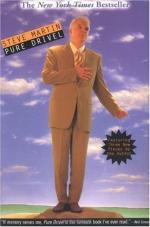
Martin also succeeded in the area of the written word. His book of comic short stories, Cruel Shoes, topped the bestseller list in 1979. His play "Picasso at the Lapin Agile" (set in a bar in 1904 Paris, with characters including Picasso, Einstein, and Elvis) was performed off-Broadway in 1995 and had a regional run. In the late 1990s, Martin began writing pieces for the New Yorker; these were released as a book, Pure Drivel, in 1998.
That same year, actor Tom Hanks told an interviewer that Martin had been a pivotal influence on comedy in general: "If you went to Cub Scout meetings in the seventies, they'd do Steve Martin bits," he said. "Everybody was 'Yeah, I'm a wild and crazy guy.' Instantaneously, it just seemed to permeate society…."
Steve Martin
Further Reading:
Anderson, Kurt. "The Tom Hanks Phenomenon." New Yorker, December 7, 14, 1998, 104-28.
Lenburg, Greg, Randy Skretvdt, and Jeff Lenburg. Steve Martin: The Unauthorized Biography. New York, St. Martin's Press, 1980.
This is the complete article, containing 515 words
(approx. 2 pages at 300 words per page).