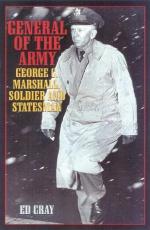
Marshall, George C.
(b. December 31, 1880; d. October 16, 1959) Soldier-statesman.
George Catlett Marshall began his career as a U.S. Army officer after graduating from the Virginia Military Institute in 1901. He served as a staff officer with U.S. forces in France (1917–1918) and in numerous important posts in the period between World Wars I and II before being made army chief of staff on September 1, 1939. After Marshall retired from active duty in late 1945, President Harry S. Truman selected him to handle three major jobs: special ambassador to China (December 1945–January 1947), secretary of state (January 1947–January 1949), and secretary of defense (September 1950–September 1951).
Vigorous criticism of the Truman administration for its China policies caused Truman to call on the respected and politically neutral Marshall to mediate the growing Chinese civil war between the Nationalists and the Communists. Marshall believed that although the Nationalists appeared to be militarily superior, neither side was powerful enough to destroy the other and thus a coalition government was essential to prevent the country's destruction. Marshall succeeded in negotiating a cease-fire on January 10, 1946.
During the spring of 1946, however, fighting increased. Marshall continued to seek nationalist government reform, an end to the hostilities, and a coalition government until his departure in early January 1947. Marshall's unwillingness to side entirely with the Nationalist government was one of the chief criticisms of him later raised by conservative critics. Accusations that the Truman administration had "lost" China fueled McCarthyism and the Red Scare that included a hunt for Communist sympathizers in the State Department.
The Department of State had been a marginal player in U.S. diplomacy for fifteen years when Marshall took over on January 20, 1947. He immediately reorganized the department, creating, for example, the Policy Planning Staff under George F. Kennan. Marshall cultivated the friendship of Arthur Vandenburg (R-Michigan), a power in the U.S. Senate and a prewar isolationist who now lead the Republican Party's internationalist wing. Events since Pearl Harbor had weakened the Republican isolationist wing. Marshall and Vandenberg encouraged the growing understanding that foreign policy should be regarded in a nonpartisan or bipartisan manner.
The inconclusive Moscow Foreign Ministers Conference of March and April 1947 convinced Marshall that the United States had to stabilize the socioeconomic situation in Western Europe or communists might take over. His speech on June 5 at Harvard University warned of Europe's economic plight and asserted that the United States could help but insisted that European nations coordinate and take the initiative. The law creating the so-called Marshall Plan was signed by President Harry S. Truman on April 3, 1948, following Marshall's strenuous political and public relations campaign on its behalf. The European Recovery Program's $13.3 billion in grants and loans marked a decisive shift in American culture from isolationism to internationalism, resulting from a combination of self-interest in combating Soviet influence and American generosity to nations ravaged by war.
War damage, weakening of the old colonial powers, and the Soviet Union's status as superpower and Communist world leader were the key problems during Marshall's period as Secretary of State. Many in Europe and Asia viewed both the USSR and Communism with increased respect. Soviet leaders used this, and the Red Army's control of eastern Europe, to strengthen what they considered a defensive barrier around themselves. Western leaders saw Soviet activities as a precursor to social upheaval and Soviet world dictatorship. The future of Germany was a focal point for many disputes between Communists and anti-Communists.
German economic and political problems swiftly escalated into the Berlin blockade and airlift of April 1948 to May 1949. Marshall worked to keep the western Allies unified and urged a firm stance against the Soviets while demonstrating a willingness to use United Nations (UN) machinery to seek a solution.
The communist threat encouraged western leaders to consider a new defensive alliance as a counterpart to the Marshall plan. While Marshall was a vigorous supporter of the UN, he also encouraged the formation of the North Atlantic Treaty Organization (NATO). America's leading role in this peacetime military alliance signified a radical departure for American foreign policy from prewar isolationism to postwar internationalism. Results of this included enhanced powers for the federal government, continued support by citizens for a large military establishment, and conversion of American domestic problems (e.g., racism) into issues of world importance.
The status of Palestine, especially whether it should be partitioned between Jews and Arabs, was another major issue during Marshall's time at the State Department. While supporting partition, Marshall preferred that the UN find a solution, fearing that unilateral Israeli independence would lead to a war in which the Arabs might overwhelm the Israelis, forcing the United States to intervene militarily, which would hurt U.S. prestige in the UN and in the Arab world and perhaps open the gates to Soviet influence in the Middle East.
Marshall resigned as Secretary of State on January 20, 1949, and Truman soon appointed him to head the American Red Cross. During 1949 and 1950, Marshall campaigned vigorously to improve the organization's image and income.
Marshall replaced Louis Johnson as secretary of defense on September 21, 1950. He and Secretary of State Dean Acheson cooperated well, and Marshall was friendly with members of the Joint Chiefs of Staff (JCS). His job as secretary was to complete the mobilization for the Korean War, but his first key decision was to accept JCS and theater commander Douglas MacArthur's recommendation to pursue the North Koreans—who were rapidly retreating after the Inchon invasion of September 15—beyond the 38th parallel.
When China's intervention in the war in late November 1950 threatened UN forces with disaster, Marshall's job was to restrain MacArthur from widening the war, placate U.S. allies worried about American leadership, and seek a ceasefire. After MacArthur became publicly critical of Truman administration policies in Asia in March 1951, Marshall and the president's other military advisors agreed that MacArthur had to be relieved of command. Frustrations with the war and unhappiness that MacArthur had been relieved of command were other causes of conservative displeasure toward Marshall.
Marshall resigned as secretary of defense on September 12, 1951; it was his last public office. On December 10, 1953, he received the Nobel Peace Prize for what he asserted were the American people's efforts through the Marshall Plan. He died on October 16, 1959, and is buried in Arlington National Cemetery.
Containment and Détente; Korea, Impact Of; Marshall Plan; Mccarthyism; Nitze, Paul; Truman, Harry S.; "Who Lost China" Debate.
Bibliography
Marshall, George C. The Papers of George Catlett Marshall, 5 vols. to date. Baltimore, MD: Johns Hopkins University Press, 1981–.
Marshall, George C. George C. Marshall: Interviews and Reminiscences for Forrest C. Pogue, 3d ed. Lexington, Va.: George C. Marshall Foundation, 1996.
Pogue, Forrest C. George C. Marshall, 4 vols. New York: Viking, 1963–1987.
Stoler, Mark A. George C. Marshall: Soldier-Statesman of the American Century. Boston: Twayne, 1989.
This is the complete article, containing 1,134 words
(approx. 4 pages at 300 words per page).