Forgot your password?  

Not What You Meant?  There are 117 definitions for Poison.  Also try: PSN or Pharmakon.

Love Canal | Research & Encyclopedia Articles

Print-Friendly   Order the PDF version   Order the RTF version
About 6 pages (1,763 words)
Poison Summary


Love Canal


Probably the most infamous of the nation's hazardous waste sites, the Love Canal neighborhood of Niagara Falls, New York, was largely evacuated of its residents in 1980 after testing revealed high levels of toxic chemicals and genetic damage.

Between 1942 and 1953, the Olin Corporation and the Hooker Chemical Corporation buried over 20,000 tons of deadly chemical waste in the canal, much of which is known to be capable of causing cancer, birth defects, miscarriages, and other health disorders. In 1953, Hooker deeded the land to the local board of education but did not clearly warn of the deadly nature of the chemicals buriedthere, even when homes and playgrounds were built in the area.
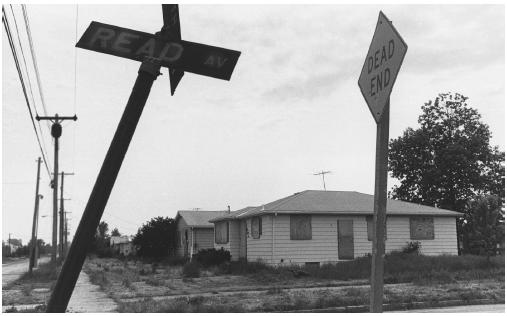
Weeds grow around boarded up homes in Love Canal, New York in 1980. (Corbis-Bettmann. Reproduced by permission.) Weeds grow around boarded up homes in Love Canal, New York in 1980. (Corbis-Bettmann. Reproduced by permission.)

The seriousness of the situation became apparent in 1976, when years of unusually heavy rains raised the water table and flooded basements. As a result, houses began to reek of chemicals, and children and pets experienced chemical burns on their feet. Plants, trees, gardens, and even some pets died.

Soon neighborhood residents began to experience an extraordinarily high number of illnesses, including cancer, miscarriages, and deformities in infants. Alarmed by the situation, and frustrated by inaction on the part of local, state, and federal governments, a 27-year-old housewife named Lois Gibbs began to organize her neighbors. In 1978 they formed the Love Canal Homeowners Association and began a two-year fight to have the government relocate them into another area.

In August 1978 the New York State Health Commissioner recommended that pregnant women and young children be evacuated from the area, and subsequent studies documented the extraordinarily high rate of birth defects, miscarriages, genetic damage and other health affects. In 1979, for example, of 17 pregnant women in the neighborhood, only two gave birth to normal children. Four had miscarriages, two suffered stillbirths, and nine had babies with defects.

Eventually, the state of New York declared the area "a grave and imminent peril" to human health. Several hundred families were moved out of the area, and the others were advised to leave. The school was closed and barbed wire placed around it. In October 1980 President Jimmy Carter declared Love Canal a national disaster area.

In the end, some 60 families decided to remain in their homes, rejecting the government's offer to buy their properties. The cost for the cleanup of the area has been estimated at $250 million. Ironically, twelve years after the neighborhood was abandoned, the state of New York approved plans to allow families to move back to the area, and homes were allowed to be sold.

Love Canal is not the only hazardous waste site in the country that has become a threat to humans--only the best known. Indeed, the United States Environmental Protection Agency has estimated that up to 2,000 hazardous waste disposal sites in the United States may pose "significant risks to human health or the environment," and has called the toxic waste problem "one of the most serious problems the nation has ever faced."

Contaminated Soil; Hazardous Waste Site Remediation; Hazardous Waste Siting; Leaching; Storage and Transport of Hazardous Material; Stringfellow Acid Pits; Toxic Substance

Resources

Books

Gibbs, Lois. Love Canal: My Story. Albany: State University of New York Press, 1982.

Regenstein, L. G. How to Survive in America the Poisoned. Washington, DC: Acropolis Books, 1982.

Periodicals

Brown, M. H. "Love Canal Revisited." Amicus Journal 10 (Summer 1988): 37–44.

Kadlecek, M. "Love Canal—10 Years Later." Conservationist 43 (November-December 1988): 40–43.

——. "A Toxic Ghost Town: Ten Years Later, Scientists Are Still Assessing the Damage From Love Canal." The Atlantic 263 (July 1989): 23–26.

This is the complete article, containing 597 words (approx. 2 pages at 300 words per page).

More Information
  • View Love Canal Study Pack
  • 117 Alternative Definitions
  • Search Results for "Love Canal"
  • More Products on This Subject
    Poison
    A substance that, when introduced into the body in relatively small quantities, causes destruction ... more

    Poison and Antidote Actions
    A poison is a compound that produces a deleterious change on or in the body. There are a large numb... more


    Ask any question on Poison and get it answered FAST!
    Answer questions in BookRags Q&A and earn points toward
    discounted or even FREE Study Guides and other BookRags products!
    Learn more about BookRags Q&A
    Copyrights
    Love Canal from Environmental Encyclopedia. ©2005-2006 Thomson Gale, a part of the Thomson Corporation. All rights reserved.

    Join BookRagslearn moreJoin BookRags

    Join BookRagslearn moreJoin BookRags