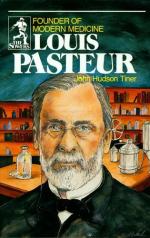
Louis Pasteur
1822-1895
French Chemist and Microbiologist
Louis Pasteur began his scientific career as a chemist and made important contributions to that field. However, he is best remembered as the father of microbiology. His work toward identifying microorganisms and understanding how they cause disease was instrumental in the development of modern medicine. By discovering why food spoils and how to preserve it, Pasteur also helped to increase the safety and shelf life of the world's food supply.
Pasteur was born in 1822 in a small village near Dijon, France. As a youth he was remarkable mainly for his talent as a painter; he struggled with his schoolwork despite spending a great deal of time at it. One schoolmaster recognized that Pasteur's work was extremely methodical rather than simply slow, and he arranged for Pasteur to transfer to a private school in Paris. But the homesick country boy lasted only a few weeks. Back at home, Pasteur resumed his exacting study habits, attending a local college until returning to Paris a few years later. There he was finally admitted to the Ecole Normale, the national school for college professors.
While studying for his doctorate in chemistry, Pasteur began his research into the optical properties of crystals and made an important discovery concerning the polarization of light. Ordinary light waves can vibrate in any direction perpendicular to the direction in which the wave is moving. Polarized light consists of waves vibrating in only one direction. Some crystals have the ability to change the direction of polarization of a beam of light, because of the structure in which their molecules are arranged. Pasteur discovered materials with both "left-handed" and "right-handed" forms that rotate the polarized light beam in different directions. This property had not been recognized before because when the two forms are mixed, the effect cancels out. With his work on crystals Pasteur founded the discipline of stereochemistry, the study of how particular arrangements of a substance's molecules affect its properties.
After obtaining his degree, Pasteur was offered an assistantship at the Strasbourg Academy. There he met his wife, Marie. The couple eventually had five children, of whom three died young. In Strasbourg Pasteur also encountered the project that was to direct his future path.
Pasteur was studying the effect of fermentation on some of his crystals. It seemed that the ones that turned polarized light to the left did not ferment, while the "right-handed" material did. Knowing he was working on fermentation, a businessman who distilled alcohol from beet juice approached Pasteur for help when his alcohol was going sour. Pasteur reluctantly left his laboratory and quickly discovered the problem at the distillery. Instead of alcohol, sometimes the fermentation would produce lactic acid, the same substance that develops in sour milk. Examining samples of properly fermenting and sour beet juice under the microscope, Pasteur discovered different microorganisms in them. Scientists had known about microorganisms, or microbes, since Anton van Leeuwenhoek (1632-1723) first identified them using a simple microscope in 1675. But there was no real understanding of what they did.
Eventually making his way back to Paris, for the next 14 years Pasteur studied the microbes responsible for the different types of fermentation. He discovered that some microorganisms were aerobic, thriving in the presence of oxygen, while others, called anaerobic, grew where oxygen was absent.
Winemaking was one of the most important French industries in Pasteur's time, as it still is today. The scientist was soon enlisted by Emperor Napoleon III in an effort to prevent wine from spoiling. But wine could be spoiled by any of several microorganisms. How could they all be destroyed? It was already known that if the wine was heated to high temperatures, it would keep indefinitely. Unfortunately, while the wine wasn't spoiled using this process, its taste was. Pasteur showed that the wine only needed to be briefly heated to between 131-158° F if it was then bottled without further contact with air. This method came to be called pasteurization, and it remainsessential for food processing today, particularly for dairy products.
Pasteur's work on wine led him to believe that, contrary to the prevailing theory of the day, microbes did not appear by "spontaneous generation." He had shown that, if proper precautions are taken, they do not appear at all. This involved him in a great deal of controversy. The spontaneous appearance of life was in concert with the religious and philosophical outlook of the day, representing as it did a Creation in miniature. Pasteur was a religious man, but nonetheless he felt sure that microbial growth did not require divine intervention. He demonstrated that the germs were carried on the dust in the air. If these germs were prevented from getting to a medium, it remained unspoiled.
Pasteur recognized the implications of his discovery for the rather primitive medical treatment of the 1870s. Injured patients and those recovering from surgery often died of infections. If germs could be prevented from reaching the wounds, these patients could be saved. But French physicians disregarded what they considered to be the irrelevant opinions of a chemist. So Pasteur's work was first applied to the operating room by the English physician Joseph Lister (1827-1912), who originated antiseptic surgery.
Pasteur was subsequently pressed into service on a number of problems important to French industry and agriculture, such as beer brewing and silkworm disease. In each case his method was to identify the germ and proceed from there. Particularly important were his experiments on chicken cholera, in which he conferred immunity to the disease by using a weakened form of the microorganism. This provided a previously lacking scientific explanation for the smallpox vaccinations that had been developed by English physician Edward Jenner (1749-1823) in 1796.
In 1885 Pasteur was working on a vaccine for rabies. He had done some successful tests in animals when he was confronted by a dilemma in the form of Joseph Meister, a young boy brought to him after having been bitten by a rabid dog. While Pasteur did not consider that he was ready to try his vaccine on humans, the boy had no other hope for survival. With great trepidation, Pasteur administered his vaccine over the course of the next few weeks. To his great joy and relief, the boy recovered. Although Pasteur was not a physician, he had found a cure for a previously incurable disease.
Word soon spread of Pasteur's successful intervention and money began pouring in to establish the Pasteur Institute for rabies treatment, which opened in 1887. Eventually it developed into a research and teaching institution specializing in microbiology. Pasteur remained associated with his institute until his death in 1895, and became known as a great humanitarian.
This is the complete article, containing 1,103 words
(approx. 4 pages at 300 words per page).