 Print
Print Word
Word PDF
PDF|
This section contains 364 words (approx. 2 pages at 300 words per page) |
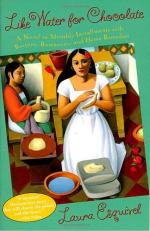
Both in style and content, Like Water for Chocolate (1993) represented a highwater mark in the late twentieth-century renaissance of the Mexican cinema, and became the highest-grossing Mexican film of all time. Described by one critic as "a feel good" drama, it captivated American audiences and grossed $8.5 million at the U.S. box office—unprecedented numbers for a foreign-language film. The screenplay, adapted from her own novel by Laura Esquivel, focuses on a woman who, as the youngest daughter of a family, is condemned by long tradition to a life of spinsterhood and domestic servitude, caring for her mother. Utilising the artistic freedoms of Magic Realism, director Alfonso Arau's film reveals the ferocity of love too long withheld and the power of a woman with the will to defy fate and convention.
The kitchen in the home of Mama Elena (Regina Torne) is the literal and allegorical center of Like Water for Chocolate. There, Tita (Lumi Cavazos) is born, and there she grows up to master the culinary arts. Frustrated in her passionate desire for the handsome rancher Pedro (Marco Leonardi) whom she is forbidden to marry—he marries one of her sisters and moves into the house in order to be near her—Tita buries her problems in her cooking and becomes a veritable sorcerer, creating imaginative and delicious dishes that induce bizarre physical and emotional reactions in those who partake of them. A series of cataclysmic events arise from this, and in a romantic climax Tita and Pedro, many years on, finally consummate their passion. Pedro dies of ecstasy and Tita, deciding to follow him, eats matches and perishes in the flames of a self-induced conflagration. At once dramatic, sad, joyous, and moving, the film encloses a message about the power of women to rise above the constraints of home and hearth, and to liberate themselves from the oppressive shackles of hidebound tradition.
Further Reading:
Barrios, Gregg, "This is Like Water for Real," Los Angeles Times, Nov. 17, 1994, p. F2.
Cohn, Lawrence, "Like Water Crossover a Spanish-Lingo Record,"Variety, June 21, 1993, p.7.
Pristin, Terry, "Chocolate's Success: A Sweet Era for Imports?" Los Angeles Times, Nov. 23, 1993, p. F1.
|
This section contains 364 words (approx. 2 pages at 300 words per page) |