BookRags.com Literature Guides Literature
Guides
Criticism & Essays Criticism &
Essays
Questions & Answers Questions &
Answers
Lesson Plans Lesson
Plans
My Bibliography Periodic Table U.S. Presidents Shakespeare Sonnet Shake-Up
Research Anything:        
History | Encyclopedias | Films | News | Create a Bibliography | More... Login | Register | Help

Search "Kuiper Belt"

Contents Navigation
 
Not What You Meant?  There are 26 definitions for Kuiper.  Also try: EKB.

Kuiper Belt

Print-Friendly  Order the PDF version  Order the RTF version
About 2 pages (690 words)
Kuiper belt Summary

Bookmark and Share Questions on this topic? Just ask!

Kuiper Belt

Comets are some of the most spectacular objects in the night sky. About once per decade, a truly bright comet comes along and can be viewed by the unaided eye. Where do these comets come from? Where do they spend most of their lives?

Some comets orbit the Sun once every thousand years or so and can be easily viewed only when they are in the inner solar system. These are known as long period comets. Nonperiodic comets appear in the inner solarsystem only once. Some comets, however, enter the inner solar system repeatedly and predictably. These are the short period comets.

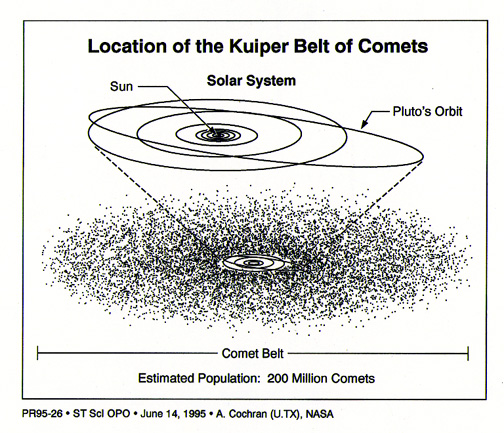
SOURCE: Adapted from the Space Telescope Science Institute, PR-95-26, created June 14, 1995. <http://www.boulder.swri.edu/clark/chance/09kbelt.jpg>SOURCE: Adapted from the Space Telescope Science Institute, PR-95-26, created June 14, 1995. <http://www.boulder.swri.edu/clark/chance/09kbelt.jpg>

All of these comets are in orbit around the Sun but, unlike the planets, which all revolve around the Sun in the same direction and are confined to approximately the same plane as Earth's orbit (the plane of the ecliptic), cometary orbits show no preferred orientations. The shortest period comets (orbital periods of less than twenty years) are an exception. Comets in this group, called the Jupiter family comets (JFCs), revolve around the Sun near the plane of the ecliptic in the same direction as Earth's orbit.

Noting the different nature of the JFC orbits, astronomers sought explanations. It had been believed that all comets originated in the Oort cloud, a halo of comets at extremely large distances from the Sun. But in 1988, Martin J. Duncan, Thomas R. Quinn, and Scott Tremaine showed that it was impossible to have the random orientations of Oort cloud comets converted to the planar orientations of JFCs. They proposed that, in addition to the Oort cloud as a reservoir for comets, there must be a disk-like reservoirof comets with its inner edge near Neptune. They called this disk the Kuiper belt after Dutch-born American astronomer Gerard P. Kuiper, who postulated in 1951 that the solar system could not end at Neptune because that would imply a sharp edge to the disk out of which planets formed.*

The objects in the Kuiper belt represent remnants from the formation of our solar system. When the planets formed 4.6 billion years ago, they formed from an agglomeration of many planetesimals, or small solid celestial bodies. Beyond Neptune, the density of planetesimals was too low and the time for them to collide and accumulate was too long for another planet to form. Thus, the planetesimals remained in the outer solar system, past Neptune's orbit. They are called Kuiper belt objects (KBOs).

The existence of the Kuiper belt was confirmed in the 1990s. In 1992 David Jewitt and Jane Luu found the first KBO, designated 1992 QB1. By 2000 many surveys had been performed and a total of 345 KBOs had been found.

In 2001, some one trillion planetesimals still existed in KBO orbits from Neptune outwards. Most remained in the Kuiper belt, interacting with one another or Neptune. Some of these were just barely visible from Earth through the most sensitive telescopes; others were too faint to see. But they do exist. And, as time passes, some will be perturbed into the inner solar system, where they will become Jupiter-family comets and appear periodically.

*In 1949 Irish astronomer Kenneth Edgeworth published an analysis similar to Kuiper's, but Kuiper's work was better known; in recognition of Edgeworth's contribution, some people call the comet reservoir the Edgeworth-Kuiper belt.

Comets (Volume 2);; Kuiper, Gerard Peter (Volume 2);; Oort Cloud (Volume 2);; Orbits (Volume 2);; Planetesimals (Volume 2);; Small Bodies (Volume 2).

Bibliography

Duncan, Martin J., Thomas R. Quinn, and Scott Tremaine. "The Origin of Short-Period Comets." Astrophysical Journal (Letters) 328 (1988):L69-L73.

Edgeworth, Kenneth. E. "The Origin and Evolution of the Solar System." Monthly Notices of the Royal Astronomical Society 109 (1949):600.

Jewitt, David, and Jane Luu. "Discovery of the Candidate Kuiper Belt Objects 1992 QB1." Nature 362 (1993):730-732.

Kuiper, Gerard P. "On the Origin of the Solar System." In Astrophysics: A Topical Symposium, pp. 357-424, ed. J. A. Hynek. New York: McGraw-Hill, 1951.

Malhotra, Renu, Martin J. Duncan, and Harold Levison "Dynamics of the Kuiper Belt." In Protostars and Planets IV, eds. Vince Manning, Alan P. Boss, and Sara S. Russell. Tucson: University of Arizona Press, 2000.

This is the complete article, containing 690 words (approx. 2 pages at 300 words per page).

More Information
  • View Kuiper Belt Study Pack
  • 26 Alternative Definitions
  • Search Results for "Kuiper Belt"
  • Add This to Your Bibliography
  • More Products on This Subject
    Kuiper Belt
    flat ring of icy small bodies that revolve around the Sun beyond the orbit of the planet Neptune. N... more

    Kuiper Belt
    Disk-shaped belt of billions of small icy bodies orbiting the Sun beyond the orbit of Neptune, most... more


    Ask any question on Kuiper belt and get it answered FAST!
    Answer questions in BookRags Q&A and earn points toward
    discounted or even FREE Study Guides and other BookRags products!
    Learn more about BookRags Q&A
    Copyrights
    Kuiper Belt from Macmillan Science Library: Space Sciences. Copyright © 2001-2006 by Macmillan Reference USA, an imprint of the Gale Group. All rights reserved.

    Join BookRagslearn moreJoin BookRags


    About BookRags | Customer Service | Report an Error | Terms of Use | Privacy Policy