Ku Klux Klan
The Civil War ended the institution of slavery. Despite the Constitutional protections of the Fourteenth and Fifteenth Amendments, peace ushered in a new struggle that would affect American society and culture for over 100 years. In the South, the war to defend slavery was transformed into a conflict to repress free blacks through custom, law, intimidation, and violence. In one sense the Civil War continued but in a different form.
The Ku Klux Klan (KKK) emerged in 1866 from the Pulaski, Tennessee, law office of Judge Thomas M. Jones as a social movement responding to the Thirteenth Amendment's legislated end of slavery after the defeat of the Confederacy. Six former Rebel soldiers changed the Greek word "kuklos" ("circle or band") to "Ku Klux," adding the redundant "Klan." Based on fraternity rituals, the Klansmen disguised themselves as spirits to torment the free black population.
Under Reconstruction, the Southern Republican Party gained political momentum as the Fourteenth and Fifteenth Amendments granted and enforced male blacks the right to vote. Angry former Confederates, disqualified from political office, resented "carpetbaggers," "scalawags," and Radical Republicans, whom they believed prevented white Southerners from retaining their proper social status. When the Freedman's Bureau granted blacks land and assistance, Black Codes echoed the antebellum period, continuing to keep the blacks disenfranchised, poor, and unable to rise in social status.
In the beginning, the Klan resembled an umbrella organization for many anti-African-American groups. Former Confederate General Nathan Bedford Forrest in Tennessee organized one of the first in 1866 (eventually becoming the first Imperial Wizard) and men united in their hatred and fears of the black population answered his call. By January of 1868, the name "Ku Klux Klan" began to become more widely adopted. Employing secret signals, complicated codes, and following a military style manual, the KKK gained momentum. Assemblages of camps and dens ranged from thirty to forty thousand men in each Southern state; there were estimated to be 500,000 Klansmen in the entire South.
The Reconstruction Acts of March 1867 prepared former Rebel states for return to the fold of the Union, reorganizing state governments in 1868. Despite President Johnson's unconditional pardon of former Confederates, Southern whites resented the ratification of the Fourteenth Amendment. Enraged, and unable to discern that the blacks only wished to achieve equality before the law, whites determined for themselves that the black population meant to dominate the native white Southern population. Capitalizing on the fear that blacks would rise against the whites, the KKK set out to scare and to stop a black extension of power through thousands of acts of intimidation and of violence. Whites too, who were deemed to be enabling or collaborating with blacks, similarly were made targets. From Radical Republicans to clergy to teachers, neither black nor white were spared. The KKK also was known to abuse those from within their own organization whom they deemed to have committed treason against the Klan. Violence escalated as civil authorities ignored, participated in, or were intimidated by Klan activities.
Mounted, hooded (many seeming to possess long moustaches and beards) and clothed in white robes, members of the Klan generally drew members from the lower white classes. Literally casting issues in black or white, with only one race or one form of politics viewed as all good or all evil, the Klan was able to muster broad appeal. Yet, the power to continue these abuses rested in the hands of the Southern elite, who directed the marginalized classes in the new cause.
Often preceding attacks with written warnings setting precise times to vacate or disband and clearly delineating punishments for decided offenses, the KKK utilized a system of surprise, appearing at night to disarm, terrorize, whip, lynch or murder chosen targets. The KKK also burned black schools and verbally and physically abused and killed their white schoolteachers. Perpetrators viewed themselves as protecting the Southern way of life, much as they had fought for it during the Civil War.
Ultimately, Congress began to act. The Enforcement Acts of May 31, 1870 and February 28, 1871 allowed the president to use military force and extended Federal control to elections. Further, Republicans pushed through Congress the Ku Klux Act on April 20, 1871, which enforced the Fourteenth Amendment. Deciding after Congressional hearings that the form Reconstruction had assumed in the South had allowed for the creation of the Klan, rules against Southern Democrats were relaxed. Federal arrests and prosecutions against the Klan began in earnest in 1871. As a result, the first wave of Klansmen disappeared in 1873 and Reconstruction ended in 1877.
In the early 20th century the KKK revived in response to efforts by blacks and whites to end segregation, the so-called "Jim Crow" laws, that had reduced many former slaves to poverty and dependency. In 1915, William Joseph Simmons led fifteen men to the top of Atlanta's Stone Mountain with an American flag, a burning cross, and a Bible (opened to the Twelfth Chapter of Romans) and pledged to the Knights of the Ku Klux Klan. Delineated in a revised fifty-four-page manual of
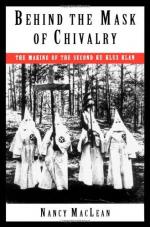
Hooded Ku Klux Klansmen from the late nineteenth century. GREENHAVEN PRESS, INC.
the original rituals (entitled and copyrighted as the "Kloran"), Simmons set the structure of a new centralized second KKK. Comprised of domains, realms, provinces, and local klaverns, it rode the rising wave of nativism that preceded and then increased after World War I. Between 1920 and 1925 membership peaked to around five million members in forty-five states. Capitalizing on the fears of white men and women at the margins of society, whose employment and social status was threatened by the tides of immigrants and returning soldiers from Europe, the Klan aimed its furious propaganda at African-Americans, Catholics, Jews, Communist labor organizers, and emigrating masses.
Utilizing films such as The Face at Your Window, newspapers like The Searchlight, and lecturers who spoke of "100 percent Americanism," protecting white women, and upholding Protestantism, appeals of recruiters (kleagles) were answered in the cities, where competition for housing, jobs, and authority was strongest. It found its base in all regions of the country where influxes of African-Americans and immigrants competed for work. Enduring internal schisms and publicly printed unmaskings, weathering legislative scrutiny incurred by increasing violence, and entering into politics with vigor (strengthened by the women's right to suffrage, and therefore increased participation in the Klan), the 1928 Presidential campaign of New York Governor and Catholic Al Smith signaled its demise. Ironically, the Klan claimed to protect the Constitutional rights of Americans, while simultaneously being anti-freedom of religion, anti-freedom of speech, and anti-equality under the law. With a dwindling influence and membership, and in some cases becoming outnumbered by minority populations, by 1944 the Klan was gone.
However, as returning soldiers and new waves of minorities moved north to compete for work, Atlanta hosted the revival of the Klan on Stone Mountain on May 9, 1946. Drawing from traditional sources, the revived Klan found its voice after the May 1954 Supreme Court decision of Brown vs. the Board of Education. The ensuing Civil Rights movement increased Klan activity and membership. By 1965, Congress began to investigate the Klan. Despite FBI infiltration, the Klan continued to publish their newspaper The Fiery Cross and to support segregationists like George Wallace. In the end, its failure to attract a larger following came from owing legal fees, FBI successes, and the inability of the Klan to effect racial, social, and political change.
No longer centralized, and hurt by the retribution of the Southern Poverty Law Center, which in 1979 began suing leaders for subordinates' violence, the Klan still can be found in many regions of the country where restricted economic circumstances among whites make the quest for white supremacy attractive.
Reconstruction.
Bibliography
Jackson, Kenneth T. The Ku Klux Klan in the City, 1915–1930. Chicago: Ivan R. Dee, 1992.
Tourgee, Albion Winegar. The Invisible Empire. Baton Rouge & London: Louisiana State University Press, 1989.
Trelease, Allen W. White Terror: The Ku Klux Klan Conspiracy and Southern Reconstruction. Baton Rouge & London: Louisiana State University Press, 1971.
This is the complete article, containing 1,326 words
(approx. 4 pages at 300 words per page).