Forgot your password?  

Not What You Meant?  There are 43 definitions for Energy.  Also try: T or KE or Kinetic.

Kinetic Energy | Research & Encyclopedia Articles

Print-Friendly   Order the PDF version   Order the RTF version
About 4 pages (1,130 words)
Kinetic energy Summary


Kinetic Energy

Energy is one of the central themes in science. There are many forms of energy, each with its own specific definition. Any form of energy can be converted into one of the other forms. This is the law of conservation of energy, which states that energy is conserved in any system. A general definition for energy is the ability to do work. This definition is oversimplified, for not all forms of energy can actually do work. It does, however, demonstrate the important relationship between energy and work.

Work is performed whenever a force moves an object. The amount of work done can be calculated by multiplying the magnitude of the force acting on an object by the distance the object moves. Using the English system of measurement, the force is measured in pounds (lb) and the distance is measured in feet (ft). The product of the two, or the work done, is then measured as foot-pounds (ft-lb). With the metric, or SI (Syst(me Internationale) system, the unit of force is the newton (N) and the unit of distance is the meter (m). The resulting unit for work is the newton-meter (N-m), otherwise known as the joule (J). One joule is equal to 0.7376 ft-lb. The unit for work, the joule, is the same as the unit for energy. If work is performed using rotation, the work performed is the product of torque and the angle of rotation. Work and energy are scalar quantities.

An object in motion can do work on another object by exerting a force on the second object, moving it through a distance. Because an object in motion has the ability to do work, it has energy. This energy of motion is called kinetic energy, from the Greek word kinetikos, meaning motion. Mathematically, kinetic energy is defined as one-half of the product of the mass and the square of the velocity of a moving object. The kinetic energy of an object is therefore dependent on the speed of the object as well as the mass. The faster an object is moving, the more kinetic energy it possesses. The more massive an object, the more kinetic energy it will have. For example, if two bowling balls were rolled across the floor at different rates, the ball with the higher rate would have the most kinetic energy. If a bowling ball and a Ping-Pong ball are rolled along the floor at the same speed, the bowling ball will have more kinetic energy than the Ping-Pong ball because it has more mass. A group of objects has a total kinetic energy equal to the sum of the individual kinetic energies.

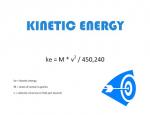
When an object with mass m (in kilograms) is moving in a straight line at a velocity v (in m/s), the kinetic energy (KE) of the object can be calculated using the following equation: KE = 1/2mv2 .

This form of kinetic energy, that of an object moving in a straight line, is called translational kinetic energy. For example, suppose a soccer player kicks the soccer ball across the midfield, and the ball is traveling at 5 m/s. If the mass of the soccer ball is 0.450 kg, then the kinetic energy is (1/2)(.450 kg)(5 m/s)2 , which equals 5.625 J.

When a moving object collides with another object, and no heat is produced in the collision, the kinetic energy is conserved. The total kinetic energy of the two objects is the same before and after the collision. If one object loses kinetic energy in the collision, the other object gains kinetic energy. A collision in which the total kinetic energy is conserved is called an elastic collision. In an elastic collision, the two objects return to their original shapes and move off separately after the collision. An example of an elastic collision is that between two billiard balls.

When a moving object collides with another object, producing heat, the kinetic energy is not conserved. These collisions are called inelastic collisions. The kinetic energy lost is converted into other forms of energy, usually heat and sound. The total energy of the system is conserved. In an inelastic collision, the objects change shape and sometimes stick together after the collision. An example of an inelastic collision is that between two automobiles.

When a moving object collides with another object, causing the second object to move, it does work on the object. The net work (W) done on an object in a collision is equal to the change in its kinetic energy (KE). In equation form, W = KE. This is known as the work-energy theorem. If work is done on an object, the object's kinetic energy increases. This increase in kinetic energy is equal to the work done. For example, if a golf club collides with a golf ball, sending the golf ball down the fairway, the club has done work on the ball. At the same time, the ball has gained kinetic energy. The kinetic energy gained by the ball is equal to the work done on it by the club. If an object does work on another object, the object doing the work loses kinetic energy. This decrease in kinetic energy is also equal to the work done. The golf club slows down after it collides with the ball, so it loses kinetic energy. The amount of kinetic energy lost is equal to the work done on the ball. The work-energy theorem, then, shows that work is a method of energy transfer.

There are several forms of kinetic energy besides translational kinetic energy. Rotational, thermal, relativistic, and orbital energies are all forms of kinetic energy. Rotational kinetic energy is the energy possessed by an object rotating about an axis. The equation for rotational kinetic energy is KE = 1/2l2 , where l is the moment of inertia of the object and angular velocity. Rotational kinetic energy is changed when a torque is applied to the object. Temperature is a measure of the average kinetic energy of the molecules of a substance, or the thermal kinetic energy. As the kinetic energy of molecules increases, the temperature increases. In other words, the faster the motion of the molecules of a substance, the higher the temperature will be. Relativistic kinetic energy describes the kinetic energy of objects at extremely high speeds and is described using Einstein's equation E = mc2 , where E is the energy of an object, m is the mass of the object, and c is the speed of light. An object in orbit, such as a satellite around a planet or a planet around the Sun, has kinetic energy that depends on the size of the orbit. For elliptical orbits, this kinetic energy will not remain constant throughout the orbit but the sum of kinetic and potential energy, called the mechanical energy, will remain constant.

This is the complete article, containing 1,130 words (approx. 4 pages at 300 words per page).

More Information
  • View Kinetic Energy Study Pack
  • 43 Alternative Definitions
  • Search Results for "Kinetic Energy"
  • More Products on This Subject
    Kinetic Energy
    Figure 2. Cross-section of a vaporizing pot burner. Energy is "capacity (or ability) ... more

    Kinetic Energy, Historical Evolution of the Use Of
    Historically humans have used three natural sources of kinetic energy: wind, water, and tides. Alt... more


    Ask any question on Kinetic energy and get it answered FAST!
    Answer questions in BookRags Q&A and earn points toward
    discounted or even FREE Study Guides and other BookRags products!
    Learn more about BookRags Q&A
    Copyrights
    Kinetic Energy from World of Physics. ©2005-2006 Thomson Gale, a part of the Thomson Corporation. All rights reserved.

    Join BookRagslearn moreJoin BookRags

    Join BookRagslearn moreJoin BookRags